Not About Lumberjacks

Be mighty, and keep your axes sharp!

  • Episodes
  • Where to Begin
  • The Quick List
  • Novels
    • HCWWPD
  • About
  • Blog
  • YouTube
  • The Talent
  • Patreon
  • Press Kit

Behind the Cut – Instead of Dreaming

July 13, 2025 by cpgronlund Leave a Comment

Left Side of Image: A cross section of a cut tree against grass. Text reads "Behind the Cut - The Not About Lumberjacks Companion." Left Side of Image: A walkway at night, illuminated by a single light revealing the pathway and foliage, Text reads "Instead of Dreaming. Commentary By: Christopher Gronlund.

In this behind-the-scenes look at the latest Not About Lumberjacks story, “Instead of Dreaming,” I talk about the real-life influences on the story, memories, healing, and how soothing the night can be.

As always, this commentary contains spoilers from the latest episode, so you might want to listen to that first.

Transcript >> (Coming Soon)

* * *

Things mentioned in this episode:

  • Ben Tanzer’s After Hours: Scorsese, Grief and the Grammar of Cinema.
  • Ben Tanzer’s website.
  • Ben Tanzer’s This Podcast Will Change Your Life.
  • Wikipedia entry for Martin Scorsese’s After Hours.

The Chicago beef stand I mention is Susie’s, at 4126 West Montrose Avenue. I believe it’s now a taco stand called Taco Pros Cocina.

Photos of the tunnel mentioned in this episode:

The entrance. My friend Lee and I were the first in. (My nickname is, and still is, Ogre.) Later, we shared our secret with a couple other friends. The “TR” stands for Tunnel Rats.

The end of a storm drainage tunnel under a bridge. Water and grime ooze from the hole. Graffiti above reads: "TR - Lee, Rob, Ogre & Jason. Below: Die Lik" before being cut off.

I looked into the tunnel. Man, we were dumb!

Camera flash view of the inside of the drainage tunnel, quickly falling off to darkness.

I was so happy to see everything still there. So many time, memories shift over the years. I think I know who “Rob” is in the first image. No idea which Jason it was…or if it was even one of my friends.

A closer image of the storm drain tunnel.

I thought I was so damned funny writing STOP VANDALISM!!! in and act of…vandalism.

Grafitti on a concrete wall reading: "Stop Vandalism!!!"

Podcast: Play in new window | Download

Subscribe: RSS

Filed Under: Behind the Cut, Episodes Tagged With: Behind the Cut

Instead of Dreaming

June 20, 2025 by cpgronlund 2 Comments

A dark path with a fence to the left. A yellowish, dim pathway light illuminates foliage. Text reads: Instead of Dreaming - Written and Narrated By Christopher Gronlund


A high school English teacher comes to conclusions about life after recovering from a hit-and-run accident.

Content Advisory: “Enemy Wanted” deals with difficulty sleeping, a blurred sense of reality, crime, cartoonish violence, illness, a death, and wishing for an early end to life. That makes it sound dismal, but I assure you…it’s a blast of a story.

Also, it’s one with no swearing. Still, were it a movie, it would be rated PG (or maybe PG-13 for mature themes), so be aware. Also, because there are scenes with action, be prepared for the occasional surprising loud sound.

* * *

Credits:

Music: Theme – Ergo Phizmiz. Story – Jospeh Beg, licensed through Epidemic Sound.

Story and Narration: Christopher Gronlund.

Episode Transcript >>

Podcast: Play in new window | Download

Subscribe: RSS

Filed Under: Episodes Tagged With: Instead of Dreaming, Literary, Quirky

Instead of Dreaming – Transcript

June 20, 2025 by cpgronlund 1 Comment

[Listen]

[Sound of an ax chopping wood. Quirky music fades in…]

Christopher Gronlund:

I want to make one thing perfectly clear: this show is not about lumberjacks…

My name is Christopher Gronlund, and this is where I share my stories. Sometimes the stories contain truths, but most of the time, they’re made up. Sometimes the stories are funny—other times they’re serious. But you have my word about one thing: I will never—EVER—share a story about lumberjacks.

This time, it’s a story about a high school English teacher who comes to conclusions about life after recovering from a hit-and-run accident.

But first, the usual content advisory…

Were it a movie, “Instead of Dreaming” would be rated PG-13. It deals with a hit-and-run accident involving a bike, melancholy, nightmares, guilt trips, teen drug use, trespassing, the dark side of nostalgia, and a sorta-grisly crime scene. And if you’re listening to this while driving, there is the sound of an accident that is pretty apparent it’s coming, and the sound of an ambulance later in a scene looking back on an injury on a swingset. I always want to call these out because it’s never fun hearing squealing tires or an emergency vehicle while driving. And…there’s really not much swearing in this story, just one place with a word you’ve probably even heard on television.

A quick thing before getting to the story. This past year has been a weird one. I’ve talked in an intro or two about dealing with a health issue. It’s something that’s been a thing for 30-plus years with no answers. In March, I finally got a couple.

It turns out there was an issue deep in my heart at the end of a couple arteries. The surgeon who did the catheter procedure said things were so low—with no other issues—that it was almost not worth messing with. But…he suspected it was causing an electrical issue, and he placed two itty-bitty stents at the ends.

The moment the second stent went in, immediately, my heart went into normal rhythm for the first time in decades. The anxiety that comes with that is slowly disappearing, and I’m not afraid to lie on my back anymore. (That’s when it was always at its worst, feeling like a fish or something was flopping around in my chest.) 

Speaking of feelings in my chest…I can no longer feel my heart beating, unless I’m exercising…and even then, I have to really exert myself to feel it. That’s perhaps the weirdest thing through all this because, at any given time—much like tinnitus—if I thought about my heart, I could always feel it thudding away in my chest.

Now, though, I can’t.

It’s brought a strange stillness to my world.

There might be one other little thing needing to be fixed down the line, and I’m currently going through cardiac rehab, but this whole thing has been one of the weirdest changes in my entire life.

As I continue getting better, Not About Lumberjacks schedules and planned stories still might change at the last minute while healing, but things are already ridiculously snazzy, and there’s every reason to believe it will only get better.

All right: let’s get to work!

* * *

Instead of Dreaming

He’d been living in dreams instead of the waking world, his way of dealing with a months-long funk—days hovering in persistent idleness, despite having so much to do. Pick up a to-do list, even a small one written to take a tiny step forward, and he stagnated. “Clean Livingroom” eventually became “Clean  Coffee Table,” and then, “Put Mugs in Sink,” when he’d spent all day doing nothing but sitting.

Sleep was an escape, a place where some nights, everything seemed okay. Even a work dream was welcomed. On nights he dreamed about running, riding his bike, or hiking, he awakened with a distant hope that returning to those activities was not too far away.

Other nights, he was haunted by shadows or lost in dark forests. Dreams that someone was in his house or waiting for him on walks. Always ending the same way: a person shrouded in darkness coming his way. He still preferred nightmares to his waking hours.

The worst recurring dream ended with the roar of the engine.

* * *

Seven months before, while cresting a long hill climb on his bike, he heard someone behind him put their foot into the gas pedal of a Dodge 2500 pickup truck. As it overtook him, he saw the SUV coming the other way. Ditching the bike wasn’t an option. The truck came into his lane to avoid a head-on collision with the SUV, grinding him along a guardrail before speeding off.

The woman driving the SUV stopped and rushed over. He knew it was bad when she checked on him, apologized, and turned away while calling 911.

The doctor in the ER called it a comminuted fracture, explained that meant the bones were in pieces and that he was lucky to still have a leg. Three surgeries followed. He took short-term disability at work to focus on healing and suing the driver of the truck, who was caught on his bike’s rearview radar camera.

More surprising than the accident was his family’s reaction.

“That wouldn’t have happened if you didn’t ride on those back roads,” his mother said. Other relatives, and even some friends, were no different. It didn’t matter that he was struck 20 yards past a SHARE THE ROAD sign—or that the driver of the truck and not him was at fault—he was told it could have all been avoided by choosing a safer hobby. 

He stopped inviting people over, turned them away when they asked if he’d like a visit. Didn’t answer the door when they stopped by unannounced to check on him and remind him that he should never have been on the road. He retreated into one of his favorite things: sleeping.

Some people drink away their problems; he dreamed his away, blurring lucid dreaming and daydreams together as a way to spend his time in a meditative state when awake, and lost deeper in his mind when he slumbered.

Even how he’d return to his usual routine came to him in a dream.

* * *

April 7

7:24 p.m. 64 degrees Fahrenheit

He begins his walk a half hour before sunset, making his way to Comanche Bluff, a dead-end street overlooking a valley where his town gives way to unincorporated land to the west. In the summer, people pack into the tiny cul-de-sac to watch the sun go down, despite the protests of nearby residents tired of the crowds. This evening, he has the overlook to himself.

The little fluffy clouds of late morning seemed like they might rise into thunderheads by afternoon, but something higher aloft prevented their growth. They float like the clouds kids draw in school, with flat bases and bulbous curves—breaking just in time to let shafts of yellow light through in all directions. After the sunset rolls through all its colors and the stars sparkle in the darkened firmament, he stretches and turns back toward town.

He has roughly 11 hours to wander before the sun comes back up in the east.

* * *

8:31 p.m. 62 degrees Fahrenheit

As he approaches Cannon Park, the THWAK of pickleball serves and returns compete with the cacophony of skateboarders doing kick flips and grinding on rails. Teenagers roll along a course the city built to give kids something to do besides getting drunk and conquering boredom through vandalism. From his view, some kids drop from sight and shoot into the air on the far side of an in-ground bowl like a pool, lingering in the air before turning and shooting to the other side.

His neighborhood shines on the tennis-courts-turned-pickle-ball courts. Beneath the bright lights, Indian families chat with Kenyans; a guy from Oklahoma practices Spanish with a group of Mexicans. A British woman asks a Korean girl about school. Once, an older neighbor down the street flagged him over when he was on a walk. The man complained to him about all the people from other places moving into town, as though it were a bad thing.

“Why are you whispering?” he said said loudly enough to cause the old man to panic. “I like my neighbors.”

He looked the man up and down and added, “Well, most of them.”

How could anyone hate people coming together on such a lovely evening?

* * *

He makes his way to a swingset beside the playground and sits in the shadows just outside the stadium lighting. He grips the chains with his hands and pushes back with his feet in a short, backwards run. The swing hooks groan, but he’s seen heavier people playing with their children on the swingset during the day. He leans back and pumps his legs out and back, gaining height.

When he was a kid, his best friend, Matthew, was the kid in town who’d do anything on a dare. He once watched him shimmy up an exposed girder on the wall of his elementary school’s gym and leap from the rooftop into a pile of grass clippings. And when they were eight, at a different park, they dragged a picnic table over to the swingset so they could stand on the edge and leap off the tabletop like paratroopers. After swinging for a time, his friend instinctively leaned back with his legs high in the air on a backswing, forgetting the picnic table was there.

He can still hear the sound of the bridge of Matthew’s nose hitting the edge of the picnic table; can still see him flip high in the air and land on top in a pool of blood. It would not be the last time he’d watch an ambulance cart his best friend away.

He leans into the backswing like Matthew, letting his head almost reach the ground. Back and forth, higher and higher, until he lets go, hearing the chains rattle as he leaves the seat. Looking down, he regrets the hasty decision. How will his untested leg hold up when he hits the ground? As a kid, he’d swing so high that when he let go, he soared higher than the crossbar before crashing down to the ground. This leap is half of that, but could end in disaster.

He braces for impact, waits for the nerves in his repaired leg to flare and burn. Wonders if he’ll hear something break. But surgeons and therapists did their jobs; he comes down without issue. He rises on the balls of his feet, testing for any pain before resuming his nighttime walk.

* * *

8:54 p.m. 60 degrees Fahrenheit

As the sounds of Cannon Park fall away behind, two skateboarders race toward him, seemingly powered by some unseen force. There’s no hill in the direction they came, and no hum of a battery-powered motor pushing them along. 

“How are they moving so quickly?”

As they speed away, he notices the slight incline, a slope so subtle, he’s only aware of it because every step after such a long recovery is a measured action. Feeling the ground beneath his feet again is wonderful. He’s amazed how quickly the memory of movement’s become after seven months of limping and shuffling about.

The skateboarders disappear into the dark as he continues on his way.

* * *

9:27 p.m. 59 degrees Fahrenheit

He slows his pace about a mile down Mockingbird Lane, looks along the curb for the storm drain inlet. When he spots it, he crosses the street and makes his way down a hill into bushes and small trees. Most people driving the road each day—some likely driving its length a thousand times over—are unaware they cross a small bridge over a creek lost in the undergrowth. Growing up, he and his friends roamed most of the town, discovering secret places they never shared with others.

He’s always happy seeing kids splashing through the same creeks he and friends explored, watching them cross fields on their way to a golf course where a groundskeeper always chased them off, even in the coldest part of winter. Old treehouses still seem to get repaired just enough that most kids wouldn’t dare climb into the canopy, but those who know where to reach and pull on the way up are safe as long as they’ve had a tetanus shot. He wonders if any kids know about the drainage tunnels beneath Mockingbird Lane.

He pulls his phone from his pocket, opens the flashlight app so he can see where he’s going. He spots what he’s looking for where the storm drain dumps into the creek, a crude bit of graffiti reading DO NOT ENTER over the entrance to the storm drainage system.

When they were 14, Matthew spotted the opening and said, “Let’s see what’s in there.”

“No,” he said. “That just…that doesn’t seem like a good idea.”

“It’s not rained in like a month. It’ll be fine.”

“What if it’s full of wasps?” The thought of being trapped in a tunnel and being stung, maybe perishing in a place no one would even consider looking, horrified him.

“Only one way to find out!” his friend said as he entered. “Come on!”

He started up, quickly realizing there was no way to turn around. He shimmied out backwards when even Matthew agreed it was too dark.

Of course, his best friend wanted to go back. Matthew climbed Mount Hood with his dad and had a camping headlamp before they were common. It was definitely enough light to spot black widows, which Matthew smacked with the padded mountain bike gloves he wore. Up they climbed, to the junction where the drain at street level went—an opening too small for even his brave friend to enter. The tunnel leveled out, and they crawled along, until encountering accumulated dirt built up like hard plaque in an artery. When it was too much, Matthew started digging, forcing his way into a junction box full of rats.

Before him, a wall of eyes glowed in the light from his headlamp.

“Back up!” his best friend shouted. Back up!”

Their arrival, or perhaps the screaming of Matthew, startled the horde. The mass of rodents raced their way, shooting past them in tight quarters. He froze. Matthew crashed into him with his feet, kicked at him while shouting, “Go! Go!!!”

He felt the nails of the rats scraping across his arms and back, hopping off and landing on his legs before racing out of the tunnel. He crawled in reverse as quickly as he could, the shouts of Matthew and squealing of rats echoing in the small passageway.

They never went back into the tunnel, but they did return the next day to spray paint a cartoon rat with a knife and the words TUNNEL RATS on the far wall beside the creek.

He’s happy to see it’s still there.

* * *

10:43 p.m. 56 degrees Fahrenheit

He’s stretching his back when he hears something in the grass behind him. Too late for rabbits, he thinks. Probably an opossum. He turns around and spots an armadillo rooting for grubs.

“Hey, you,” he says.

The armadillo continues with its armadillo business. They’re one of the better things about living in Texas to him—armadillos and roadrunners. Damn-near blind and with few cares in the world beside being hit by cars, he loves how close he can get to them.

“Nice evening for a walk,” he says. “Or eating grubs. But I guess any time is good grub time, huh?”

The armadillo pauses and digs; puts its snout into the ground and comes up chewing.

“Wanna know a little secret? You have to promise not to tell anyone, even your armadillo buddies. I’ve really liked the past seven months. I mean, sure, much of it was spent in pain, but I finally got a break. I suppose armadillo life never slows down, either, eh? Always on the go, just like us. But it was nice having time to just sit and think. Or just sit for the sake of stillness.

“I feel bad about enjoying some of my time, lately. I’m told I have a noble job as a teacher, and I do take what I do seriously. But I can’t pretend having time off in the summers wasn’t a big reason for my career decision—months to do the things I most enjoy. I do care about my students, but I’m not particularly fond of them. I think a lot of them are shitty, and that makes sense because a lot of adults are shitty. And sooooooooo many shitty parents.

“Are there shitty armadillos? Like some hardback named Brad you all slag on when he’s not around? Rolls up in a ball and crashes into you when you’re just trying to relax a moment from busy armadillo tasks? Pisses everywhere and starts fights?”

The armadillo carries on, seemingly oblivious to his presence. It bumps his foot and sniffs the air before returning to its mission.

“I got a good little chunk of money from a guy who hurt me and ran. That’s the only way you can damage people like that: hit them in the pocketbook. Between years of saving and the payout, I really don’t want to go back. At least I don’t think I do.”

The armadillo looks up at him before heading the other way.

“I don’t want this time to end…”

* * *

11:13 p.m. 54 degrees Fahrenheit

It was once a cowpath cutting through a small forest when the town wasn’t even a town and ranchers transitioned their herds from winter forages to warm-season grasses. When corn took over, the old trail was used only by the toughest teenagers around. Classmates claimed that to enter the cowpath was to put oneself at risk for beatings on the best days, or disappearing at the hands of reputed gangs, serial killers, or Satanists lying in wait along the trail like highwaymen on the worst. But housing developments defeated all, even beating back crops. The trees surrounding the cowpath shrunk, until only enough remained to make a paved trail cutting through still seem remote.

He stops and sniffs the air, thinking he smells a skunk.

Keep an eye out.

He turns his head and listens, hearing distant muffled voices instead of another animal in the grass. As he gets closer to the chatter, he realizes what he smells.

The two teenage skateboarders from earlier sit on a bench sharing a joint. He’s only smoked marijuana once, when Matthew was getting high and he wanted to see what the big deal was. Even though he liked some of the effect, it just wasn’t his thing. He considers asking the skateboarders if they’ll share; see what effect a hit or two has on his walk. But that would be condoning what they’re doing—not a good move for a teacher.

They make no attempt to hide what they’re up to. Kids today are more bold than when he was young, when everything scared him. They remind him of yet another reason teaching is growing old. He doesn’t recognize them—assumes they’ve dropped out or attend another school. There’s not much he can do—so he nods, says, “Hey,” and continues walking.

* * *

Midnight. April 8.

53 degrees Fahrenheit

Ahead, he sees something moving in the darkness, an upright shadow coming his way on the sidewalk. The hairs on his arms rise up, the skin on the back of his neck tightens. The way the figure moves gives him pause; he considers turning and running. 

Shadow people only exist in dreams.

He’s never been one to believe in the supernatural. As he gets closer, it’s just a guy in a black track suit.

His gait is unsettling. Not like there’s anything physically off with the way he walks, but something doesn’t feel right. Now, if he turned and ran, he feels like the man in the black track suit would chase him down. He is in a track suit, after all—he’d surely catch him. He tells himself maybe the guy’s cooling down from a run and every bit as unsettled by him, two chickens in the night making everything worse in their heads.

At the point they almost meet, he considers what he’ll do if Track Suit makes any sudden moves. The other walker’s hands are buried deep in the pockets of his jacket. He keeps eye contact with Track Suit until looking down, watching his pockets for any sudden motion. He takes a deep breath. It comes with the scent of clean laundry and soap, neither masculine or feminine—just fresh.

Maybe Track Suit is on his way to work?

When they’ve passed each other, he turns around and walks backwards, ready to have the advantage if Track Suit turns and attacks, but he never looks back. Just keeps walking until he’s a shadow again and then swallowed by the night.

* * *

1:37 a.m. 52 degrees Fahrenheit

He hears music getting closer, Bon Jovi’s “Living on a Prayer.” It arrives and departs with a doppler effect, growing louder and then fading away as car headlights turn to tail lights—a 2018 Camaro passing by. It grounds him to a time and place, even though he never liked the song. Still doesn’t. But his mind is back in high school, on a spring break ski trip to Colorado where he cannot escape the grip of Jon Bon Jovi, his New Jersey buddies, and that damn song!

He’s never been nostalgic, but he understands the appeal. For some, high school days were a perfect time, even though he couldn’t wait to leave. The morning after graduation, he stared at his bedroom ceiling when he woke up, considering what it meant to be so free. Despite promising himself he’d leave that summer and never look back, he ultimately returned: teaching English, the only class he enjoyed, at his old high school.

Matthew did leave after graduation, drifting away and never heard from again. Sometimes, he wonders if the friendship was really that great, or if they were simply two outcasts bound by geography and a desire to make the most of an unfortunate situation. When he bumps into people he once knew around town, they assume those were his best days as well, like a Bryan Adams song. They talk about parties and events he never attended; football games and names he’s long forgotten. To them, time stopped in 1987.

How sad must it be to travel back almost 40 years to feel happy? How strange to wish you could trade in adulthood for the only time you felt like you mattered?

* * *

2:08 a.m. 50 degrees Fahrenheit

The trail widens on the backside of an affluent neighborhood, cobblestones meandering through trees and bushes from other places. Yards that look like fairways and putting greens. He’s heard one of his senators lives behind the gated entrances, along with a boy band, several professional athletes, and a podcaster making millions through misinformation and something techbros devour as philosophy.

Headlights illuminate the road beside him—he turns back to look because now he trusts nothing moving up fast from behind. The car slows and comes to a stop. A cop car. The window goes down, and a face illuminated by the dash and a mobile data computer seems to float before him.

“Evening,” the cop says.

“Hello.”

The cop continues. “Lovely night.”

He nods in agreement, wondering if he’s about to be screened for trouble.

“Have you seen a couple kids on skateboards this evening?”

“No,” he says. “What’s up?”

“Ah, we got a call about a couple kids smoking marijuana in the area.”

He’s happy he didn’t ask for a hit from the joint.

“Naw. I saw several kids skateboarding in Cannon Park, earlier. At the skatepark. But that’s it.”

The cop says, “Thanks,” and then sits there.

He doesn’t know if he should continue on his walk or ask if the cop needs anything else.

“So, you’re just out walking?”

“Yes,” he says. Before the cop can ask more questions, he says, “I know it’s late. Or early, depending how you look at it. I’m walking tonight from sundown the sunrise, so you’ll probably see me around. It’s a long story, but I’m the guy who got hit months back on Tubbs Road. On the bike. Wrecked leg guy. It seemed like the best thing I could do to make sure I’m healed is walk all night. Probably seems weird, but it’s what I’m up to.”

The cop nods. “Oh. Yeah, I remember. That doesn’t seem weird at all. You doing okay?”

“Yeah. I took some time, but I’m good.”

“All right,” the cop says. “Enjoy your walk, then.”

“You too. Your patrol, I mean…not walk. Be safe.”

“I will if you will.”

“Deal.”

* * *

3:22 a.m. 49 degrees Fahrenheit

The Camaro passes him again, this time blaring Bruce Springsteen’s “Glory Days.” So many happy-sounding tunes with sad lyrics back then he’s not sure some people ever listened to. He wonders if Camaro Guy drives around at night, listening to music from his youth and reminiscing about his glory days. Or maybe he works a night shift and it’s his day off, out running errands or just out and about because—to him—it’s the middle of his waking time. With a slide into looking back and wanting to stay there, he’s not much different than Camaro Guy.

Before Matthew left town for good, he begged him to follow. Even his parents wonder why he’s stuck around.

“Why do you stay there?” His father sometimes asks on their weekly phone call.

“Simple,” he says. “Everyone I know who boasts about all the places they’ve traveled say the same contradictory thing: ‘Always ask locals where they go if you want to really experience a place. Ask them where they eat, what they do for fun, and where they hang out that no tourist knows.’ Well, I’m that local.”

He believes there’s no shame in knowing a place very well. He’s had experiences on local hikes rivaling any trek he’s had in faraway places. A quiet morning on a local trail with his thoughts beats the crowded trek to Machu Picchu—a thing so packed with loud tourists that you try convincing yourself you had a magical experience with 500 other people. But he’s far from some yokel content to stay in a perceived bubble of safety in his hometown. Summers have found him packing up his bikes and heading abroad. He’s climbed the Alpe d’Huez and survived the Galibier descent. Bikepacked his way through Norway, Sweden, and Finland; chased the sun across southern England on the summer solstice. Cycled the length of the Andes and went tip-to-tip across New Zealand on the Aotearoa Route.

As strange as it seems to some that he’s not left the town where he was born, he finds it even stranger to work 60-plus hours a week, and when vacation comes around, still work on the go. Rush through seeing the sights, standing in crowds awaiting your turn to take a photo of the one place everyone knows, but knows little about—because if they did, they’d know meeting schedules and fighting crowds, all so you can return to work and say, “I saw the place!” isn’t much of a break.

The magical places he knows just outside his door are places few ever see. No crowds, noise, or expenses; no missed connections or lost luggage.

And that’s what makes them special.

* * *

4:07 a.m. 48 degrees Fahrenheit

Another figure heads his way; this time, a woman in a Whataburger uniform. Her face glows from the light of her phone, which she seems lost in as she plods along the sidewalk. He clears his throat, hoping to get Whataburger’s attention, but the screen holds her gaze. Earbuds silence the world around her. He steps to the side, into wet grass; says, “Hi,” but Whataburger doesn’t seem to notice.

Were he wired for thievery or violence, it would be easy to take anything he wanted with people lost in screens—in their own bubbles of sound—oblivious to their surroundings.

“We steal so much from ourselves,” he thinks, “fill every gap in time with distraction.”

Two minutes in line at a store is viewed as suffering that can only be soothed by checking social media or messages. He thinks about how often he’s been out riding or hiking, hearing music that doesn’t belong in the space getting closer. Louder. Someone with a wireless speaker attached to their bike or pack deciding anyone seeking the refuge of nature or a back road needs to hear music deemed better than the sound of birds, wind, or the cadence one’s breath. So much lost by fearing even a moment alone in our heads. Thinking about bigger things or facing what we ignore when giving into distractions instead of reflection.

* * *

4:35 a.m. 47 degrees Fahrenheit

The Hill House was a wreck of a place when he was young, and each year it’s gotten worse. Some call it the Psycho House because of its menacing posture on the edge of town, a dilapidated structure visible for miles. To others, it’s simply “the old haunted house.” He wonders what names kids today have for it today; he wonders if it will ever be restored or finally toppled for safety reasons.

In junior high, he accepted a dare to enter the Hill House at midnight during summer break between 7th and 8th grade. While camping out with a group of friends in Matthew’s backyard, his best friend—usually the one to accept all dares—encouraged him to enter. He looked at the attic window as he walked up the meandering drive, then told himself to look away. 

Do nothing to build up the tension of imagination.

He went around to the side and pulled back the boards nailed over a window meant to keep kids out, even though everyone under 18 in town knew it was the way in. He expected it to smell musty, but it was more like entering a crypt. The challenge was simple: make his way upstairs to the attic window— wave down to his friends outside to prove he made it. When his eyes adjusted to the darkness, he went to the staircase and listened.

The creaking he heard would have sent most of his friends back through the boarded-up window and back to their campsite in Matthew’s backyard, but he was logical. “There’s no such thing as ghosts. Monsters are only in movies.”

But transients looking for a dry place to sleep and serial killers were neither spirit or beast. Someone genuinely real and dangerous could be upstairs.

“It’s windy,” he told himself. “The house is just shifting.”

On the second floor landing, he thought he heard something in the attic above. A thud—maybe even footsteps. He looked around for a 2×4 or a broom handle—even a loose stone from the primary bedroom fireplace.

No luck.

A fist would have to do.

In a back hallway he opened the door he assumed led to the attic. Creaking hinges erased any stealthy efforts to that moment. Before him was the steepest staircase he’d ever seen. He climbed up, using hands and feet, pausing at the top before bursting up, ready to face anyone who might be there. He knew the most likely culprit would be a friend lying in wait to scare him, and he was prepared to go as far as breaking a nose to teach someone a lesson.

Nothing.

He went to the window and waved down to his friends.

* * *

The boarded-up window is still the way in. It’s a tighter fit, but he squeezes in.

Up the stairs and to the attic entrance. The door leading up is covered with graffiti: a crudely rendered naked woman, a stylized signature tag that looks like “Monster,” and “666” painted over an upside-down cross. There’s something reassuring about it—proof that kids still venture into places they shouldn’t be, like Matthew and him entering the storm drain tunnels beneath Mockingbird Lane.

He opens the door and heads up; goes to the window and looks down like it’s the early 80s and he’s waving to his friends. Of the four companions outside the Hill House that night, one is dead—an aortic dissection in his cubicle on the third day of a new job. Matthew and another have disappeared—never popping up in late-night online searches when they come to mind. The one person from that night who does show up has a Facebook page where he posts angry videos from the comfort of an eighty-thousand-dollar pickup truck that looks like it’s never seen a day of hard work. Not someone he’s interested in contacting.

When he turns away from the window, he sees a shadow expand on the far side of the attic, almost as wide as he is tall. His heart races as he calls out: “I’ll mess you up!” even though he’s never been in a fight.

“Appear strong—confident,” he thinks, even though a strong and confident person would stand readied in silence, not call out with a hollow threat. He’s given away that he’s an easy mark.

More movement, like the shadow from a dream. He squints, trying to make out what’s on the far side of the attic. He imagines Track Suit coming out of the darkness with a knife, but he sees no legs.

When he steps to the side to get a head start to the steep stairway leading down from the attic for escape, it sails toward him like a nightmare. No footfalls against the floor. He rushes to the stairs, feeling a blast of wind behind him on his neck. The sound of wings, and something large dropping to the floor: a turkey vulture, every bit as startled by his presence as he is of it. The bird cranes its head forward and scrutinizes him…maybe its way of saying, “What the hell, man? I was dreaming, and it was a good one! Just cracked into an armadillo, and I was about to feast…”

“Sorry,” he says, while slowly making his way to the stairs.

When he reaches the bottom of the steep staircase, he hears the vulture make its way back to its roost above.

“Sweet dreams,” he whispers—and then leaves the Hill House.

* * *

5:49 a.m. 47 degrees Fahrenheit

A feeling of ease settles into his shoulders as he crosses back into his neighborhood. He thinks about how many after-dinner and even late-night walks he’s taken on these streets. All the good evenings and hellos to people he’s seen for years, but knows nothing about. Good friends only visually.

He rounds a corner and sees the flickering of emergency lights against the brickwork of the houses on the right side of the street. Likely just a cop catching someone speeding, or rolling up on a couple kids like the weed-smoking skateboarders. Another turn, and the street flashes red and blue: too many cop cars and SUVs to count. One of the SUVs blocks the street.

He approaches, and a cop stops him.

“Sir? This area’s closed off.”

He points and says, “I live down there.”

The cop looks at another, who nods.

“Okay, go ahead. But you need to cross the street and stay on that side.”

He wants to ask what happened, but knows they won’t tell him. Keep asking questions, and he’ll be told to walk back around the block and over several streets. He wants to see why so many cops are in his neighborhood.

Between the cars, he spots it: a black barrier like a parade gate covered in fabric. Just outside the perimeter, a Bluetooth headset on the sidewalk. A crime scene investigator looks down and takes photos. The flash pops bright white in his eyes, even among all the emergency lights. During one of the flashes, he sees a pool of blood dripping out beneath the barrier.

Ahead, he spots the cop from earlier in the evening.

“Hey,” he says.

The cop stops talking to two others and says, “Oh, hi.”

“What’s going on?”

The cop looks at the others—looks across the street at the photographer and says, “An investigation.”

“What happened?”

“We’re piecing it together. That’s all I can say right now.”

The chill of the early morning finds its way into his bones. He shivers and thinks, “I’m the only one out here. What if they think it’s me?”

He looks beyond the barriers and notices people at two houses standing on their porches, watching. What if the cops decide to take him in for questioning, how quickly will it spread throughout the neighborhood that he had something to do with it?

“Do you at least know who did it?” he says?

“Yeah,” the cop says. “One of our guys came up on him as it was happening.”

The morning feels even colder. How could such a horrible thing happen so close to home? He always thought it was weird when something like this made the news and it cut to the obligatory quote of someone living nearby saying, “You never think it will happen in your neighborhood…”

“Well, y’all be safe,” he says and continues on his way.

He passes an SUV surrounded by more cops than others. He looks inside as he walks by. In the back, behind the driver’s side, is the man in the black track suit. Track Suit looks at him and nods; smiles, as if to say, “You got really lucky this evening.”

* * *

6:21 a.m. 48 degrees Fahrenheit

As he passes his house, he thinks about how close he might have come to his end; instead, it’s likely an early morning jogger crossed the wrong guy at the wrong time. Couldn’t hear their surroundings over the music.

“What was it,” he thinks, “that made Track Suit pass me by?”

Why someone else when it could have been him?

It could have been him when he was hit on his bike; could have been him on his sunset-to-sunrise walk. Could have been him so many times in his life: all the near-miss car wrecks, T cells destroying cancer before having a chance to take hold, that time as a kid when all the cheese slid off a slice of pizza and lodged in his throat. For all the comforts in life, it’s easy to forget we’re just as susceptible to the whims of circumstance as wild animals: here one moment, and gone the next.

The black sky gives way to deep blue as he heads east to Olander Park. Stars that guided him all night blink out, losing brilliance to an ever-glowing light on the horizon. He finds a spot in the center of a soccer field overlooking Griffith Lake. Just as the sun begins to break the horizon, a hissing sound startles him.

Sprinklers!

He laughs as the water instantly soaks him. Of course the moment he looked forward to all night didn’t work out as planned. Despite the chill in the air, he doesn’t move. The pain of the past seven months is washed clean, the shock from the surprise soaking clears his head. No longer is he thinking about the cops back in his neighborhood—he’ll find out what happened in time. No longer thinking about the accident.

Instead, he thinks about all before him.

To say the time since he was hit by the truck hasn’t had a profound effect on him would be an injustice to his healing. All that time to think while recovering, living with an absolute he always knew: anytime can be our time.

As the sun warms his face, it becomes clear: there’s no need for profound change—at least right now. His life is good, and sucking the marrow out of life is a desperate act that soon runs out. Thoughts of an early retirement fade away like an armadillo lumbering off into the night. Why turn away from teaching English to kids when he’s been there and can help them figure it all out? He’s happy to be the local who knows his hometown like few others, but also the guy who has summers free to travel and find his equivalent in other places, kindred spirits bound to a place like him. His body still works, despite it having been broken and getting older each day.

That’s not a bad way to live.

When the sprinklers stop, he lies on his back until the sun dries him. When its warmth turns to heat, he gets up and walks home—giving  no cares to what dreams await him on the other side of sleep.

* * *

[Quirky music fades in…]

Christopher Gronlund:

Thank you for listening to Not About Lumberjacks

Theme music, as always, is by Ergo Phizmiz. Story music this time is by Joseph Beg, licensed through Epidemic Sound.

Sound effects are made in-house or from Epidemic Sound and freesound.org. Visit nolumberjacks.com for information about the show, the voice talent, and the music. Also, for as little as a dollar a month—or even free—you can support the show at patreon.com/cgronlund.

In July, it’s either going to be the thriller/mystery story featuring characters from “Godspeed, Crazy Mike” or a fantasy. Or even, as I mentioned up front, something else entirely. I’m still doing a little healing from the procedure in March, but there will be a July story!

[Quirky music fades out…]

[The sound of an axe chopping.]

Until next time: be mighty, and keep your axes sharp!

Filed Under: Transcript

Behind the Cut – Enemy Wanted

March 9, 2025 by cpgronlund 1 Comment

Left side: a Cross section of a cut tree with a grassy background. Text reads: Behind the Cut. The Not About Lumberjacks Companion.

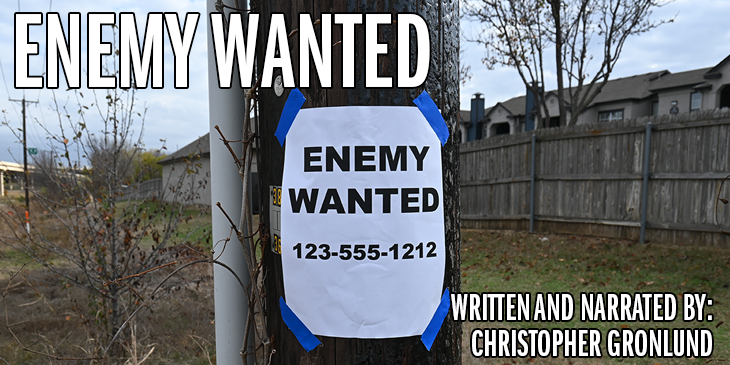
Photo of a piece of paper taped to a telephone pole with blue tape. Text reads: ENEMY WANTED. 123-555-1212. To the left, the wires from the pole continue to another. Behind that, a bit of a highway overpass. To the right, grass, a wooden fence, a free behind that, and apartments. Text reads: Enemy Wanted. Commentary by: Christopher Gronlund.

In this behind-the-scenes look at the latest Not About Lumberjacks story, “Enemy Wanted,” I talk about the first writing I was ever paid to do, collaboration, and how I’m lucky to have support from creative friends I’ve known for decades.

As always, this commentary contains spoilers from the latest episode, so you might want to listen to that first.

Transcript >>

Podcast: Play in new window | Download

Subscribe: RSS

Filed Under: Behind the Cut, Episodes Tagged With: Behind the Cut, Enemy Wanted

Enemy Wanted – BtC Transcript

March 9, 2025 by cpgronlund Leave a Comment

[Listen]

[Intro music plays]

[Woman’s Voice]

This is Behind the Cut with Christopher Gronlund. The companion show to Not About Lumberjacks.

[Music fades out]

Christopher Gronlund:

Behind the Cut is an in-depth look at the latest episode of Not About Lumberjacks and often contains spoilers from the most recent story. You’ve been warned…

* * *

The first thing I ever wrote for submission was also the first thing I ever had accepted by an editor: a 12-page comic book script. 

The two friends I hung out with the most in my very early adulthood were not only into reading comic books, but also writing and illustrating them. At a convention in 1989 or 1990, I met an editor looking for short scripts for a monster anthology he was putting together. While my story wasn’t quite a monster story, he liked it enough that he made an exception and accepted it for publication.

An artist friend and I immediately got to work on the story. (My friend Tim, who did the logo for Not About Lumberjacks…and convinced me to start a Patreon for the show.) We recruited other friends we met through indie comics to work on inks (William Traxtle) and lettering (the mighty Brad Thomte).

It was such a rush holding a finished copy of the book when it was published (MOJO Press’s CREATURE FEATURES), but the best part of it all was the collaboration with editor, Rick Klaw—and other people who became friends through comics.

* * *

Writing is a solitary act: hours alone at a keyboard or notebook, lost in worlds and situations and characters. If you’re lucky, maybe you have trusted readers helping you along the way. If you’re very lucky, you’ve chatted with an agent or editor about the story…and have support when finished through a publisher. But unless you’re working on a story with another writer, writing fiction is not the most collaborative effort.

* * *

The two creative things I’ve done that have made money—writing and juggling—were collaborative endeavors earlier in my life.

A friend and I used to street perform…not that we made a lot of money passing the hat. The fun came in the hours of practice together, honing our skills and coming up with routines. They were the stories that came with what we did: things like almost being set on fire by the lead singer of a punk band, or having a stranger on the street mess with us and our gear while we were strapped into straitjackets.

The fun with comics was hanging out with supportive friends who had a shared dream, spending most of our free time working on pitches, stories, and talking about this thing we loved. There was a time it consumed us.

(A quick side story: I met my wife, Cynthia, through a small comic book company—where she was an artist—in the spring of 1992. We started hanging out when she heard I juggled. She was taught how to juggle in elementary school and always wanted to learn more. So, I taught her—and we’ve been together since those days.)

* * *

I miss those early days of collaboration and absolute support. Not that I don’t feel supported with Not About Lumberjacks—I hear from people who love the show, and some even support it financially. What I’m talking about are those late nights staying up and working on something with friends; talking about the thing you love more than most other things every single day.

Letting a creative love wash over you and provide shelter, no matter how rough the world might become.

I sometimes talk with Cynthia about stories, but she’s usually there as a second set of eyes after I’ve finished things. And I regularly talk with my friend, Deacon, about writing, even about works in progress around during our annual long-weekend writing retreats.

But there’s nothing like the days when working with friends…when our heads—even at our day jobs—were always full of what was next in our shared efforts.

* * *

Most Not About Lumberjacks stories are lonely efforts—and I’m fine with that. I adore creating a thing that is wholly my own, from an idea, to the story…and then recording the narration, making sounds (or finding them), and choosing music tracks from a library I use. Loading it all online and promoting new stories.

It’s still a shelter I can rely on no matter how ugly the world outside may be.

When my mind turns toward stressful or even darker thoughts, a story is always there needing my attention—a switch that makes the worst of things disappear from my head. I find solace in this process that rewards my mental time and efforts, instead of making me feel even worse.

And the show is not entirely devoid of collaborative efforts…

* * *

In November, I released a tall tale called “The Legend of Mighty Missy Stewart,” that turned out to be one of my favorite stories on the Not About Lumberjacks website. It was written, in part, with a voice in mind: a professional voiceover artist and actor named Dave Pettitt.

Working with Dave was a blast! Along the way, we worked on how he’d read the story—in the more typical “podcast voice,” or treating it like an audiobook? Sample bits to approve and then the final track. The option for second takes, although none were required because it was perfect with the start!

I’ve worked with other narrators along the way, and have even done a couple one-shot audiodramas requiring multiple voices contributing to stories.

I’ve spent time in our closet recording booth with Cynthia as she’s recorded full stories, dialogue for background scenes, and even provided growls and snarls for a dragon in the story, “Rockbiters.”

Most recently, I collaborated with Clarke Jaxton Motorbike on a Not About Lumberjacks story called “Enemy Wanted.” Mr. Motorbike provided the recurring music used throughout the story.

* * *

Sometimes collaborations didn’t work out, even when I was younger. And sometimes collaborations ended as higher paying work was offered to people you once worked with in the hope of a shared something more.

But that’s a rarity. And when things don’t work out—even today—it’s no problem: we’re all busy with life. Sometimes schedules that once seemed open close for other things.

There are always more stories and opportunities for collaboration, even with a show like Not About Lumberjacks, which is mostly a thing all my own. (Or something with Cynthia’s assistance if a story is heavily from the point of view of a woman.

* * *

There’s another kind of collaboration many people don’t consider: the support of others who do something similar to what you’re doing, even if you don’t work together.

Most of the other narrators and voices I’ve used for Not About Lumberjacks are people I’ve met through podcasting…with many working on audio fiction themselves.

I can talk to other creative friends doing similar things about snags I might encounter along the way. If I mention my digital audio workstation seizing up in the middle of recording—or that I was set up to record, but was getting a buzz that took 20 minutes to find in my setup and eliminate before recording—those friends have been there themselves. (Or, if I encounter something I can’t figure out on my own, some are only a text message away!)

And then there are creative friends working in other fields I chat with about overlapping challenges and concerns about what we do: balancing life with creative schedules; overcoming those times of lower energy and personal challenges; even talking about being a creative person in a time when A.I. keeps affecting the industries we all work in.

* * *

I’m a very fortunate person to have begun my creative life in such a collaborative way. I still have that belief I had in my late teens and early 20s that if I want to do something, it’s just a bit of effort (or a lot) to make it exist.

I’m still in touch with most of the people I met through comics books in the late 80s and early 90s. I cherish these decades-long friendships and how we support each other even today.

Some of those friends still work in comics full time. Others went on to illustrating book covers and interiors for bestselling novels. A good friend who still occasionally works on comic books pays the bills as a voice actor, voicing cartoon characters you likely know…or maybe even grew up watching.

Through collaboration, I know screenwriters and animators; musicians, directors, and other creative people.

Outside of working with other narrators, Not About Lumberjacks is mostly a solitary effort.

But you’d be mistaken to believe I do it all on my own…

To all those who supported (and still support me), whether it’s working together on something in the past, working together on a Not About Lumberjacks story, or just rooting for me and this little thing I do: thank you so much!

(I may work in silence, but I’m never working alone…)

* * *

Thank you for listening to Not About Lumberjacks and Behind the Cut. Theme music for Behind the Cut is a tune called “Reaper” by Razen. Visit nolumberjacks.com for information about the music, the episodes, and voice talent.

Also, for as little as a dollar a month—and actually even free—you can have access to a bigger behind-the-scenes look at Not About Lumberjacks on Patreon. Check out patreon.com/cgronlund if that sounds like your kinda thing.

In May, it’s a return to two detectives from an earlier Not About Lumberjacks story called “Godspeed, Crazy Mike.” This one’s more of a thriller than a full-blown whodunit mystery, but there will still be plenty for those who love to guess what’s going on before things are revealed.

Until next time: be mighty, and keep your axes sharp.

Filed Under: Transcript

Enemy Wanted

February 22, 2025 by cpgronlund 2 Comments

Photo of a piece of paper taped to a telephone pole with blue tape. Text reads: ENEMY WANTED. 123-555-1212. To the left, the wires from the pole continue to another. Behind that, a bit of a highway overpass. To the right, grass, a wooden fence, a free behind that, and apartments.

Text reads: ENEMY WANTED. Written and Narrated by: Christopher Gronlund

Ferdinand Pérez gets more than he bargained for when he answers a flyer ad taped to a telephone pole looking for an enemy.

Content Advisory: “Enemy Wanted” deals with difficulty sleeping, a blurred sense of reality, crime, cartoonish violence, illness, a death, and wishing for an early end to life. That makes it sound dismal, but I assure you…it’s a blast of a story.

Also, it’s one with no swearing. Still, were it a movie, it would be rated PG (or maybe PG-13 for mature themes), so be aware. Also, because there are scenes with action, be prepared for the occasional surprising loud sound.

* * *

Before we get to the story, I want to talk about the music in this one. Clarke Jaxton Motorbike makes electronic music and writes badass stories on his YouTube channel. (You should go listen and read some…most are only a couple minutes long.)

We started chatting after I replied to some of his work. One day, he contacted me — saying he would love to do the score for a Not About Lumberjacks story. Originally, we thought his music would be perfect for “A Very Strange Day (On Our Neighboring Red Planet),” from this year’s Christmas episode, but Mr. Motorbike was in the middle of scoring a feature film.

So, instead, he gets the first Not About Lumberjacks story of the new calendar year!

* * *

Oh! One more quick thing: there’s mention of a soup review podcast in this story. Paul Csomo’s The Soup Review Podcast is a real thing, and you should check it out!

Onward!

* * *

Credits:

Music: Theme – Ergo Phizmiz. Story – Clarke Jaxton Motorbike.

Story and Narration: Christopher Gronlund.

Episode Transcript >>

Podcast: Play in new window | Download

Subscribe: RSS

Filed Under: Episodes Tagged With: Enemy Wanted, Humor, Quirky

Enemy Wanted – Transcript

February 22, 2025 by cpgronlund Leave a Comment

[Listen]

[Sound of an ax chopping wood. Quirky music fades in…]

Christopher Gronlund:

I want to make one thing perfectly clear: this show is not about lumberjacks…

My name is Christopher Gronlund, and this is where I share my stories. Sometimes the stories contain truths, but most of the time, they’re made up. Sometimes the stories are funny—other times they’re serious. But you have my word about one thing: I will never—EVER—share a story about lumberjacks.

This time, it’s a story about what happens when a sleep study technician with insomnia answers a flyer ad found on a telephone pole looking for an enemy.

But first, the usual content advisory…

Were it a movie, “Enemy Wanted” would be rated PG. It deals with difficulty sleeping, blurring reality, crime, cartoonish violence, illness, a death, and wishing for an early end. That makes it sound dismal, but I assure you…it’s a blast of a story. Also, it’s one with no swearing. (I always want to swear in the intro when saying a story is without “mature language.”)

Before we get to the story, I want to talk about the music in this one. Some time ago, a friend getting into making synthesizer music stumbled upon a guy on YouTube named Clarke Jaxton Motorbike. Mr. Motorbike shares top-notch stories in text over electronic music he composes for the pieces. My friend knew it was my kinda thing and shared it.

I fell in love from the first story. You know how sometimes you hear a band and think, “Wow, this is an instant fave?” Clarke Jaxton Motorbike’s writing is like that for me. Sure, it’s not novel-length stuff, but what he packs into several minute stories is incredible—a total masterclass in brevity.

So, I was happy when he messaged me after commenting on his stories on YouTube and Instagram, letting me know he liked my writing…and that he’d LOVE to do the music score for a story.

The timing was perfect for “Enemy Wanted.” (I think you’ll agree.)

I’ll link to Clarke Jaxton Motorbike’s online accounts in the show notes and on the talent page. Seriously, his music and writing are wonderful things, so be sure to check them out!

All right, let’s get to work!

#

Enemy Wanted

Ferdinand Pérez stopped walking and read the flyer taped to the telephone pole a block from his house:

ENEMY WANTED

123-555-1212

It was the kind of thing someone would make, post, and take a photo of to share online, a meme-ready image waiting to go viral. Or a guerrilla marketing campaign: call the number and end up listening to a recording about whiter teeth, hot singles in your area, or the dreaded extended auto warranty. There was even the possibility of someone actually looking for an enemy, however that would work. Believing it was a scam, Ferdinand removed the flyer and threw it in the trash when he got home.

It was the beginning of four days off from long nights at the sleep lab where he ran studies. Ferdinand looked forward to—and dreaded—these days. Three nights on and four days off sounded great when he started. A life-long insomniac, it seemed like the ideal job, but now his days were spent trying to sleep instead of his nights.

As morning rolled into afternoon, exhaustion got the best of him. He pulled the flyer out of the kitchen garbage and called the number.

* * *

Someone masking their voice like a true crime TV show witness picked up.

“Yes?”

“Hi,” Ferdinand said. “Uhm…I saw a flyer on a telephone pole. Looking for an enemy? Now that I’m thinking about it, this is probably all a prank. Someone messing with you as much as me. I’m sorry.”

“Who is this?”

“Ferdinand. Ferd.”

“Ferdinand who?”

“Pérez.”

“No, Ferdinand Pérez…Ferd. I put the flyer there, and I am looking for an enemy.”

“Okay…so what’s next?”

“What do you do for a living, Ferd?”

“I’m a polysomnographic technician.”

“Sleep studies, correct?”

“Uh…yes. Most people don’t know what that is. Who are you?”

“It will be all be revealed, once I know you are a worthy opponent. Goodbye, Ferd.”

* * *

Ferd sat on his couch, debating with himself about calling the number again. His mind wasn’t completely scrambled in his 23rd hour of being awake—including a 13-hour shift in the lab—but he was slipping into a state of hazy focus. He knew better than calling again until his head was more clear.

An hour later, he shuffled off to his bedroom, where he finally dozed off two hours later.

* * *

Between his waking hours, constant exhaustion, and rough sleep in which Ferd’s mind seemed to fold over on itself—his dreams like nesting dolls—reality was a nebulous domain leaving him wondering what was real and what wasn’t.

A man in a gas mask stood at the foot of his bed.

“Are you really here?” Ferd said.

The man raised a pistol and pointed it at Ferd. The barrel flared out at the end, like a blunderbuss. A faint green light illuminated on its side. On top, a glass cylinder full of liquid.

The man in the gas mask took a step closer and pulled the trigger.

Fog rolled out from the barrel as the man said, “Sleeeeeeep,” in the voice from the phone call.

* * *

Ferd woke up and looked at the clock on the nightstand beside him: six-o’-clock in the evening. After a momentary panic, thinking it was time to begin a night in the sleep lab, he remembered he was done working for the week.

“Just two friggin’ hours,” he said while stretching in bed.

He tried dozing off again, but his stomach kept growling.

“Fine, fine, I’ll feed you.”

When he got up and flipped on the light, he saw a box atop a mound of laundry he needed to put up. He opened the bedroom door and checked every other space in the house before returning. He slowly entered, fully expecting to see the man in the gas mask by his bed.

Ferd looked at the box and noticed a piece of paper on the floor. He grabbed a pillow from his bed and tossed it at the note. He threw another pillow at the box, expecting it to explode. When he felt reasonably sure the items weren’t booby trapped, he picked up the pillow on the floor and read the note.

A GOOD ENEMY IS A WELL-PREPARED ENEMY. CARRY WITH YOU AT ALL TIMES THE ITEM IN THE BOX.

– D

Ferd removed the other pillow and tossed it back on his bed. He closed his eyes as he removed the box’s lid.

Inside, he saw the handle of what looked like a ray gun in a holster. He removed it from the box and carefully pulled out the gun.

It weighed less than expected. Ferd wondered what kind of metal it was made out of to be so light. A prong in the back lined up with a sight at the end of a barrel sporting a series of rings, like cooling fins. The gun had two triggers—one above the other. The top read BLAST and the bottom: STUN. On the side, an Art Deco font over a stylized lightning bolt read ELECTROCUTER.

Ferd searched his house again before popping a frozen pizza in the oven.

He put the gun in the holster and took it to his office.

When Ferd flipped open his laptop and checked the time, he was surprised to see Tue Mar 4 6:17 PM. He checked his phone to verify the date and time: same thing.

No wonder he was so hungry—he had slept 26 hours straight.

* * *

When he was 19 and started working regularly, Ferd took up jogging in the hope of making himself sleepy. Between odd construction jobs and running for miles, he thought he’d fall into a deep sleep each night, but the insomnia afflicting him since childhood kept its hold.

At 26, since he was up all night anyway, he considered moving to an overnight security position, but his uncle suggested studying to become a sleep technician at Thanksgiving. He’d seen something about it on the news and thought it was perfect for his nephew. After eleven years on the job, Ferd was glad he took his uncle’s advice.

His nightly runs took him a mile through his neighborhood, to a park across a quiet highway bordering one side of his development. The loop around baseball fields and a pond at the back of the park worked out to be a half mile—a perfect distance for speed drills or running all night.

He was wasn’t sure about jogging with the holster belt and gun, so he tied a long-sleeved shirt around his waist to conceal it. The night patrol officers in town were used to seeing him, waving as he ran through neighborhoods or on his way to his favorite running loop.

Ferd was at the back of the park when it happened: someone came rushing out from the tree line to his right. When he turned around to run away, another figure charged him. To his left, down a dock leading to an observation deck overlooking the pond, someone else approached—someone with a chainsaw! Trapped on three sides, instinct told him to run into the trees and lose them, but his hand went to the gun. As he put the person in front of him in the gun’s sights, Ferd realized they weren’t people at all.

He almost laughed at how ridiculous the robot looked as it passed beneath a light along the trail. It rolled along on a single wheel extending from a body that looked like a metal barrel. Its hands reminded Ferd of the claw game at arcades, three fingers on the ends of arms like ductwork. And its ridiculous head, an oval hunk of metal with glowing eyes and a speaker for a mouth. Antennae poked out on each side; a glass or plastic dome on top glowed a brighter blue the faster it moved.

The robot wasn’t so funny when its hands started whirling. Its arms extended and retracted as it tried striking Ferd, barely missing him. When Ferd pulled the BLAST trigger on the gun, a tiny lightning bolt struck the robot in the chest, frying its circuits and sending it to the ground. Ferd turned just in time to dodge an attack from the one behind. The BLAST effect sent that one down as well.

The final robot was like the others, only with chainsaw blades for hands instead of claws. Ferd charged into the trees, hoping it couldn’t pursue on its little wheel, but it gained on him. He turned to shoot it, but hit a tree instead, splintering it like a lightning strike. The robot raced down the trail toward him. He fired another blast, but missed when the robot extended and retracted a chainsaw hand. And then another. Ferd dropped to his knees as the robot closed on him.

When it reached him and came down with both bladed hands, Ferd shoved the gun into the wheel housing and pulled the STUN trigger. The maniacal robot fell back and down.  When Ferd stood up, he shot it with the BLAST setting to be sure it was immobilized.

It didn’t matter if he was on friendly terms with the police or not, there was no way to explain what had just happened. Ferd ran deeper into the trees until reaching railroad tracks, which he followed to the far side of his neighborhood, before doubling back and returning home.

* * *

When he finally settled down, Ferd called the number on the flyer.

“Yes,” said the altered voice.

“What the hell just happened?!”

“Whatever do you mean?”

“You know what I mean. Those robots!”

“Think of them as a test. You did a stellar job defeating them, Ferd.”

“How do you know I did?”

“Cameras, dear boy.”

“What?”

During his run home along the railroad tracks, Ferd wondered if the noise of the attack had attracted attention. If not, would the robots be found in the morning? Now he worried they’d be discovered and he’d be on camera.

“Don’t worry, Ferd. I sent a clean-up crew to take care of the mess. You did well, all things considered.”

“I’m done!” Ferd said.

“No, you are not. You answered the flyer ad. We’re in this until one of us defeats the other.”

“You didn’t do a thing! You let robots do your dirty work!”

“A good enemy always sends henchmen, first. To test their foe.”

“I’m not your foe. I quit!

“You can quit, Ferd, but I will still come for you. Enjoy the rest of your evening.” 

* * *

Ferd went to his office and opened his laptop. He typed the flyer’s phone number into Google.

No results.

A search for “attacked by robots” resulted in a fake news story about a robot assaulting an autoworker on the assembly line after turning off other bots. “Captured by robots” resulted in a strange band with a human lead singer who performed with robot band members. On a scrap of paper, he jotted down the band name and added MAYBE? (IT’S STRANGE ENOUGH!)

Searching for “lightning gun” pulled up TV tropes and lists of video game weapons, but nothing that would make him say, “Ah-ha—that’s it!” “ELECTROCUTER” resulted in a song hit and a music compilation—as well as plenty about electrocution—but nothing about the gun.

Ferd thought about his enemy’s henchmen and typed “man in robot suit.”

The top searches were all costumes, articles about dancing and military robots, and something about a man on Russian TV who brought a robot on the news appearance. That sounded promising, but it ended up being a hoax. Digging deeper, though, Ferd found a 1974 newspaper article headline from The Akron Beacon Journal: “Man in Robot Suit Baffles Authorities.” The link sent him to a nationwide newspapers site through a genealogy service. He signed up for a free seven-day account and found the article.

MAN IN ROBOT SUIT BAFFLES AUTHORITIES – OCTOBER 28, 1974

Authorities are on the lookout for what witnesses describe as a “man in a robot suit.” Two sightings in the area have residents wondering what is going on.

“I was out walking my dog when I saw it,” said Thomas Berger. “At first, I thought it was a man on stilts dressed up for Halloween, but he was inside some kind of armor. He picked up a picnic bench with one hand and spotted me before running away faster than anyone I’ve ever seen.”

Another witness, Donald Sanke, said he was watching his two children playing on a park swingset when he spotted the man.

“I saw him by the trees in the back of the park and got up. I didn’t know if he meant us harm or not. When he noticed I spotted him, he ran away.”

Police said they have no leads, but Mr. Sanke has an idea.

“You remember that weird bank robbery up in Cleveland seven or eight years ago? I wonder if it’s the same person.”

Ferd searched for “Cleveland Bank Robberies 1960s,” and found a 1967 article in the Cleveland Plain Dealer about a robbery where a man used a “ray gun” to enter a vault and get away with 1.2 million dollars. The article claimed the gun made the vault door “disappear.” The only thing left behind was a calling card reading THE DECIMATOR.

Additional searches produced a 1976 article in the Pittsburgh Post-Gazette about a “man in flying boots,” and a Detroit Free Press article from 1979 about a costumed man in a gas mask stopping a robbery using a “sleep gas gun.” Ferd even stumbled upon a YouTube clip from a 1989 episode of Unsolved Mysteries about the Cleveland bank robbery. The segment claimed only D.B. Cooper’s mid-air plane heist and whereabouts eclipsed the strange crime in Cleveland.

* * *

On Wednesday afternoon, in his 25th hour of being awake, Ferd heard a noise at his front door. He went out through the back and snuck around to see who was there. Someone had placed a package on his doormat.

It was larger than the lightning gun box—and longer. He wondered if it was a trap, but was growing too tired to care. Ferd had reached a state of sleeplessness where he wondered if the box was even real.

He set it on his coffee table and opened it. Inside, he found a jumpsuit. It was covered in wires and round metal discs several inches wide. A belt with an ON/OFF switch looked like it hooked into the wire connections covering the garment.

“Why the hell not?” he said. Ferd pulled it on, hooked up the belt, and flipped the switch.

The suit hummed to life, surrounding him in a warm blue glow. He tapped his arm and felt nothing. Ran at a wall and bounced off with no bruising. A forcefield suit. After testing its strength in the garage (hammers, saws, and even a soldering iron had no effect), he returned to the living room. He looked at the box the suit arrived in and saw a note. It read:

IT WOULD BE WISE TO WEAR THIS BENEATH YOUR CLOTHES WHEN YOU GO OUT.

– D

* * *

Ferd stayed in Wednesday night, keeping an eye outside in the hope of spotting the person sworn to be his new enemy. He opened a window when the world was quiet and asleep, listening out for a drone. Somehow, he must have been tracked.

When he was convinced a drone wasn’t giving him away, he spent the next hour looking for a tracker. He pulled out the soles of his shoes; emptied his wallet and took his key fob apart. Finally figured out how to turn off all location tracking on his phone. After that, Ferd considered researching some more, but opted for watching TV instead. He kept the force field suit on, figuring if something happened, safety was an ON switch away.

When the sun came up, he watched his go-to comfort show: the Teenage Mutant Ninja Turtles cartoon. It was a favorite show as a kid, and it still kept him entertained years later—a thing he could watch for hours again and again. In one episode, the turtles found a card at the scene of a crime. It read “– S.” Every kid knew it was from the show’s main villain, The Shredder.

It made him think of the note included with the force field jumpsuit ending with “– D.”

He went to his laptop and continued searching for “The Decimator,” finding pages of table-top war game results, but nothing more than the article about the Cleveland robbery. When he eventually gave up, he crawled into bed, where he finally fell asleep three hours later.

* * *

Thursday evenings were Ferd’s Sundays. While he enjoyed his job and the focus that came with it, 13-hour shifts and trying to get back on schedule wrecked him even more. As his restlessness intensified, he put on the forcefield suit. Over that, his running clothes. Ferd finished by strapping on the lightning gun, and headed out for a run.

Each time he passed the back of the park, he expected another robot attack. He had considered driving to a more public park and running, but figured if something was going to happen, he’d not be able to avoid it by changing locations. His enemy knew where he lived. For all Ferd knew, they were waiting for him at home.

On his fourth mile, he paused and looked skyward, at what appeared to be a meteor breaking up as it entered the atmosphere. It continued flaring and turned his way, landing on the trail before him. Not a man in a robot suit, but a man in powered armor.

Gone were the ridiculous heads of the robots two nights before. A sleek helmet and visor replaced speaker mouths and antennae jutting out from the sides. No clunky barrel-shaped body; instead, a two-toned gray armor like a sci-fi version of motocross protective gear. The jetpack and stabilizers on the sides of its feet glowed orange from the flight.

Ferd flipped the forcefield suit’s ON button just in time. The man in the powered suit pulled a gun from a holster and fired a blue beam his way. Ferd felt its warmth radiate across his chest, a ripple of energy absorbed by the energy bubble surrounding him.

Ferd returned fire, but the crackle of the lightning gun had no effect. He turned to run, but the man in the armored suit leaped over him in a flip and blocked his way. Another shot from the lightning gun yielded no results—Ferd clicked it into its holster and took off across the grass toward a playground. Again, the man in the suit blocked his way.

The armor looked like it had exposed areas at its joints. Ferd threw a punch at his foe’s lower abdomen. He cut his fist on the bottom of an armored plate, but landed a blow. The man in the suit extended his arm and hit Ferd with a white blast emanating from his palm, knocking Ferd back across the grass and into the post of a swingset. No damage.

As Ferd stood up, the man in the armored suit let loose a blast from the jets on his feet, giving Ferd no time to react before closing the distance and crashing into him. Their forcefields canceled each other out—the blow blow Ferd as he was sent back into the post a second time. Blood dripped from his forehead. He looked up and saw the man inside the armor through a broken visor.

Ferd hadn’t given much time to considering what his enemy looked like. When he did, he imagined someone his age, possibly advised by an old spy. He didn’t expect a man in his 80s who looked familiar, even though he couldn’t place who the man was or where he’d seen him.

Ferd’s enemy raised his hand and covered the side of his face exposed by the collision. Ferd readied another punch as a car pulled into the parking lot. Bright lights flared as a police patrol spotted them.

“Hold onto me, Ferd!”

Ferd stood on the armored man’s feet and found handholds on his sides. The man in the armored suit wrapped his arms around Ferd—and with a WHOOSH—they were airborne.

The city fell away from view as they climbed, and then tilted east. They flew to the edge of town and landed in a field. The man in the armored suit let go of Ferd and said, “Head through those trees over there. You can catch a bus home.”

Then he reached down and removed the holster and lightning gun from Ferd’s waist.

He took off before Ferd could protest.

* * *

When he got home, Ferd plopped down in his favorite chair in front of a silent television. While reclusive by nature, he considered contacting a friend and talking about his strange week. But who would believe him?

“You answered a flyer ad, and now an old man you think is a 1960s bank robber is attacking you with robots and powered suits? I know we barely talk and that you have issues sleeping—are you okay?”

So he sat in his chair on edge, jumping at any creaking of the house settling at night. Wondering if a passing car was delivering a new message, or a distant plane some new construct coming his way for another fight. When the sun came up, Ferd went for a run in his neighborhood. He’d sworn off the park and figured he was safe on the waking streets. He spent a calm morning, thinking about what might happen next. Then he did something he’d not done in years: he crawled into bed and got six hours of sleep before waking up for work.

* * *

Ferd’s two favorite things about his job were helping people and—once a study was underway—having a little time for other things. As he monitored the evening’s study, a 38-year-old office manager who admitted at least some of her problem was an urge to check her phone for work messages all night, he looked through recent studies. The man in the flying suit looked old, so he searched for all males he recently monitored over 70.

When his current study stirred awake and settled back to sleep after remembering where she was and that she was not allowed to check her phone, he looked through videos from those he whittled down for his search. Eventually, he saw him: an 85-year-old man who looked exactly like the person behind the broken visor from the night before. How could he forget that name: Clarence Grossweiner!

He remembered, now. He was, perhaps, the most exhausted study Ferd conducted in at least a year. A man who told him he started having sleep issues for the first time in his life and didn’t know why. Ferd had everything he needed: his enemy’s address, phone number, and even some personal information about the man tormenting him all week.

When the night’s study was complete and he finished all his notes, Ferd went home to get the forcefield suit.

* * *

On his walk home, Ferd thought about what he’d do: monitor Clarence’s house and catch him out of his armor. Rush him, tie him up, and force him to reveal everything. When he got home, Ferd saw an envelope taped to the door.

He went around to his shed in the backyard and got a rake. He used its tines to pull the envelope out, checking to see if it was a trap. When he was convinced it was just another communication from Clarence, he set the rake down, removed the envelope from the door, and went inside.

The note read:

Ferd,

You have proven yourself to be a worthy adversary—an enemy beyond my expectations. I believe it best to skip to the end.

Meet me in the field where I dropped you off after our fight Thursday night. Midnight. This all ends in a duel.

– D

Ferd was not going to wait. He put on the forcefield suit and headed out.

* * *

Clarence Grossweiner lived on a tiny estate at the edge of town, a stout brick home built before shoddy McMansions crowded the area. The property was surrounded by an iron fence and manicured hedges; the driveway tucked behind a wrought iron gate and stone wall. Looking on Google Maps, the likelihood of sneaking across the grounds unseen was slim. Ferd pulled to the callbox, pressed the intercom’s button, and said, “I know you can hear me, Grossweiner. Probably see me, too! Open up and face me!”

From the intercom speaker came a frail voice. “Please don’t call me that, Ferdinand. My name is Clarence.”

“Fine. Clarence! Better?”

“Yes. Thank you. What do you want, Ferd? Our duel is scheduled for Monday.”

“I want all this to stop.”

“It will end Monday.”

“I’m not going to fight you anymore.”

“Okay.”

Ferd looked for the camera on the callbox—found the lens and stared into it.

“Okay? You’ve tormented me all week and now you’re just stopping? Forgive me if I don’t believe you.”

“You’re forgiven, and I’m sorry for all I’ve put you through. You’re relieved of your duty.”

“What?” Ferd said. “No!”

“You said you want this to stop. That you refuse to fight anymore. So, be on your way.”

He pointed at the camera. “You’ve got something planned. I know it.”

“I am a sincere person, Ferd. Or is there something more you want?”

“Uhm…”

“Uhm what?”

“I guess I want to know why you chose me?”

“You answered a random flyer taped to a telephone pole.”

“Sure. Yeah. But…it looked like it hadn’t been there that long. And few people pass by that way.”

“Fine, Ferd. I will tell you why I chose you if you accept my duel. Right now.”

“I can’t do that.”

“Then I can’t tell you why I chose you.”

“Fine!” Ferd said.

The gate separated in the middle and opened wide.

“Come to the house. I promise I have nothing planned until we speak.”

* * *

Ferd cautiously made his way up the long drive and parked before the stairway leading to the house. The entry double doors parted before Ferd could knock or ring the doorbell. Before him stood Clarence Grossweiner, the tired old man from a sleep study two months earlier.

“Welcome, Ferd. Please, come inside.”

He turned and disappeared into the shadows of the large foyer. Ferd followed, closing the doors behind him. He flipped the ON switch of the forcefield suit as he passed through. The dark interior of the house gave way to a bright solarium running the entire length of the back of the house. He hoped Clarence wouldn’t notice the suit’s glow in the light.

The black and white checkered floor opened to Mediterranean arched windows on three sides of the large sunroom. Potted plants and flowers were placed along the outside of the space and atop ornate pillars in the corners. Vines hung down from a glass roof held in place by intricate Art Nouveau ironwork. At one end of the space, a heavy wooden table with equally stout benches. On the other side, a sitting area composed of a long couch and two club chairs. In the center of it all, a small fountain.

“Would you like something to drink, Ferd? Some lemonade, perhaps?”

“No, thank you.”

“Well, I’d like some if you’d allow me a moment.”

Ferd expected Clarence to return in the biggest, most ridiculous robot suit of them all, but he came back with a glass pitcher on a tray with two glasses. He set it down on a table between the two chairs and poured himself a glass.

“I assume you figured out who I am?”

“Yes,” Ferd said. “But it doesn’t explain all this.”

Clarence Grossweiner admired his solarium and said, “I invested my sole criminal haul rather well. That’s the problem with most people: they get a taste of the adventure and riches and keep going until caught. I simply wanted to fund the things living in my imagination. I’m not proud of how I went about it, but what’s done is long done.

“But you don’t care at all about that. You’re here to find out why I chose you.”

Ferd nodded. “Yes.”

“If you recall, during my sleep study, we talked about how funny it is that you help people sleep better, but struggle with insomnia. You mentioned your days running together—how your job was the only thing that felt real. I figured your life could do well with a break from the monotonous trudging of blurred days and nights. I’m sure you were hoping for more, but that’s my motivation. I’m sorry you’re not some ‘Chosen One,’ or that all this culminates in some grand purpose.”

Clarence took a sip of his lemonade and opened a box on the coffee table in front of the couch. He pulled out two ray guns, handing one to Ferd.

* * *

“We’re going to do this like they do in the movies: back to back and ten paces. I’ll count them out, and then we turn and shoot. Understood?”

“Yes,” Ferd said. He followed Clarence to the middle of the solarium and took a step forward with each number called out.

“One…two…three…”

Ferd flipped the OFF switch of the forcefield suit beneath his clothes…

“Four…five…six…”

He scrutinized the heft of the ray gun in his hand. Carefully slid his finger into the trigger guard.

“Seven…Eight…Nine…Ten!”

Ferd turned and deliberately shot one of the plants on a stone column the corner. The column and everything in an eight-foot sphere around it, disappeared, leaving a deep divot in the checkered floor. He waited for the the shot coming his way. Instead, Clarence stood tall, his arms spread wide—eyes closed. When he opened them, he followed Ferd’s gaze to the crater in the floor.

“Perhaps 10 paces each was too much,” Clarence said. “Shall we try again with five?”

“No,” Ferd said. “You didn’t even shoot.”

“I must have missed as well.”

“No, you did nothing. Why?”

“Because I’m sick, Ferd. I found out about a week after the sleep study. I’m not going to get better, so I’ve chosen not to treat it at my age. But it’s caught up with me, and I just want the pain to end. We’re not kind to people in my state in this country.

“So, I figured I’d find someone I could bother—work them up to a point they’d gladly fire on me. POOF—gone! No evidence left behind. Leave The Decimator in the hands of someone I felt would not use it for nefarious reasons. You were so friendly and understanding during my sleep study.

“I know it’s a horrible thing to put upon another person, but I can’t bring myself to do it on my own. I didn’t count on you being such a terrible shot.”

Ferd placed The Decimator on the ground and said, “I missed on purpose.”

“Why would you do that?”

“I initially figured the suit would absorb anything you fired my way, and that if I missed you, we’d both live. But as we started pacing off, I changed my mind. I’m not sure this is real.”

“What do you mean?” Clarence said.

“This. My life. Does all this exist, or is it because I suck so much at sleeping? Are all the weird things I see in my periphery now standing right in front of me? I feel so locked in. I’m terrified that I’m wrapped up in two or three layers of dreaming and at home or even in a hospital bed. Or worse: dead…and this is my eternity. I don’t know. Nothing works: sleeping pills, meditation, none of it. It’s like I’m a ghost.

“So, I thought, ‘I’ll miss and he’ll hit and it will all be over. I’ll finally get to rest.’”

Clarence’s grin turned to laughter.

“Well, aren’t we both the proper mess.”

“Yeah, we are. So, what now?”

“I release you as my enemy. Go home, Ferd. I’m sorry I involved you in all this. Keep the forcefield suit as payment.”

“What about you?”

“I’ll figure something out. Goodbye, Ferd. You were a wonderful enemy.”

* * *

Saturday night’s sleep study was an eighteen-year-old college football prospect who slept well once settled. It wasn’t Ferd’s call, but with no disorder, he guessed it was simply anxiety that would go away once the kid decided where he’d sign. Sunday was an artist who stopped breathing 50 times an hour. She seemed happy something was caught and that a CPAP machine would help her finally get some rest.

On Monday morning, Ferd smiled as he passed the telephone pole where the week before, he spotted Clarence’s flyer. He thought about the week ahead of him, how he’d give Clarence a call and take him up on that glass of lemonade. At home, he warmed up some leftover Thai takeout and sat down on his couch.

Ferd turned on the local news to catch the weather—seeing if the forecast matched what the app on his phone predicted. Onscreen, a reporter stood in front of a familiar gate where a familiar house once stood. Police on the ground—and circling in a helicopter above—marveled at the massive divot where Clarence Grossweiner’s house once stood. No sign of an explosion—just like everything simply disappeared.

* * *

Epilogue

Wednesday afternoon, while catching up on a podcast from a guy in Florida who reviewed store-bought soups, Ferd got an alert from his camera doorbell. A FedEx delivery. He watched the courier set down a package and return to his truck. Ferd got up and opened the door.

It was the size of a shoe box. Ferd brought it inside and set it on his coffee table. When he went to the kitchen to get scissors to cut through the tape, he poured the last of the lemonade he made in honor of Clarence. He set the glass down on a coaster next to the box.

Inside, was a note and something beneath, wrapped in a towel.

Ferd,

I want to properly apologize for involving you in my ridiculous plan. By the time you read this, you’ll likely have heard what happened to me. While I cannot bring myself to pull the trigger on The Decimator, I’ve long speculated what would happen if its core were breached by a timed explosion while I was asleep. I guess I’ll find out. Or not if it works the way I hope.

It was terrible of me to expect you to do such a thing. I had written a confession for you, explaining to authorities how I manipulated you to fire on me in self defense. Fortunately, that was not needed. Everything was decimated with me, save what’s in this box. I hope it helps you.

Your enemy,

Clarence Grossweiner

(It really is quite a name, huh?)

Ferd lifted the item wrapped in the towel. Beneath it: six stacks of hundred dollar bills! Sixty-thousand in cash with a Post-it Note reading: CLEAN CASH—NOT FROM THE BANK HEIST.

He carefully unrolled the object wrapped in the towel, revealing the gas gun Clarence used the afternoon he entered Ferd’s bedroom. Another note included the formula for the sleep gas and a final message:

SWEET DREAMS, FERD. THANK YOU FOR MAKING AN OLD MAN’S FINAL DAYS SO MUCH FUN.

* * *

[Quirky music fades in…]

Christopher Gronlund:

Thank you for listening to Not About Lumberjacks.

And a HUGE thank you to Clarke Jaxton Motorbike for providing custom music for “Enemy Wanted.” Like I said up front, you can find links to his stories and music in the show notes for this episode…and on the Talent page.

Speaking of music…as always, theme music is provided by Ergo Phizmiz.

Sound effects are made in-house or from Epidemic Sound and freesound.org. Visit nolumberjacks.com for information about the show, the voice talent, and the music. Also, for as little as a dollar a month, you can support the show at patreon.com/cgronlund.

In May, it’s a return to two detectives from an earlier Not About Lumberjacks story—this time, more of a thriller than a full-blown mystery, but there will still be plenty for those who love to guess what’s going on before things are revealed.

[Quirky music fades out…]

[The sound of an axe chopping.]

Until next time: be mighty, and keep your axes sharp!

Filed Under: Transcript

Not About Lumberjacks Q&A 2

February 9, 2025 by cpgronlund Leave a Comment

A close-up image of a gray concrete wall at its corner. Sticking out, and electronic sign displaying a glowing reddish/orangeish question mark.

Four years ago, I did a Q&A for the Behind the Cut episode for “Geocached.”

No idea why I’ve not done another, but with this being the long time between episodes (after back-to-back stories last November and December), it seemed like a good time to do another.

I asked members of the Not About Lumberjacks Patreon for questions — as well as some questions from social media. These were the results:

  • Are there any limitations that frustrate you about stories you would like to tell? Whether it’s your technical skills or the medium itself (obviously it’s audio, so you can’t use visual effects etc that sort of thing where you find yourself thinking “if only I could ___, I would be able to tell this story the way I want to”).
  • Are there styles or types of stories you wish you were able to write?
  • At what point did you realize you had found your voice/style, and how much of it stays solidly “you” as you go from serious to goofy stories.
  • What’s the longest you sat on a story for Not About Lumberjacks?
  • Any stories you refuse to abandon because there’s got to be some kind of conclusion to it somewhere, and the plot is too cool to walk away?
  • Might be a bit personal, but is Not About Lumberjacks breaking even? Losing money, Because I never did a podcast, I don’t know the finances of having one.
  • Did you know Dave Pettitt before reaching out to him about narrating? Did he know (or know of) you and Not About Lumberjacks?
  • What is the favorite thing you’ve written that is the least liked by other people and why do you think that disconnect happened?
  • Which story surprised you the most that became a fan favorite – why do you think it was so popular with your listeners?
  • Between seminars, writing courses, writing groups, etc., what do you think has helped you improve the most as a writer?
  • How do ideas for stories come to you? Do you randomly say something like, “I want to write about this kind of guy who lives in this kind of setting and has this unusual thing about him,” and then fill in? Or does some small thought catch you and you turn it into a story? Or what other ways?

Links to people and things mentioned in the Q&A:

  • Dave Pettitt
  • William J. Meyer
  • Rick Coste
  • Clarke Jaxton Motorbike
  • The Sula Society
  • The Not About Lumberjacks Patreon

Podcast: Play in new window | Download

Subscribe: RSS

Filed Under: Episodes, Question and Answer Tagged With: Q&A

Behind the Cut – Christmas Miscellany 8

December 21, 2024 by cpgronlund Leave a Comment

Left side: a Cross section of a cut tree with a grassy background. Text reads: Behind the Cut. The Not About Lumberjacks Companion.

Right side: A red glass Christmas ornament on snow. Text reads: Christmas Miscellany 8. Commentary by: Christopher Gronlund.

In this behind-the-scenes look at the latest Not About Lumberjacks collection of stories, “Christmas Miscellany 8,” I talk about writing coincidences that make it seem like writers copy from other writers or current events…

As always, this commentary contains spoilers from the latest episode, so you might want to listen to that first.

Transcript >>

Podcast: Play in new window | Download

Subscribe: RSS

Filed Under: Behind the Cut, Episodes

Christmas Miscellany 8 – BtC Transcript

December 21, 2024 by cpgronlund Leave a Comment

[Listen]

[Intro music plays]

[Woman’s Voice]

This is Behind the Cut with Christopher Gronlund. The companion show to Not About Lumberjacks.

[Music fades out]

Christopher Gronlund:

Behind the Cut is an in-depth look at the latest episode of Not About Lumberjacks and often contains spoilers from the most recent story. You’ve been warned…

* * *

If you write enough, it’s bound to happen: something you’ve finished or released is similar to (or even very much like) something else out there. And with the Internet being what it is, you’re likely to hear, “You swiped from that new story that’s out!”—or even something older. Something you’re not familiar with.

Thing is: it’s entirely possible to write a very similar story as someone else without knowing the other story exists.

It happens all the time…

* * *

My first novel, Hell Comes with Wood-Paneled Doors, is a humorous coming of age story about a family traveling cross-country in a possessed station wagon. And if I had a book published for every time I heard, “That’s just like National Lampoon’s Vacation,” I’d have a shelf full of books.

Hell Comes with Wood-Paneled Doors came about when I first started considering submitting fiction, when I was twenty. I had a copy of the Novel and Short Story Writer’s Market guide and was looking for places accepting short fiction. One place was a publication specializing in station wagons. It turned out to be a newsletter, so the story the publication inspired in me was too long for what amounted to a tri-fold pamphlet, but I had a story that would not leave my mind.

When I released it as a podcast and later as an e-book, I heard the comparisons to National Lampoon’s Vacation. But aside from a father and son buying a station wagon in the opening scene, they are very different stories!

(By the way, the story now lives on the Not About Lumberjacks site, under the Novels link.)

* * *

There’s an early-ish Not About Lumberjacks story called “Standstill.” It’s about a woman whose husband is dying, and she has a magical watch that can pause time for 24 hours. The watch breaks, and they are stuck in time together. She loves it, because it means her husband will not die, but he grows to hate it because she’s holding on to him and denying herself so many experiences.

I released the story about the time a coworker at an old job found out I have a fiction podcast. “Standstill” was the first story he listened to. He came in one morning and told me he listened…and loved the story. And then he said, “You totally got that idea from Futurama, didn’t you?”

I didn’t, but…maybe I did? Subconsciously? Because I loved Futurama when it was on, even though I’d forgotten there was an episode in which main characters, Fry and Leela, end up stuck in time and grow old together. [Spoiler alert: the characters in my story don’t grow old in their time stall, but maybe I did put my own spin on that Futurama episode without realizing it?] The episode, called “Meanwhile,” aired on September 4, 2013, and my story “Standstill” came out on July 3, 2016. (I probably shouldn’t have released a story with a dying husband on my 24th anniversary!)

It’s possible that Futurama story subconsciously stuck in my head for three years. (It was a great episode, although “The Luck of the Fryrish” episode about Fry’s brother is my fave.) Or it’s possible one of the many other time-bending stories involving a watch inspired it. (For all I know, the Futurama episode was inspired by another story.)

This type of thing is rather common with writing. You can almost always read, see, or listen to something that makes you think of something else. (I once had someone tell me my second completed novel reminded them of the TV shows Twin Peaks crossed with Northern Exposure, even though I didn’t set out to mimic either show. Mine was just a surreal story about a murder in a very quirky small town in the Northwoods of Wisconsin that reminded someone of those shows. If anything had an influence on that particular book, it was Robert Olmstead’s, A Trail of Heart’s Blood Wherever We Go, even though they are very different things.)

* * *

Another thing that can happen when you write: you release a story that suddenly becomes topical through some news-worthy event.

The final story of this year’s Christmas episode features the ghosts of Christmas Past, Present, and Future tormenting a corrupt pharmaceutical CEO. As that character defends his greed, he blames things on health insurance companies denying claims for people’s struggles and woes.

And…The week it was released, a gunman killed the CEO of UnitedHealthcare. Suddenly, that scene in the story—and a healthcare CEO being tormented throughout—was even more topical.

Because this sometimes happens, I still released the story…but I did put a disclaimer right up front that it was written before that murder.

But there’s another little twist in my writing and that recent news story.

The characters in my first novel are going to the Grand Canyon to spread the ashes of the protagonist’s grandmother, a woman named June Mangione. And a younger, alternate version of June Mangione is the protagonist of the last novel I finished.

I shook my head when they caught the killer of UnitedHealthcare’s CEO and heard his name: Luigi Mangione.

While I still released the Christmas episode, were I submitting the last novel I finished, I really do think I’d change June’s last name. (And I still have days where I think, “Shorten the novel, rewrite the query to make it clear the protagonist can do real magic, and see what happens…” If I did, I’d definitely change her last name.)

* * *

I can think of many other instances where this kind of thing happened to me. Or even times an opportunity was passed by because a company was interested in what I pitched, but doing something similar.

In the spring of 2005, I was sent to Atlanta for two months (with a new job that told me mere weeks before in my interview that there’d be no travel). It was the time Cartoon Network’s Adult Swim Sunday lineup was getting really big. And because nothing other than recording and releasing Hell Comes with Wood Paneled Doors happened, I thought, “Pitch it to Adult Swim as a summer mini-series for 2006!”

It was a long shot, but why not, right?!

I was surprised when I heard from the person heading up Adult Swim while I was still out there. He said my story sounded great and…if they didn’t have something similar in the works, he’d have me in to pitch the series in person. (Which I thought was really cool!)

The similar show turned out to be “Lucy, the Daughter of the Devil,” which came out in October of the same year. It had virtually no similarities to Hell Comes With Wood Paneled Doors, but when you’re putting together a lineup of shows, even vague similarities (having Hell-based things in common), is too much.

* * *

I expect things like this to happen as long as I write and release stories. It’s entirely possible—even likely—for a handful of people to come up with very similar things, especially if dealing with topical ideas.

For all I know, right as I press publish on this behind-the-scenes look at this year’s Christmas story, someone else is releasing a podcast making the exact same points, completely independent of this one…

* * *

Thank you for listening to Not About Lumberjacks and Behind the Cut. Theme music for Behind the Cut is a tune called “Reaper” by Razen. Visit nolumberjacks.com for information about the music, the episodes, and voice talent.

Also, for as little as a dollar a month—and actually even free—you can have access to a bigger behind-the-scenes look at Not About Lumberjacks on Patreon. Check out patreon.com/cgronlund if that sounds like your kinda thing.

In March (but probably in February knowing me), it’s a story about a sleep technician who answers a random ad for somebody looking for an enemy.

Until next time: be mighty, and keep your axes sharp!

Filed Under: Transcript

  • « Previous Page
  • 1
  • 2
  • 3
  • 4
  • …
  • 29
  • Next Page »

Subscribe to the Mailing List

* indicates required
A monthly update and links to snazzy things! (I will never share your email address with others -- even ax-wielding lumberjacks!)

Copyright © 2026 · Epik on Genesis Framework · WordPress · Log in