Not About Lumberjacks

Be mighty, and keep your axes sharp!

  • Episodes
  • Where to Begin
  • The Quick List
  • Novels
    • HCWWPD
  • About
  • Blog
  • YouTube
  • The Talent
  • Patreon
  • Press Kit

Firing the Muse – BtC Transcript

July 29, 2023 by cpgronlund 1 Comment

[Listen]

[Intro music plays]

[Woman’s Voice]

This is Behind the Cut with Christopher Gronlund. The companion show to Not About Lumberjacks.

[Music fades out]

Christopher Gronlund:

Behind the Cut is an in-depth look at the latest episode of Not About Lumberjacks and likely contains spoilers of the most recent story. You’ve been warned…

* * *

Before I had teenage dreams about becoming a wildlife biologist, a professional juggler, or joining the Peace Corps after high school, I wanted to be a novelist.

Fame didn’t matter to me as much as making a living doing this thing I knew I wanted to do, even though I was too young to wrap my head around how to get there. I just knew the writers I read about seemed to live neat lives in which they got to do something they loved—and that sounded like a great life to me.

* * *

My Peace Corps dream was shattered when I discovered you had to have a degree to join. College chemistry classes thwarted my dreams of studying bears or wolves in Canada or Alaska. And my dream of being a professional juggler dissipated when my juggling partner moved three hours south. So, when I was twenty years old, I made writing the thing within my control that I would do.

At the time, the path to publication was clear: even if you didn’t graduate college with a degree in English literature (I dropped out of school because I couldn’t afford it), there was still a way to publication through literary journals and then querying agents with novels. Once you had a pile of short stories in publications, you could point to them and say, “See? I’ve done my work!”

Oh, sure…you could also self-publish, but that was deemed—at the time—as something only reserved for those who didn’t have what it took to be a “real” author.

* * *

I did everything I was supposed to do: I submitted stories to literary journals and researched agents. I learned everything I could about the industry. And when the time came to submit my first novel…nothing happened.

I’d grabbed the attention of agents and publishers—even the alternate weekly papers I hit up as a last-ditch effort to see something happen with that first book. But in the end, it was rejected by everyone I showed it to.

* * *

In 2005, my good friend Larry told me about some fiction podcasts he’d been listening to. Escape Pod was the audio version of a sci-fi magazine, and Scott Sigler was recording his novels and serializing chapters each week.

“It’s the perfect time to record and release your first novel as a podcast,” Larry said. “Your writing is good and different, and nobody else releasing audio fiction does what you do. Hell, barely anybody’s releasing audio fiction at all!”

But I didn’t listen to Larry because…much like self-publishing your novels, it wasn’t “real” in my mind. It was admitting defeat.

So, instead, I wrote my first “serious” novel—sure that it would be the story to give my dedication to writing legitimacy.

* * *

You probably know what happened next without me telling you.

Yes, that novel was also met with a mix of praise and rejection. One agent told me he knew by the second chapter that he’d not represent it, but he still read the damn book because there was much he loved about it. He just thought it would be very difficult to sell.

Others felt the same way: it fascinated them, but it wasn’t their sure thing.

Another story I’d poured so much of myself into went nowhere. (That particular book is likely the most “me” novel I may ever write.)

I had two different ideas for my next novel, and I struggled to decide which to work on next.

I needed to do something new.

* * *

In October 2010, I finally listened to Larry. With no idea what I was doing, during a period of unemployment I knew would go through—at least—the holidays, I recorded and released my first novel, Hell Comes with Wood Paneled Doors as a podcast.

That feeling of not “making it” in a so-called proper manner disappeared when I heard from people I didn’t know, telling me about how much they loved that goofy little story. (Hell Comes with Wood Paneled Doors is a coming-of-age story about a family traveling cross-country in a possessed station wagon, and you can listen to it from the Not About Lumberjacks website.)

I didn’t care that it had not seen publication through any legitimate channels…it saw over 125,000 downloads! Even factoring in that each download was a chapter and that some people bounced, it was the equivalent of moving almost 6,000 books, which many people would have been happy to do in 2010.

I wished that I had listened to Larry five years sooner…and not waited another five years to begin Not About Lumberjacks.

* * *

At least 10 stories on nolumberjacks.com were written in an old writing group I used to attend. Two friends and I met every other week to review each other’s work, talk about writing, and challenge each other.

One night, a good friend who doesn’t write asked if he could listen in. It was breaking rules we set for ourselves when we formed the writing group, but we agreed.

That friend-in-attendance admired our dedication to craft and how we supported each other as writers. He was happy to see what we did behind closed doors every-other Wednesday night. Then, he said something I still tease him about to this day…something to the effect of:

“It’s inspiring to see you all work so hard at a dying art.”

“What?” one (or all) of us said.

“People aren’t reading as much as they used to,” our friend said. “Sales are down. I’m not saying writing is a lost cause, but there are fewer readers for what you write each year…”

Years later, I still tease my friend Steve about the “Death of literature” chat, but he wasn’t entirely wrong.

Fewer adults read for pleasure than they did in the past. By the time younger people graduate college, their reading-for-pleasure numbers drop and don’t seem to pick back up as they age. Those of us with hope spin the numbers in our favor (the rise of indie bookstores being a biggie), but so many people—including myself—don’t read as much as they used to.

Or…they consume stories in different ways.

* * *

What does all this have to do with the latest Not About Lumberjacks story, “Firing the Muse?” Warren Quinn is a writer during a time of change. The story takes place in 1957, the year the American News Corporation—the primary distributor of pulp fiction at the time—was liquidated. Other companies had already made the move to changing the kinds of stories they published.

The traditional route no longer worked.

Warren (and Butch) had to devise a different plan…

* * *

I’d be lying if I said I’m not-at-all bothered by never seeing a novel I’ve written on a shelf in a bookstore. I still have a dream of that one day happening, but it’s no longer a driving motivation in my life. But it’s also not a dream I’ve set aside.

The ways to traditional publication have changed, but it’s still a thing worth pursuing. I’ll let you in on a little secret: Not About Lumberjacks was formed, in part, as part of that plan.

* * *

When I started this show in 2015, I’d been doing another podcast with a friend for a couple years. I wanted to do something entirely on my own.

At a podcast festival it clicked: why not return to podcasting fiction? I’d been focusing on novels so much that I hadn’t written a short story in years! Beyond that, the show would serve as an online repository of my fiction—something I could point to when querying agents with novels…proof that I’m online and active—that I work hard and have at least a small following.

I’d love to say this show was 100% born out of a creative desire, but its existence was at least—in part—by design.

The point of the latest Not About Lumberjacks story is that things change.

* * *

I still tease my friend about the death of literature, but he saw something my two friends and I didn’t see: how much things were about to change.

Self-publishing is no longer the albatross it once was. I can wander out to the living room right now and watch Silo, based on Hugh Howey’s partially self-published series.

Salman Rushdie said if he were starting out today, that he’d try writing for television instead of novels.

While audio fiction podcasts have not risen to the heights of popularity as true-crime podcasts or talking meatheads spreading misinformation and pretending to be philosophical, they have the attention of fans and other media.

There are more ways than ever, today, to have your writing seen. That arguably makes it harder to support yourself writing fiction, because there are more writers than ever, but when I started writing, my only real option was print publication. Today, it’s possible that someone wanting to find their next thing stumbles upon nolumberjacks.com and sees something they want to develop.

* * *

I ended “Firing the Muse” with Warren and Butch taking a bold step into a future in which their approach to writing was different than what got them there. They adapted to changes, and I like to imagine they went on to greater success.

Every so often, I go through old boxes and see type-written stories from when I started writing. I see the rejection letters I saved, saying there was something editors liked about those stories, but that they were going to pass. All those pages tucked away to be seen only by me. All that effort for naught.

But every one of those stories eventually found a home…here. Some of the stories doomed to live in the darkness of that old box became personal faves of some Not About Lumberjacks listeners. Because of this show, all those rejected stories saw publication.

They don’t exist in a traditional sense, but I make more money in a year with this show than most people writing short stories for the same rates paid in the 80s…if they are paid at all. I no longer spend my time looking at reading periods and waiting months for rejections or acceptances. If I want a story to exist as something more than a file on a hard drive and backed up to the cloud, I simply record it and release it.

Not About Lumberjacks is far more real than my old dream of “making it” through so-called proper channels. That’s not to say I still don’t dream of one day seeing a novel I’ve written on a shelf in a bookstore, but it’s not my driving motivation. Even if I somehow became a known novelist, this show would still be my refuge…because here, I am free to be the writer I never knew I’d become.

I’m so glad I listened to Larry!

* * *

Thank you for listening to Not About Lumberjacks and Behind the Cut. Theme music for Behind the Cut is a tune called “Reaper” by Razen. Visit nolumberjacks.com for information about the music, the episodes, and voice talent.

Also, for as little as a dollar a month, you can have access to a bigger behind-the-scenes look at Not About Lumberjacks on Patreon. Check out patreon.com/cgronlund if that sounds like your kinda thing.

In September, the residents of a trailer park battle a developer and city to save their homes from being bulldozed to make way for a golf course.

Until next time: be mighty, and keep your axes sharp!

Filed Under: Transcript

Firing the Muse

July 16, 2023 by cpgronlund 1 Comment

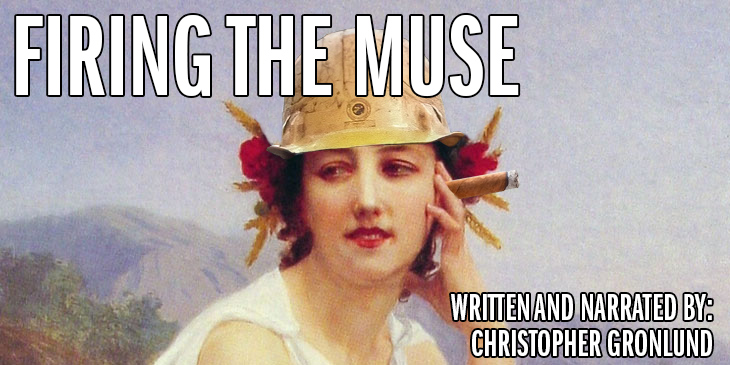
A classic painting of a female muse (head and shoulders). She is wearing a white robe. Behind her: trees and a mountain. Added to the image: a yellow hard hat rests on her head and a thick cigar is held between her fingers.

Text reads: Firing the Muse. Written and Narrated by: Christopher Gronlund.

When Warren Quinn trades his existing workaday muse for a more literary muse, he gets much more than he bargained for.

Content Advisory: “Firing the Muse” deals with stresses and job loss around creative work. There’s casual alcohol consumption and smoking—and a very brief allusion to combat PTSD. Unless you consider “dammit” swearing, this is the sixth Not About Lumberjacks story with no language advisory. (I can already tell you there won’t be a seventh.)

* * *

Credits:

Music: Theme – Ergo Phizmiz. Story – Jackie Martin, licensed through Epidemic Sound.

Story and Narration: Christopher Gronlund.

Episode Transcript >>

Podcast: Play in new window | Download

Subscribe: RSS
Filed Under: Episodes Tagged With: Fantasy, Firing the Muse, Humor, Literary

Firing the Muse – Transcript

July 16, 2023 by cpgronlund 1 Comment

[Listen]

[Sound of an ax chopping wood. Quirky music fades in…]

Christopher Gronlund:

I want to make one thing perfectly clear: this show is not about lumberjacks…

My name is Christopher Gronlund, and this is where I share my stories. Sometimes the stories contain truths, but most of the time, they’re made up. Sometimes the stories are funny—other times they’re serious. But you have my word about one thing: I will never—EVER—share a story about lumberjacks.

This time, it’s a light-hearted tale about a writer who trades in his long-time muse for another…to disastrous effect.

But first, the usual content advisory…

“Firing the Muse” deals with stresses and job loss around creative work. There’s casual alcohol consumption and smoking—and a very brief allusion to combat PTSD. Unless you consider “dammit” swearing, this is the sixth Not About Lumberjacks story with no language advisory. (I can already tell you there won’t be a seventh.)

To that point, the show is nearing its 50th full story episode in November. I have big plans for the annual anniversary show, including a giveaway.

All right, let’s get to work!

Firing the Muse

1957

The blank page in Warren Quinn’s trusty Olympia typewriter was ready for words that didn’t come. Like all the days before, he rose before the sun, made a pot of coffee, and sat down to write. The room normally echoed with the clattering of keystrokes and bars striking the typewriter’s platen, leaving behind the words of pulp stories read by millions. It was honest work, but it had become a task Warren no longer enjoyed.

He smelled the cigar smoke before a fireplug of a man in a hard hat materialized at his side.

“Mornin’ kid. What’s wrong?”

“Nothing, Butch.”

The pop-eyed man squinted and said, “Don’t gimme that—you’re normally typing away by the time I clock in. I told ya: no such thing as writer’s block, so get yer ass in. Not gonna happen if you mope around all morning on your keister.”

“I’m not blocked. I’m just…”

“Just what?” Butch said.

“Tired. I’m tired.”

“It’s early—you’re supposed to be tired. There are tired iron workers watching the sun rise over Manhattan right now. Tired women opening cleaners in the dark canyons of our streets. Tired people all over the city who would love to be sitting in front of a typewriter instead of doing what they’re doing.”

“Thank you for the reminder that everyone has it worse than me.”

“You’re welcome.”

“I was being sarcastic.”

“I know. I’m not gonna let ya wallow.” Warren’s muse sat on the edge of his desk.

“I’m sorry I’m sometimes hard on you, but when you get paid by the word, you’re losing money when those fingers aren’t moving.”

“That’s the problem,” Warren said. “I’m tired of always rushing. And before you say it, I know, I know—I’m lucky to have this job. Sometimes, though, I want to write something requiring a bit more thought. The city’s full of authors writing novels, and I’m up in this little apartment telling stories that don’t matter.”

Butch blew a cloud of smoke at the ceiling. “Don’t matter? Tell that to the guy who busted his balls ten hours in a factory for next to nothing—who sits down at the end of the day with a beer and reads something you wrote. That’s important to him. I’ve seen people on trains and buses reading your stories in magazines. Trust me, you don’t want to be one of those hoity-toity writers begging for attention because they don’t have what it takes. They only wish they had your chops!”

Warren sighed and said, “Things are changing, Butch. I’d be better off writing comic books.”

“Don’t talk like that, kid.”

“I’m not wrong. What happens when people move on from the kinds of things I write?”

“Ya deal with it then. But it’s no good worrying about tomorrow if it ruins today.”

* * *

1945

The War changed Warren. It didn’t traumatize him in the same way it did many of his brothers-in-arms he served with while beating back the Nazis. He came back home with a perspective on life he didn’t have going in. To return to the factory work he did before the war was accepting defeat. He made it through the hell of the European Theater—why not give his dream of writing a shot?

As a child, Warren spent more time with his nose in a book than playing in the streets with friends. His early attempts at writing stories impressed teachers enough that he saved his money selling newspapers and bought a leather-bound journal and a Waterman fountain pen. Each blank page was an invitation to pour out a piece of his imagination to be shared with others. He decided to become a writer on his 13th birthday.

When he was fifteen, two books changed everything for him: John Steinbeck’s, The Grapes of Wrath and The Big Sleep, by Raymond Chandler. Until finishing The Grapes of Wrath, Warren believed “serious” fiction was a hardboiled tale in Nick Carter Detective Magazine. A choice was laid before him: go the way of Steinbeck or follow Chandler’s path? He emulated both, until—eventually—the War had the final say. Warren’s gift to himself for surviving? An Olympia typewriter and six months’ rent on an apartment in Hell’s Kitchen. Unfortunately, the words did not come as easily as he hoped. One night in a fit of frustration, he pulled at his hair and said, “I can’t go back. I deserve this one little thing, dammit.”

Warren screamed when Butch appeared in a puff of cigar smoke at his side. Warren grabbed his pen and wielded it like a knife.

“You can stab me all you want, but it ain’t gonna do nothing,” the squat man in the hard hat said.

“Who are you? How did you get in here?”

“I’m Butch. I’m your muse.”

“What?”

“Be happy—not all writers get one.”

Warren slapped his face, and Butch said, “I’m real, kid.”

“I thought muses were beautiful women?”

“There’s a lot ya don’t know.”

“Then why don’t you tell me?”

Butch explained that anytime Warren needed help, all he had to do was call on him. He told Warren to think of him more as a partner than a boss. The words would belong to Warren; Butch would be his motivation.

“And what if I don’t like this?” Warren said.

“Then you can trade me. You only get to do that once, but we’re sure I’m the right muse for you.”

“Who’s ‘we?’”

“Gods? I don’t know, I’ve never seen them. One day I’m sitting in my place, and then FOOM, I’m in your apartment. I’m not even sure how it all works. But I can tell ya right now, you’re not gonna want to get rid of me, ‘cause we’re gonna get things done.”

And they did…

* * *

1957

Writing had lost its thrill. Where once, gritty detective stories and sensational tales of adventure stirred something inside Warren, the thought of sitting at his desk and going through the motions left him drained. Butch teased him when he moved out of Hell’s Kitchen and into Greenwich Village in the hope of reigniting his love for writing. With fewer places to publish Warren’s stories, he figured it was a way to double back on his earlier life decision and see what might have happened had he pursued Steinbeck’s way instead. To be less like Dent, Howard, and Hammett and more like Salinger, Ellison, and Cheever.

During a rough time when no publisher seemed interested in buying Warren’s short stories, he asked Butch what he thought about working on a novel.

“Why would you spend all that time on a chance, when you can write a pile of stories that make you money?”

“I’m not selling much, lately.”

“Dry spells happen. You’re a smart cookie and saved yer clams for hard times like I taught you. Give it a bit more time…”

* * *

On a particularly frustrating day when words and sales seemed lost for good, Warren called on Butch.

POOF!

“What’s up, kid?”

“I get one trade, right?”

“Huh?”

“In the beginning—the day you arrived. You said I can trade for another muse.”

Butch shook his head. “Don’t do this, kid. Not for my sake—for yours.”

“This is for my sake. My savings are dwindling. I don’t want to lose this place.”

“You were the one who wanted to move into fancier digs. You’d have a lot more money had you listened to me and stayed in the Kitchen.”

“Listening to you got me where I am right now.”

The burly muse narrowed his eyes and pointed a stubby finger at Warren “You’re not pinning this on me, kid. You were the one who chose what you thought was the easier route to making it as a writer. You were the one who looked at all your starts and stops and decided to write entertaining short stories and not risk it all on the challenge of a serious novel. I was assigned only because I was the best fit for what you wanted.”

Warren said, “Sometimes what we want in life changes.”

Butch threw up his hands. “All right, fine. I wish you’d reconsider, but rules is rules. I hope you find what you’re looking for, kid.”

With that, Butch disappeared. Eventually, even the lingering cloud of cigar smoke was gone.

* * *

The day after parting ways with Butch, Warren sat before his typewriter, waiting. In the back of his mind—and in his old journal—he’d pieced together a story about a writer struggling to make it in the city. Butch had told him the worst thing a writer can do is write about writers.

“People would rather read a book about a rusting fence than that!”

Warren finished his pot of coffee and went for a walk in the neighborhood to clear his head. When he returned home, words still didn’t come. He called out.

“Hello? Anybody here?”

Nothing.

“I’m supposed to have a new muse. Hello?”

Out of desperation, he was about to call for Butch when a lithe figure in a bathrobe materialized at the side of his desk.

“Are you my new muse?” Warren said.

The man rubbed his eyes with the palms of his hands and smacked his lips. “What time is it?”

Warren pointed to his watch. “Almost eleven. I’ve been up for hours.”

“We need to get you on a different schedule if this is going to work.”

Warren extended his hand. “I’m Warren.”

“And I am…aware of that.”

“I need a little help. Just to get started.”

Warren’s new muse yawned and said, “Give me a bit of time to get some coffee and wake up…”

* * *

Warren’s new muse finally returned around two-o’-clock. He told Warren his name was Cristano and that he only had an hour to help.

“Nabokov’s muse is in town, and some of us are meeting up for drinks.”

“You know Vladimir Nabokov?” Warren said.

“No, I didn’t say that.”

“But you know his muse?”

“I didn’t say that, either.”

Warren surveyed his new writing partner. Cristano was indistinguishable from the aspiring Beat writers Warren bumped into on the streets. Counter-culture by design, they were people who tried too hard being different, all in an effort to fit in.

“So, who do you know?” Warren said.

“It’s not about who you know, man. It’s about the scene.”

* * *

Cristano frequently went missing for days. At first, Warren wondered if it was part of his approach, to force him to find his own words and sense of pride. But when Cristano did appear, he offered no help or advice.

“Are you really a muse?” Warren said one afternoon.

“Did I not just appear before you from nothing?” Cristano said.

“I didn’t ask if you were magical—I asked if you’re a muse. Have you ever helped a writer actually finish anything?”

“I don’t have to tolerate this.”

POOF!

He was gone…

* * *

Two months into his floundering attempt at a novel, Warren spent the morning reading what little he’d finished. He could hear Butch: “Never read what you’re writing until you’re finished with a draft! Stop looking for an excuse to not write! Put yer backside in that chair and get typing!”

Looking at what he’d written, maybe Butch was right—maybe a writer writing about writers really was about as exciting as watching rust form. While fewer places were publishing what got him to where he was, with Butch’s guidance, he’d have at least written a small pile of stories and not seen his savings dry up.

He thought about spending the day writing a detective story—even thought about calling out for Butch and apologizing. Instead, he went looking for Cristano.

* * *

While Warren moved to Greenwich Village in the hope of becoming a more serious writer, his writing schedule and Butch ensured he rarely got out. His former muse was like a protective father when it came to the neighborhood.

“I’m not saying don’t go to any bars bars, kid, but they’re not gonna do ya any good.”

“I’ve never had a problem with drinking,” Warren said.

“I’m not saying you do—this has nothing to do with booze. It has everything to do with not needing those kinds of writers in your life.”

* * *

Warren had passed the White Horse Tavern many times, but never stopped in. He figured, if he was going to find Cristano anywhere, it was a good place to start.

Warren expected a more refined space—not an everyday establishment with a dozen stools at the bar and half a dozen tables packed into a small area and a tiny side room with a few more places to sit and talk. It lacked the regal standing of The Chelsea Hotel or the Algonquin Round Table, and perhaps that was its charm. A bar once claimed by longshoremen, now overrun by writers and artists.

Warren approached a table and said, “Excuse me, I’m looking for someone named Cristano. Do you know him?”

The resulting sneers told him that, even if they did, it was best to move on. Other tables yielded more side-looks or “No”s. Warren was about to give up when a man in the back of the side room waved him over.

He tried a bit too hard to fit in: an open flannel with perfectly rolled sleeves over a white t-shirt. Jeans and boots that looked like they’d never seen travel or a day of hard work.

“Heard you asking about Cristano Leventis,” he said.

“I don’t know his last name…”

“Tall, thin blond guy with a face that looks like a classical sculpture? Bit of curl in his hair and piercing eyes? Arrogant as hell?”

“That sounds like him.”

“You’re a writer then?”

“Yes, how do you know?”

He pushed a chair out with his foot. “Take a load off…”

* * *

The man in the flannel took a sip of whiskey and lit a cigarette before reaching across the table.

“Name’s Paul.”

Warren shook his hand and told him his name.

“So,” Paul said. “You’re Cristano’s new writer?”

Warren nodded. “I take it you’re Cristano’s old writer?”

“I’ve not put anything in my belly today but whiskey—so, yep! Lemme guess, you’ve not seen him for days. When you do, he always has an excuse about why he can’t help out. And you’re left sitting there—not writing a word—wondering what you did to deserve him?”

“Yes.”

“Trade him.”

“Huh?”

“Trade him for another muse.”

Warren said, “I already did a trade. He was the replacement.”

“Oh. What were you writing before?”

“Detective and adventure stories for magazines. I wanted to write something more serious.”

Paul laughed and said, “I suppose it could be worse. I was writing plays, but wanted to become a novelist because I imagined more fame. Now, look at me. You have two choices as I see it: deal with Cristano and all his baggage…or fire him.”

“You can do that?”

“The whole thing’s weird, man. You can trade them once. After that, you’re stuck with them or have to quit.”

Warren looked around the room, wondering how many others in the space had suffered the same fate. After considering Paul’s words, he said, “Have you heard about anyone rehiring their old muse?”

“Nope. I mentioned that to Cristano before I canned him. He said once a muse is reassigned, that’s that. Your old muse is probably sitting with another writer right now, working away. You’re better off getting a regular job than suffering with Cristano the rest of your life.”

* * *

Warren grew determined to make his collaborative alliance with Cristano prosper. He ignored all slights in the month that followed, giving the muse’s never-ending parade of excuses the benefit of the doubt.

Each time, Cristano got worse.

 A month later, during a particularly flippant visit from Cristano, Warren finally lost his temper.

“Do you even know how to write?! You’ve given me nothing the whole time I’ve known you.”

“How dare you!” Cristano said. “Of course I know how to write.”

“Good. Then help me!”

“Not if you’re going to be like this!”

Cristano disappeared in a sudden POOF!

Warren brought a fist down on the top of his desk, causing his pen to roll off his old journal. He picked it up and looked at the nib.

When he finally calmed down, he devised a plan…

* * *

Warren spent the following three afternoons at his desk, pen in hand over his journal, waiting. When Cristano finally appeared at his side, Warren scribbled in the book.

“What are you writing?” Cristano said.

“A story. Without you.”

“You’re not supposed to do that,” the muse said.

“I wouldn’t if you did your job.”

Cristano tried peeking at the page, but Warren blocked the view with his shoulder.

“Is it a detective story? Like you used to write?”

“No, it’s a serious story,” Warren said. “The kind you’re supposed to help me write.”

“Let me see.”

“No.”

“I’m your muse. I demand to see.”

Warren sighed and said, “Okay…”

He moved his shoulder, giving Cristano a view of the page. When the muse bent over for a closer look, Warren drove his Waterman pen into Cristano’s neck.

Cristano took a step back and raised to his full height. His mouth formed a surprised O. Half the pen was lodged deep in his throat. It rocked up and down as he swallowed.

He met Warren’s eyes and tilted his head. Then, he reached up, calmly extracted the pen, and handed it back to Warren.

“What the hell was that?” Cristano said.

“Uhm…”

“Uhm, what? Did you think that would work?”

“I figured it was worth a shot.”

“And if it did work,” Cristano said. “What then?”

“I’ve written piles of detective stories. I had a few plans to get rid of you based on what happened.”

“What?!”

“I wasn’t sure if you’d disappear or die like a human. Or something else.”

“You actually believed you could kill me?  Why would you do such a thing?”

“You’re never around. We’re getting nothing done.”

Cristano shook his head. “It may look like I’m doing nothing, but I’m meeting people. That’s how it’s done. You hole up in this room all day and night thinking what you write matters? If you want to be a known writer, you have to be known for more than just your writing.”

“That’s what writers who don’t know how to write do,” Warren said. “I asked you before: do you even know how to write? And don’t disappear this time!”

“Of course I know how to write. I’m a muse, aren’t I?”

“Tell me something you’ve written.”

“You wouldn’t know it.”

“Try me!”

“This is ridiculous. I don’t have to stand for this.”

“Neither do I,” Warren said. “You’re fired.”

“What?!”

“I don’t know if there’s any special thing we have to do, but I’m done with you.”

“You can’t do this.”

“Why not?” Warren said.

“If you get rid of me, you’ll never write again.”

“That’s preferable to dealing with you.”

Cristano’s temperament changed. “Please reconsider. Please?”

“No! Why would I?”

“To help me. They said this was my last assignment.”

“Who’s ‘they’?” Warren said.

“Gods? I don’t know, I’ve never seen them.”

“What will they do to you?”

“I don’t know—make me work?”

Warren considered stabbing Cristano in the throat again, knowing it would do no harm, but feel so good. Instead, he said, “What a horrible thing to do to you—make you work.”

“You agree?”

“No! Of course I don’t agree.” He thought about what Butch would do, and said, “The effort you put into not working is greater than most people put into work. Get out of here.”

“Please!”

“I said leave.” Warren poked Cristano in the forehead, and he disappeared for the final time.

* * *

Warren thought about work often in the month that followed the firing of Cristano. After the War, he’d moved on from factory work by working harder than ever at writing. Now, he’d returned to where he started: back in Hell’s Kitchen, toiling through his days for a loud boss on a factory floor. He consoled himself by thinking how the time for writers like him was nearing an end. Publishing was changing, and he was destined to be left behind, despite his best efforts. He’d at least done more than most who set out to make a living with words, and had a shelf in his tiny apartment to always remember those days.

Another month of trying to convince himself he was okay with how things turned out wasn’t working. He thought about ways to get close to publishing again, even if it was working for a print house instead of writing the words to be printed. Maybe a maintenance job in a publishing house, where he could talk with an editor and let them know he was more than just a person to call on when light bulbs needed changing. He even considered becoming a merchant marine, just to get away from it all and later write about his travels.

One payday, too tired to go home and cook, Warren treated himself to dinner at his favorite neighborhood diner. As he waited for his pork chops, he smelled cigar smoke and heard a familiar voice.

“Well, who do we have, here?”

The squat man set his hard hat on the table and slid into the booth across from Warren.

“Butch!”

“The one and only. Howya doin’, kid?”

“Not so good.”

“What’s up?”

“I should have listened to you,” Warren said.

“Things didn’t work out, huh?”

“No. I’m sorry.”

“For what?”

“For trading you.”

“Don’t worry about that,” Butch said. “You did what you thought you had to do, and I’m proud of your moxie.”

“That does me no good, now. They assigned me a new muse who did nothing. I fired him.”

“You did?”

“Yes. He was never around. I don’t know if he even knew how to write.”

“Maybe. We have some charmers among our lot.”

“I tried killing him, Butch.”

“You what?!”

“I stabbed him in the neck with my pen—”

Butch howled with laughter. When he finally dried his eyes, he said, “Oh, kid…you’re the best!”

“Thanks,” Warren looked around the diner.

Butch said, “If you’re wondering if they’re looking at me for laughing, they aren’t. You look like a crazy guy in a booth talking to himself as far as they’re concerned.”

Warren lowered his head and voice. “It’s good seeing you again.”

“Good seeing you.”

“So, what’s your new writer like?” Warren said.

“Huh?”

“Your new writer.”

“Oh! I didn’t take a new assignment.”

“You quit?”

“No! Why would I do that? I finally took a vacation. Been ages. Literally.”

“Where’d you go?”

“We have an island in Greece all to ourselves. Gave me plenty of time to think.”

“About what?” Warren said.

“You.”

“What about me?”

“I figured things might not work out for you and my replacement, so I didn’t take on a new writer. Guys like me aren’t in great demand these days, so it’s not like nobody was beating down my door.”

“What does that mean for me?”

“It means I’m gonna ride your ass harder than ever for thinking you could trade me away, but I’m not gonna hold a grudge.”

“You’re my muse again?”

“Kid, I never left—you did. You needed to figure some things out. We both needed time to think. But yeah, we’re a team again. And you’re right: things are changing. I should have listened to you more instead of being so stubborn. I’m sorry I didn’t see that.”

“It’s okay,” Warren said. “I think we were both too set in our ways.”

Butch knocked on his head and said, “So hardheaded, I really don’t need that hat!”

People at nearby tables watched Warren laugh to himself. When he stopped, he said, “I’ve been thinking about where things might go. I’ve been thinking about writing spy novels.”

“That’s a good idea,” Butch said. “But is it what you really want?”

“No,” Warren said, “but there are worse ways to spend a day.”

“True. But I think I figured out a way for us to both be happy,” Butch said. “I think there’s a damn good market coming for your ‘serious’ stories…but not stories like all the others everyone’s writing, now. Serious stories about people like us. Everyman stories.

“Instead of stories that let people escape into lives they can only dream about, or writing about rich people and their problems, why not show people they aren’t forgotten? I think the future’s gonna become busier than we can imagine, and stories are gonna become more important than ever. I think that’s our new place. Sound good?”

“Sounds great!” Warren said.

“Good…good. All right, I’m gonna let ya eat your dinner in peace and enjoy the weekend. ‘Cause Monday morning when the sun comes up, I want to see your keister in that chair ready to work harder than ever. We got a whole new world ahead of us, kid…”

* * *

[Quirky music fades in…]

Christopher Gronlund:

Thank you for listening to Not About Lumberjacks.

Theme music, as always, is by Ergo Phizmiz. Story music was by Jackie Martin, licensed through Epidemic Sound.

Sound effects are made in-house or from Epidemic Sound and freesound.org. Visit nolumberjacks.com for information about the show, the voice talent, and the music. Also, for as little as a dollar a month, you can support the show at patreon.com/cgronlund.

Next time, the residents of a trailer park battle a developer and city to save their homes from being bulldozed to make way for a golf course.

[Quirky music fades out…]

[The sound of an axe chopping.]

Until next time: be mighty, and keep your axes sharp!

Filed Under: Transcript

Behind the Cut – The Song of the Stone

June 3, 2023 by cpgronlund 1 Comment

Left side of image: A cross-cut section of a tree stump against green grass. Text reads: "Behind the Cut - The Not About Lumberjacks Companion"

Right side of image: A large stone in a forest. Text reads: "The Song of the Stone - Commentary by: Christopher Gronlund."

In this behind-the-scenes look at the latest Not About Lumberjacks story, I talk about the audiences I imagine when I write — and how the struggle to live a life true to oneself is not a new concept.

Episode Transcript >>

Podcast: Play in new window | Download

Subscribe: RSS
Filed Under: Behind the Cut, Episodes

The Song of the Stone – BtC Transcript

June 3, 2023 by cpgronlund Leave a Comment

[Listen]

[Intro music plays]

[Woman’s Voice]

This is Behind the Cut with Christopher Gronlund. The companion show to Not About Lumberjacks.

[Music fades out]

Christopher Gronlund:

Behind the Cut is an in-depth look at the latest episode of Not About Lumberjacks and likely contains spoilers of the most recent story. You’ve been warned…

* * *

I was six years old when, during a weekend visit with my dad and his family, I was told my purpose in life was to carry on the family name.

It wasn’t said in those exact words, but that was the message.

It was a strange demand; after all, my father was creeping toward his mid-30s and still fertile. In fact, he did go on to remarry and have another child—a girl. But had my younger sister been a boy, and had I bought into the position of importance bestowed upon me by the Gronlund men who came before me, I would have been dethroned at the age of 10.

Just beginning life, but with no purpose.

* * *

Obviously, I don’t believe any of that…but I know people who would in that situation. Growing up, I saw many friends and acquaintances living lives chosen for them by others at a young age. Maybe it was the result of a dad lost in the glory days of his youth who ends up screaming at coaches at youth sporting events because—unlike him—his kid is destined for the big leagues.

Maybe it was an overbearing father pressuring his kids to succeed in business just as he had, even though the only thing going for him was money…if that’s your measure of success.

I’ve seen many people with lofty dreams told by those entrusted with their well-being to give them up and do what they deemed was best for them.

And, other times…I’ve seen people stick to their dreams and tell even family they no longer wanted them in their lives.

* * *

I wasn’t sure how the latest Not About Lumberjacks story, “The Song of the Stone,” would be received. I know first-hand how deciding to not have children can be seen by some…even though I would expect no one to do the same. Even more: creating a character who disowns family can be seen as extreme and wrong. (It’s always amazed me how quickly people can dispel the lifetime of abuse some faced with, “Your parents were only doing their best,” when they really weren’t.)

All these elements are part of a greater theme in the latest story: being true to yourself…living a life that, when your end comes, you don’t regret “what might have been…”

That aspect of “The Song of the Stone” seems to have resonated with listeners and readers, and I’m glad.

I often have a person or audience in mind when I write a story. If it’s a humorous story, I think about the friends I laugh with and know if they’d laugh at a scene, others will as well. Sometimes it’s not as specific—sometimes it might be as simple as, “I want to lift the spirits of someone feeling a bit down by the end of this story…”

With “The Song of the Stone,” I deliberately wrote a story for child-free people…and those who have stepped away from overbearing—even abusive—families.

* * *

Of course, when you write a story with such purpose, some might assume the actions of the characters are also those of the writer. It’s a fair point…there are some things I pulled from in my own life that made it into this tale.

  • I was told at a young age that my duty was to carry on the family name.
  • My wife and I were told by someone at a family reunion that we would have children…”just wait and see—you will!” (And, at another family reunion, told we clearly wanted kids because of the way we were “longingly” looking at a kid—when in reality, we were trying to determine if her face was smeared with dirt, chocolate, or feces.)
  • And I did step away from most of my father’s side of the family because they were largely a bunch of bitter racists. (I believe if one won’t tolerate certain behaviors from a stranger, why accept them from family?)

But my story is not Zander’s story.

  • Zander doesn’t want to marry…and I’m a month shy from 31 years with my wife.
  • Zander did what his parents expected from him. My parents made no demands on me…I was allowed—even encouraged—to pursue my wildest dreams.
  • Zander is so into solitude that he’s fine not having any friends. While I might be the most reclusive extrovert on the planet, I love my friends like family and enjoy time spent in their company.

I simply wanted to write a story for people like Zander because there aren’t many stories written for people like him. And I know, given history, there were no stories written for people like Einvaldr, who struggled with many of the same things people still deal with eleven-hundred-years later.

With “The Song of the Stone,”  I wanted to write a story that says, “There’s nothing wrong with you or the different things you want from life.”

* * *

For all the smaller themes in the story, it’s clear the big one is about living a life free of regret. (Specifically, not living the life others demanding of you.)

There’s a song called “Sweat Loaf” by the Butthole Surfers that…well, I’m not recommending you go listen to it, but there’s a good line about regret in it. A son asks his father what regret means.

The father answers: “Well, son, a funny thing about regret is that it’s better to regret something you have done than to regret something you haven’t done.”

In the context of the band, one could easily make an argument that it’s an endorsement of hedonism, but as a writer, I understand people sometimes see different things than the author’s intent—and that’s valid.

I always saw the line as saying, “At least try doing something”—that regretting a mistake is better than regretting not doing anything at all with your life.

* * *

I recently turned 54, and I can tell you there are things in my life I wish I’d done differently. But…it’s not regret.

No one lives a life free of mistakes. We all make poor decisions along the way and shouldn’t be made to carry them the rest of our days. I believe, if you’re a good person and do what you can to honor some of your truths, that you’re living well.

Your life may look like a wreck to others—and it very well might be—but if you’re living a life true to who you are, you’re doing better on some level than most people.

The line in the story: “I wish I’d had the courage to live a life true to myself, not the life others expected of me,” really is from an essay and book from a palliative care nurse named Bronnie Ware.

In the end, for all one might have accomplished, that is the most common regret she heard from dying people. And it’s no surprise—the people I know who carry the deepest regrets often came from judgmental households. They are often the people who lived the lives others expected of them, never even trying the things they always wanted to do.

* * *

Of course, many things are easier said than done.

I have a good job, but it is not the job I hoped to be doing when I was 20. Yet I’ve still found a way to be true to myself with this show. In ways, its lack of greater “success” only strengthens that truth. I keep making Not About Lumberjacks because I’ve always wanted to write and share stories with others.

I think the important thing is to not confuse one’s truth with an imaginary ideal.

When I was 20, I was naïve enough to believe the two were the same. Because I wanted to be a successful writer, anything less than that wouldn’t do. But I was still a realist: I believed I’d be comfortably supporting myself writing fiction by the time I was forty. (I gave myself 20 years to get there.)

That didn’t happen.

I can be sad about that, or…I can look at the body of work behind me—and know there’s still so much more to be written.

I know more than a few people who very well might have gone further with their writing than me but gave up because they didn’t get into a certain program or have a blockbuster debut. The imagined ideal mattered more than their truth. They were raised to believe if they didn’t succeed in a big way, that they failed.

In “The Song of the Stone,” Eivaldr still spent much of his life in Birka because most of us are bound by realities beyond our control. Zander lives in a time allowing more freedoms, but still doesn’t end up as a history teacher. And yet, each character found a way to make the things they loved their truths…because they refused to live the life others expected them to live.

I’m not the writer I believed I’d be when I was 20, but I’m not sure I’d be as true to myself had that been what I became.

* * *

Thank you for listening to Not About Lumberjacks and Behind the Cut. Theme music for Behind the Cut is a tune called “Reaper” by Razen. Visit nolumberjacks.com for information about the music, the episodes, and voice talent.

Also, for as little as a dollar a month, you can have access to a bigger behind-the-scenes look at Not About Lumberjacks on Patreon. Check out patreon.com/cgronlund if that sounds like your kinda thing.

In July, it’s a light-hearted tale about a writer who trades in his long-time muse for another…to disastrous effect.

Until next time: be mighty, and keep your axes sharp!

Filed Under: Transcript

The Song of the Stone

May 23, 2023 by cpgronlund 3 Comments

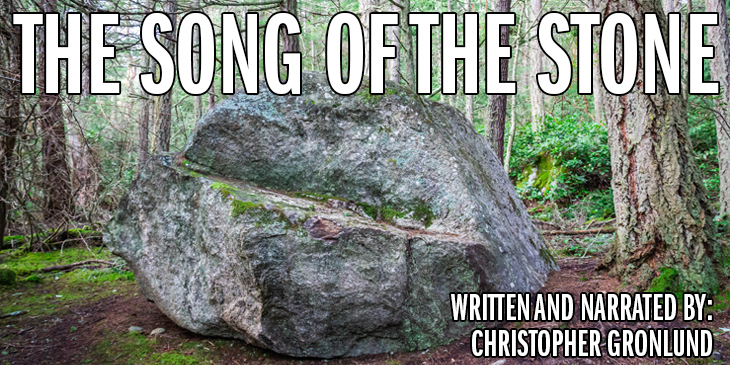
Image of a gray, lichen-covered stone in a forest. Text reads: "The Song of the Stone. Written and Narrated by Christopher Gronlund."

Zander Pierson’s dissatisfaction with living the life others expected from him leads to a stone in a Swedish forest that also called to Einvaldr Brúnn at a turning point in his life in the early 860s.

Content Advisory: “The Song of the Stone” deals with lack of job and life satisfaction, pressure to marry and have children, career pressure, and death from illness.

A Thank You and Some Links…

A mighty thank you to Miro Karjalainen, aka Three Star Vagabond, for answering some questions about Stockholm and Birka. If there are any inaccuracies in the story, they are all on me.

Miro is my favorite travel vlogger. Each week, he documents his travels around Stockholm, the rest of Sweden, and the world. It’s an impressive one-person operation, full of great places, history, and humor.

Miro also has a second YouTube channel called This is Geeky! in which he knocks around documenting geeky things. Of course, I love that channel as well.

So, check out what he’s up to at either link above, or swing by his Three Star Vagabond Facebook group.

And here’s Miro’s Birka video, which came in handy for this story!

* * *

I hint at a couple YouTube channels in this story. If you’re curious who inspired the lines, here you go:

Roaming Wild Rosie – A thru-hiking designer who stepped away from the hurried pace of life in London and bought a cabin in the Swedish woods. Most Sundays, she chronicles her efforts restoring her home and tending to her little plot of land. I can’t tell you how much I love the commentary in this particular video.

Lowkey Swedish – Ally and Hamish are the “adorable couple from New Zealand,” mentioned in the story. Like the others mentioned above, each Sunday they share their restoration progress on their cabin in the woods not too far from Stockholm.

It’s already hit 97F / 36C in Texas this spring, so I’m sure I’ll revisit their snowed-in video as it gets even hotter in Texas.

* * *

Credits:

Music: Theme – Ergo Phizmiz. Story – Licensed through Epidemic Sound.

Story and Narration: Christopher Gronlund.

Episode Transcript >>

Podcast: Play in new window | Download

Subscribe: RSS
Filed Under: Episodes Tagged With: Literary, The Song of the Stone

The Song of the Stone – Transcript

May 23, 2023 by cpgronlund 1 Comment

[Listen]

[Sound of an ax chopping wood. Quirky music fades in…]

Christopher Gronlund:

I want to make one thing perfectly clear: this show is not about lumberjacks…

My name is Christopher Gronlund, and this is where I share my stories. Sometimes the stories contain truths, but most of the time, they’re made up. Sometimes the stories are funny—other times they’re serious. But you have my word about one thing: I will never—EVER—share a story about lumberjacks.

This time, it’s a story about a person’s dissatisfaction with living the life others expected from him leading to a stone in a Swedish forest that also called to someone else during a turning point in his life in the early 860s. Not 1860’s…860s.

But first, the usual content advisory…

“The Song of the Stone” deals with lack of job and life satisfaction, pressure to marry and have children, career pressure, and death from illness.

Before we begin, A mighty thank you to Miro Karjalainen, aka Three Star Vagabond, for answering some questions about Stockholm and Birka. If there are any inaccuracies in the story, they are all on me.

Miro is my favorite travel vlogger. Each week, he documents his travels around Stockholm, the rest of Sweden, and the world. It’s an impressive one-person operation, full of great places, history, and humor.

Miro also has a second YouTube channel called This is Geeky! in which he knocks around documenting geeky things. Of course, I love that channel as well.

So, check out what he’s up to at either link above, or swing by his Three Star Vagabond Facebook group.

Also, I hint at a couple YouTube channels in this story. If you’re curious who inspired those lines, here you go:

Roaming Wild Rosie – A thru-hiking designer who stepped away from the hurried pace of life in London and bought a cabin in the Swedish woods. Most Sundays, she chronicles her efforts restoring her home and tending to her little plot of land. I can’t tell you how much I love the commentary in her video about being a hermit.

Lowkey Swedish – Ally and Hamish are the “adorable couple from New Zealand,” mentioned in the story. Like the others mentioned above, each Sunday they share their restoration progress on their cabin in the woods not too far from Stockholm.

It’s already hit 97F / 36C in Texas this spring, so I’m sure I’ll revisit their snowed-in video as it gets even hotter in Texas.

Links to everyone and everything I just mentioned are in the show notes.

All right, let’s get to work!

The Song of the Stone

It was always about more than just my job, but I didn’t realize that until I found the stone. One day we’re told we can be anything we want, but as we get older, we’re told those dreams aren’t “responsible.”

I’m sure there are six-year-olds who decide they want to be an accountant from the start, but growing up, all my friends wanted to be artists or writers or in bands. They wanted to make movies or explore the world. Now, they spend their days in cubicles or tucked away in home offices, never feeling able to fully step away from their work. But chat with them—maybe even loosen them up with a drink or three—and many admit they wonder what their lives would be like today had they been more true to themselves and not those who raised them.

Me? I wanted to be a history teacher, but my parents wouldn’t hear it.

“It’s a noble profession,” my father said, “but it won’t provide the life of a doctor or lawyer. At least consider business.”

The saddest thing about that day? Me saying, “I was raised to believe I could be anything,” and my mother looking at me and replying, “You should listen to your father.”

And that’s what I did.

I moved from my hometown of Olathe to Lawrence, where I enrolled in the University of Kansas School of Business. If nothing else, I was out of the house.

After I got my MBA, though, I was back home, working as a business analyst where my dad worked in Kansas City.

That’s when Crisis Number One hit…

* * *

I know I wasn’t the first 26-year-old to be burned out at work and feeling some degree of guilt about such a seemingly fortunate problem to have. My grandparents were married and had several kids by 26, and they sucked it up—so what was my problem? But why should a person compare themselves to others, and be made to suffer, when that’s not who they are?

I later found out from my mom that her parents were miserable together. My grandfather cheated on my grandmother for years, and she eventually had more than just a clinical relationship with the family doctor. My dad’s side of the family at least didn’t try keeping things together in an effort to appear happy. My grandfather had the typical mid-life crisis, dumping my grandmother for someone younger who eventually dumped him.

My grandmother, on the other hand, rolled with it and started living for herself instead of to the expectations of others—and today she’s one of the happiest people I know. She doesn’t regret having children, but there’s a spark in her eye when I say I don’t want that.

For as long as I can remember, I’ve been told it is up to me to continue my family line. That’s a ridiculous weight to place on the shoulders of a six-year-old, but that’s how old I was when I first recall my family telling me—the last male in our family branch—that I was essentially here for one thing: to carry on the Pierson name. I have considered my aversion to being a father might be linked to that. Were my feelings just me pushing back against my dad, his father, and aunts and uncles telling me memories of them would die unless I sired at least one male child myself? Like we were royalty or something?

But it’s not that: I just like solitude. I’ve never dreamed of having a relationship with someone, let alone a marriage. I’ve been told by family, and even some people I barely know, that I’m greedy for being this way. I think it’s more greedy, however, to have children because it’s what’s expected of us. I’ve been told I can’t know what I’m missing until I hold my own child in my arms and look in its eyes, but I have many friends whose parents did that and then put on them all their regrets and failures and expected them to carry those hopes and dreams—even if they did not share them—to some imaginary end. The world is full of neglected children, many from some of the wealthiest neighborhoods that exist.

Yet I’m somehow the broken one rolling in a puddle of greed for not producing the children I don’t want, just so someone can say, “See? I told you so!”

I’ll admit, my solution to Crisis Number One might have been a bit extreme, but I made the decision on my 26th birthday to leave Kansas. I’d been thinking about getting my own place in Kansas City, but it was apparent I needed even more distance from home. Somehow, the conversation during my birthday dinner turned to talk about when I was going to settle down and give my parents grandchildren. I zoned out, but I remember my dad saying something about leaving behind a legacy and my mom asking me who will care for me when I get older.

It was my friggin’ birthday, and that was my gift? I looked at my mom and told her: “If I had kids, I’d not have them to take care of me. We shouldn’t be talking about my inevitable death on my birthday, but since we are, I’m fine walking into the woods and dying when it’s my time. And legacy, Dad? Who’s your great-great grandfather?”

He couldn’t name him.

“That’s legacy, Dad: forgotten in a few generations.”

“I’m here because of him, though,” my father said.

“Yes, you are, and honoring his legacy by working a job I know you can’t actually enjoy—and badgering your son on his birthday, despite knowing my feelings about all this.”

I’d done what I was supposed to do: I got an MBA and a good job, but it still wasn’t enough.

I knew the longer I stayed in Kansas that things would only get worse.

I wondered what another life entirely might be like…

* * *

AD 857

Einvaldr wondered what his life might be like had he stayed on the farm. It’s not that he lacked interest in the bustling trade city of Birka, with its people from distant places converging on the island to peddle and purchase wares, but it was the life his father wanted—not him. Einvaldr preferred the quiet pace of farm life, tending to the land and sheep, instead of the din and throng surrounding him. That didn’t stop his father from trying to convince him they shared a dream.

“Do you agree this is a good life, my son?”

The two huddled around the hearth in the center of their small shelter and shop.

“It is, father. But it is not the life I imagined.”

“What do you not like about it?”

“This building is small, and the village is crowded.”

“This building is warm and a reminder of our family’s work. This city is our connection to the world.”

Einvaldr looked at the piles of fabric making their already tight dwelling even more claustrophobic.

“I am proud of our work and do not mind coming here to sell it. I do not like living here, though.”

At first, Birka was not without its excitement. Einvaldr was content to sleep beneath their stand when the weather was pleasant, and moods were bright. When they settled into a permanent space—staying even through winter—the novelty quickly faded. Einvaldr only saw home when his father sent him back to the farm to retrieve more fabric.

“That we can survive, here, is a testament to our way of life,” his father said.

“My way of life is not here.”

“Your beard is still short. You will one day see the opportunities before us as I do.”

Einvaldr’s father stood and retrieved a piece of silk from a nearby stack of fabric.

“I will put our family’s work against any local, but it is not like this. Do you not want to travel east to see how this is made?”

Einvaldr drew his cloak around his body. “That will not keep you warm during winter.”

His father settled back beside the small fire. “I have given you a better life than mine. Your children will have a better life than you. One day, you will realize this.”

Einvaldr stared at the flames and said, “I had a better life on the farm.”

* * *

Crisis Number Two was on me.

I left Kansas for a corporate training position in Portland. It wasn’t teaching history, but it was teaching. I quickly realized how easy it is to convince yourself that doing something similar to a dream is the same as living the dream, but it didn’t last long. What I was doing in Portland was not much better than analyzing data back home in Kansas. Training people how to use proprietary software is not the same as teaching people something you love—it’s just a job like any other if your heart’s not into it.

I had aspirations to get outside with my move to the Pacific Northwest, to soak in the landscape—maybe become one of those people who forages for mushrooms and knows hidden places even most locals don’t know exist. But I spent most of my time in Globotek’s Pacific Northwest office, or in my studio apartment, exhausted. While I was free from the pressure of family, I was not free from its effects.

The problem with running from something is that you’re running. Instead of holding my ground when others demanded things from me, I gave in because it was easier than confrontation and feeling like the bad guy. Once you establish that as normal, though, you are—in essence—giving others permission to continue doing things in your life you do not like.

I once read an article written by a palliative care nurse—about the regrets people have at the end of their lives. I figured wishing they had worked less would be the number one misgiving, but it was number two. The number one regret of the dying? “I wish I’d had the courage to live a life true to myself, not the life others expected of me.”

At least I was in good company.

I was on the cusp of another full-blown crisis just three months into my move when my boss asked me to come into her office. I hoped it was a layoff. I’m not sure what I would have done, but I was able to save much of what I made and knew I’d be fine. Worst case: I’d have a little bit of time to get out and see things I moved to experience before finding another job. But instead of saying, “We’ve unfortunately made the difficult decision that we have to let some people go,” she said, “How would you like to spend a year in our Stockholm office?”

* * *

Stockholm was nothing like Kansas City, or even Portland. If I had to compare it to other places, I’d say it’s like a cross between Paris and Vienna, with a lot more water and bridges. But that’s not fair—it is a city all its own, where Baroque masterpieces stand beside minimalistic works of art. A city that built its streets around walking and cycling. Despite breaking each morning for fika and eating pastries with coffee, it took little time to lose the bit of extra weight I hoped to shed hiking in the forests of Oregon. It was every beautiful thing about other wonderful cities in one place.

My work life was much different as well. I never quite figured out why I was needed, other than my manager wanted a native English speaker to create training content for some clients, even though my coworkers spoke better English than many native speakers I knew back home. When we worked, we worked with focus, but when the day was done, we stepped away. I wasn’t expected to answer email on my phone after hours or work on weekends. I never realized until then how even on my best day in the states, I still carried the hum of low-grade stress with me everywhere I went. When you factor in how stringent my parents were about school and sports growing up, I found myself with time to myself for the first time in my life. That’s when I discovered a new problem: I had no idea what to do with that time.

I mentioned my predicament to my manager, Nora. She suggested I get a hobby. I told her I enjoyed hiking, and she said, “That is a part of life. You need something to focus on.”

I said, “I enjoy history and reading.”

“That is also part of life.”

* * *

Another thing I discovered about Sweden is your work friends are your friends at work, but it’s up to you to find friends outside the office. It’s not like in the states where work friends are often personal friends; in part, because we never seem to stop working in the U.S. I suppose that’s why Nora suggested I find a hobby—so I’d at least have friends at a club for whatever I decided to focus on. But I preferred being alone.

I was content to wander Stockholm, so there was no reason to take up something new. The history of the area, and the city’s myriad museums and parks, meant I always had something to do. When the novelty of living in a new place faded, I rented an Aimo carshare one weekend and explored outside the city.

Of course, I still focused on history—opting to visit the ancient trading outpost of Birka west of Stockholm. It was a simple plan: visit Birka early, and then drive around and see what else was out there.

I was surprised how quickly the city gave way to suburbs, and then suburbs turning into country. The urban sprawl of the U.S. was so normal that I never gave much thought to how far you have to drive before things feel even a little open. A ferry ride got me to the Lindby jetty, where I parked and hopped a final boat to the island of Björkö.

The recreated Viking village reminded me of the Western villages I visited as a kid in Kansas and Missouri: everything was meant to appear authentic—and perhaps it was. At least there were no Viking battles in the streets like the mock shootouts back home. The museum was everything I craved, full of weapons, jewelry, clothing, and dioramas. After that, I wandered down to the water, where I saw a handful of replica boats on either side of a small pier. It was easy to imagine what the island and city must have been like then, with its tightly packed structures and throngs of people living along the banks of Lake Mälaren.

While it seemed most people’s favorite part of the visit was the overlook at the Cross of Saint Ansgar atop a stony hill, I preferred wandering the rest of the island. The trail meandered around so many burial mounds that I lost count of how many people were buried there. Sheep and cows lazed about in the shade of trees, and I was surprised to see fields and small farmhouses. I found a trail cutting through a small cluster of trees, giving me my first taste of Swedish forests. On a rise on the south side of the island, I wondered what it must have been like looking out across the water and the trees beyond. Or living there and looking across to Birka.

* * *

AD 862

No matter how low Einvaldr felt, returning home to the farm for stock and supplies always brightened his spirits. The family home sat on a slight hill overlooking a pasture full of sheep. Behind it all, trees scraped the sky. Their farm was humble, but a sprawling estate compared to the tight quarters in Birka.

It was Einvaldr’s first visit home since the death of his grandfather the previous spring. He had argued that his mother, uncle, and aunt needed him on the farm, but his father had final say. As he approached home, he considered anything he missed back in Birka. He liked being closer to the water, but not at the price he and his father paid. There was nothing else he liked about the place. All that mattered at the moment, though, was he had a few days at home before his uncle would help him drive a cart full of fabric back to a waiting boat Einvaldr would struggle to row back to Birka.

After their bellies were full of dinner, Einvaldr’s mother asked how his father was doing.

“He is father,” he said. “He should be here as well.”

“He is doing what he feels must be done,” his mother said. “I love your father, but I do not miss him. I miss you, however.”

“And I miss you. All of you. And home.”

“There are many years before you,” Einvaldr’s uncle said. “Give it time.”

“Time is one of the things I do not like about Birka,” Einvaldr said. “Here, time passes slowly. A year is measured on the land. There, it all runs together. We are losing our fascination with slower things. Now, it’s all about trade routes and goods. Birka is a place of desperation.”

Einvaldr’s uncle laughed and said, “You have always been wiser than your years. Do not worry—your day will come.”

* * *

Einvaldr fell immediately back into the routine of the farm. He rose early and helped his uncle tend to their cart. He cleaned up around the house, giving his mother and aunt time to ensure the fabrics they had woven were ready for market. He sat on the hill watching the sheep graze in the pasture stretching before him. Birka was not without its open spaces outside the village, but Einvaldr’s father kept him tethered to their small shop.

In the afternoon, Einvaldr returned to the lake the check on their boat. Perhaps the thing he disliked most about Birka was absorbing his father’s fear that if things were not watched, they would be taken. He never had such a concern on the farm.

After confirming the boat was secure, Einvaldr walked along the edge of the lake, eventually spotting a large stone through the trees. He made his way into the forest and climbed atop it. There was something about the way time had worn it down that cradled Einvaldr’s frame in all the right places. His stresses seemed drawn from his body and into the chunk of granite. Across the water, he could see the better side of the island of Bierkø. Birka lay out of view—from his vantage point, one would never know there was a city on the far side of the island, were it not for the occasional ship on the water or tales of the port.

It was a luxury for Einvaldr to lose track of time; he only realized how long he’d been sitting on the stone as the shadows of the day grew longer.

He couldn’t explain what it was about the spot he’d found, but he had never felt such a connection to a place.

* * *

I wanted to see what was south of Birka, so I doubled back after leaving the island. A couple ferry rides got me to where I wanted to go.

It’s funny how places far from each other can seem familiar. You could just as easily film a movie set in old England near Birka as you could a Viking saga. And when I lost myself among the pines, fields, and cabins south of the island, it became easy to understand why so many Scandinavians who found their way to the United States settled in Wisconsin and Minnesota—the scenery, in spots, was practically interchangeable. I parked the car at the end of a gravel road and stretched my legs.

It was what I hoped for when I moved to Portland and then agreeing to work on the project in the Stockholm office: the smell of the pines and lakes, the sound of water lapping along the shoreline and wind through the trees. Birds, the occasional boat, and nothing more. I grabbed my water bottle and headed into the trees.

It wasn’t a deep forest, but when you’re new to a place, even a small stand of trees feels huge and magical. I followed the shoreline where I could, occasionally making my way back into the forest. About 50 yards in, I found the stone.

It was roughly the size of a small car and smoothed by time. The annual expansion and contraction of ice on its surface created a ledge on one side almost like a chiseled seat. It was the perfect place to sit and think, or to clear your mind and do nothing more than take in all the forest offered. Years of stress melted away. I found myself practically sobbing as I let go of unseen weight carried within.

I couldn’t tell you why, but I’d never felt such a connection to a place.

* * *

When I lived in the United States, I believed my dissatisfaction with work came from the long hours I endured. My time in Stockholm revealed a deeper problem: I was not happy with what I was doing, even when I had more time to myself.

Parts of my job interested me: creating interactive learning modules, writing and voicing scripts, and even the occasional video presentation, but the topic always left me wanting more. Proprietary ordering software was not history. At times, I felt undeserving of the role I worked my way into as an escape from analyzing data. Somewhere, there was a person who studied what I had figured out largely on my own—some days, imposter syndrome got the best of me. Was someone with better credentials stuck in a job they hated because I took the seat in the role they craved?

I considered returning to school, to study what I wanted to do all along, but a semester had already started, and I only had a year in Sweden. So, I did my job as best as I could, and looked forward to my weekends.

* * *

There was no reason to explain why I kept returning to the stone, other than it was a place of comfort for me. There were more places to see north, south, and even the islands to the east—places I knew were more impressive than a boulder in the trees by a lake—but that spot had a strange allure.

I loved seeing cabins tucked away in the trees and imagining what it would be like to live in one, and I did visit more than just the stone. I’d pick a direction and drive, watching fields and trees roll by, or stopping for lunch in small towns along the way. It was a reminder that people were the same all over, city dwellers retreating to the country, searching for antiques and specialty shops, or time away at a bed and breakfast.

No matter how far I roamed, though, I always felt pulled back to the stone.

* * *

AD 864 – 873

In time, Einvaldr’s father’s promises of travel became reality. They traveled west into Värmland and north into Kvenland. They crossed the Baltic Sea into the land of the Rus. No matter how far they roamed, Einvaldr always felt pulled back to the stone.

When his father followed trade routes deeper into lands they’d heard about in Birka, Einvaldr insisted he stay behind to manage the shop. He missed the farm but appreciated his time alone—and came to appreciate being in one place again, even if it was a place where he didn’t want to live. When he was able to get away from the city, he wandered to the south side of the island, scanning the far shore for the spot where the stone lay.

Trips back to the farm to restock were also times to ground himself in his secret spot in the woods. His uncle joked with Einvaldr, asking if he had found a father’s daughter who held his heart. He told his family it was nice being in a place not so crowded and loud—that time walking released the stresses of living in Birka.

What Einvaldr didn’t tell his family was that he’d begun feeling unwell.

* * *

Fall was every bit as beautiful in Sweden as it was in Portland. Winters in Kansas City prepared me for the cold of winter, but not the darkness. Spring was an explosion of light and relief. Through it all, I visited the stone when I could. Like the seasons, I always returned.

That cycle was a reminder that life is never truly behind—it all loops back if we’re willing to receive it. It’s easy to feel lost if you measure your own worth based on the perceived successes of others, but I can say with confidence that while my father appeared to have everything constituting a well-lived life, he was not a happy man. My time in Stockholm, particularly my weekends, were happy times. And maybe that’s why I always returned to the stone: it was a reminder that if something stuck around in my mind, eventually I got to the things I want to do.

Sitting on the stone, looking across the water to Björkö, I could imagine someone long ago sitting in the same spot doing the same. Maybe a farmer imagining what life would be like there, or even someone from the city wishing for a slower pace to their life.

I have to think, even long ago, that people got burned out by the speed at which the world grew, and time passed.

* * *

Einvaldr’s life turned with the seasons. With his father mostly gone, he settled into his own routine. He came to enjoy winter—not because it was a slower season in Birka, but because he could walk across the ice to home, which was easier than arranging for a boat in warmer seasons. Other days, he crossed the lake and visited the stone.

With nature’s annual cycle came great changes in Einvaldr’s life: news of his uncle’s passing—and eventually, his aunt. When he insisted he come home to help his mother, she insisted he stay in Birka. In time, Einvaldr assumed his father passed away or found a new family in a faraway land. With his mother unable to keep up with demand, he sold his spot in Birka and returned to the farm. Eventually, it was just him.

Each year brought more fatigue, but visits to the stone rejuvenated him. Now, when Einvaldr looked across the lake to Bierkø, his past felt like a strange dream told to him by another person.

* * *

The last time I visited the stone was the weekend before my project came to an end. I expected a profound visit for some reason, but it was like all the others—which was not a bad thing. Sitting there eating a sandwich, I did spend a moment thinking about how many other places I could have seen during my time in Sweden. But I was always content to know specific details about a smaller area rather than seeing a smattering of things quickly over a wider space. I wouldn’t go as far as saying I lived like a local during my time in Stockholm, but on Mondays when chatting with coworkers, more than a few nodded and said, “That’s a good place,” when I told them where I’d been.

I’d seen more of the country than I’d ever expected to see. To think about what I might have missed served no purpose, other than unnecessary regret.

Before leaving, I placed my left hand on the stone. I wished I could absorb what it was that drew me there and carry that energy back to the states with me.

I patted the stone and said “Goodbye…”

* * *

AD 881

In the dark of morning, after summoning his final reserve of strength, Einvaldr struggled through the woods to the stone. It was more than the usual pull to the spot he loved, as though something inside had finally given up and sent a message to his brain that it was time, and that was the place to be. Too weak to climb atop the boulder, he gave it his back, propping himself up so he could see through the natural window of the trees to the lake. Above, stars shimmered as gentle waves counted down time against the shoreline.

The blue sky gave way to the sun’s glow beneath the horizon. Einvaldr listened to the arrival of another day in the forest: birds calling and animals scurrying about, all oblivious of their mortality. It would be easy to envy them, were it not for the pride he felt in living a life without regret. In the end, the demands of others did not weigh upon his soul.

Einvaldr reached back with his left hand and placed it against the stone. It gave him just enough strength to see his last sunrise climb above the trees.

He patted his old friend and whispered, “Goodbye…”

* * *

I thought I’d carry my Swedish weekends in the woods back to the states, but I was quickly reminded how broken work is in the U.S.—even in Portland. With the opportunity—even expectation—to work oneself to exhaustion, I did. When I was able to get away, I looked for a place that made me feel like I felt on the south shore of Lake Mälaren. I could argue the forests of the Pacific Northwest were more majestic than those in Sweden, but I felt more grounded over there. I loved the smell of ancient glacial lakes others might even find repulsive: the pungent decay and rebirth along the shoreline mingling with cool breezes and cold water.

I daydreamed about returning, becoming obsessed with YouTube channels about people buying cabins in Sweden and slowing down. I knew I’d have no idea how to fix up an old place, but each Sunday I watched a British designer who left her secure world behind to have a go on her own in the middle of nowhere, and an adorable couple from New Zealand who seemed to inspire people to help them figure things out in their efforts. It made it feel not so out of reach.

When I found myself working for the god-knows-how-many-consecutive weekend in a row (after promising myself I was done working weekends and would get out to do things that made life worth living), I told my manager I wanted to take a little time off to step away from the rush of days.

“We’re busy right now,” she said.

“I know. But we’re always busy. It’s my time to take.”

“Those Swedes got into your head.”

“Maybe. I’m not even talking about a week off. Just two or three days packed around a weekend,” I said.

“We’re pushing toward a product release. We need you to be laser focused in case training needs to be updated or the dev team drops a new feature on us without notifying product managers. After this project—I promise.”

Maybe my manager believed that, but I’d heard that line so many times before. I emailed Nora.
Nora,

Hi, it’s Zander Pierson, but you know that. Since returning to the U.S., things have not been great. I find myself working far too often. Any time away is spent preparing to work: doing laundry, shopping, and planning the next week. I miss Stockholm—I miss Sweden.

I feel I proved my abilities when I worked for you, and I wonder if there’s a permanent role for me at the Stockholm office? If there is, I’d love to return. I promise I’ll even get an actual hobby.

All the best,

Zander

I knew it was a risk. If word got back to my manager in Portland, she’d have likely taken it personal. Fortunately, Nora’s reply was more than I hoped for.
Zander,

Your timing could not be better. I’m leaving Globotek in three months to form my own company. How are you in front of a camera? We’ll need a native English-speaking content developer for an online effort. The first project is an educational series about Swedish emigration to the United States. You’d work with historians developing scripts and be one of the hosts on the series. There’s a need for your skills after that, so yes: it would be permanent.

Please let me know your thoughts. I look forward to hearing from you soon,

Nora

* * *

I had always done the right thing, but never the right thing for me. I avoided a third crisis by accepting Nora’s offer to help with her startup educational media company in Stockholm. My manager in Portland told me I was making a mistake by going to another country to support something that might fail. I reminded her in the few years I was with Globotek, that I’d seen enough layoffs to know loyalty and security only goes one way. It’s a matter of time before most of us, these days, are shown the door for no fault of our own.

The good thing about living a solitary existence is there’s no one to tell you you’re living life wrong—no one to tell me, “How can you leave your parents behind and move to another country?” as though I owe them something for which I had no say. No one to tell me I’m greedy for not having kids or that I should suffer because others have had a harder life than me. I know my parents did their best, but their blood does not bind me. I should not suffer and be judged based on their preconceived notions of who and what I should be.

I didn’t buy a cabin in the woods; instead, I stayed in the city and settled into a new job that satisfied my love of history. Things that didn’t seem possible in Kansas City or Portland seemed viable in Stockholm. My work friends were my work friends, and I was happy to spend my days with them. I didn’t need more beyond that.

On weekends, I explored. I visited the stone frequently, but also traveled north, south, and far enough east to where the Stockholm archipelago gave way to the Baltic Sea. I even discovered forests every bit as majestic as those along the Oregon coast.

And…I kept my promise to Nora that I’d take up a hobby.

* * *

Nora was right: reading for me was a part of life, not a hobby. Still, I wanted something that complemented the pile of history books about the area I kept on my nightstand. From its first episode, I fell in love with the TV series Detectorists, so I purchased a metal detector. Of course, the first place I visited was the stone.

Along the trail from where I parked to the stone, I discovered two pull tabs and a 25 öre coin from 1983; the body of a tiny toy car and a crushed beer can.

An initial sweep in the area around the stone revealed nothing, but when I moved closer to the boulder, I got a good hit on my metal detector.

After digging down a handful of inches and poking around with my pinpointer, I pulled out a metal loop about the size of a poker chip. In the same hole, I discovered a metal belt tip. The items were caked in dirt and corroded, making it difficult to see the simple design on the belt tip in any detail. Another sweep of the area exposed a cloak pin and a ring appearing to be made by the same hand. My heart raced as I set the pieces on the stone.

Almost immediately after returning to my search, I got my biggest hit. From a hole in the dirt beside the place I’d sat for who knows how many hours on weekends, I uncovered a knife. Its handle had long decayed, but the six-inch blade, extended tang, and pommel were in tact. I placed it with the other items and spent the next 20 minutes searching the area for anything more. The only other signs of life in the dirt revealed that sometime, probably in the 80s, someone liked to sit on or near the stone and drink beer.

As a kid in Kansas, I loved exploring the trails behind my hometown’s water works. Looking back, it wasn’t a huge swath of land, but it seemed endless when I was young. I’d lose myself in those woods, convinced I’d traveled back through time. It was always the discovery of a beer can that pulled me back to reality.

I put the cans in my pack and returned to the items on the stone. For all the history books I’d read, I could only guess at the age of the items before me. With no bones to be found, they were either placed beside the stone, or the owner of the tiny cache had been there so long that their mortal remains had been claimed by time. I carefully soaked the metal belt end with water from my water bottle, gently removing the dirt. It seemed the stone had been calling to others for a very long time.

Certain places stir something deep inside a person. Were I to analyze why this particular spot meant so much to me, I couldn’t explain it. Sure, it was a nice rock tucked back in some nice trees beside a nice lake, but for most people, it might only be a place to stop for a water break, perhaps a photo, and move on. For all I know, the person leaving behind the items I had spread out on the stone before me was just stopping by, but something told me I wasn’t the only one who heard its song.

I also wondered what became of the beer drinker of the stone. Was he still alive and in the area? Did he live in one of the nearby cabins that stirred a different sense of comfort in me? Perhaps one day I’d visit the stone and share a beer with him.

I was further removed from the life of the person whose life seemed to end beside the stone. There was no sword or surviving metal from a wooden shield, so it’s unlikely they met a violent end. The bit of cleaning I did on the found items indicated they once belonged to someone of modest standing. Was this spot his escape from what passed as the rush of life back then, like it was mine today? What were his final moments like? (What would my final moments be like?) What was it about this spot that seemed so important to us?

I contemplated returning the items to the soil, but I feared someone else might find and take them. I always had mixed feelings about respecting the final resting places of those who came long before us and removing remains. But when I thought about someone taking what I had discovered putting them in a drawer or showing them off to friends as a novelty, I knew what I had to do.

* * *

A proper archaeological survey of the area around the stone revealed a fragment of bone and some teeth—enough left behind to conclude my guesses weren’t far off from those of experts. Roughly eleven-hundred years ago, someone likely died beside the stone. There was nothing to indicate a burial, and with little more than remnants of a body to determine a possible cause of death, it was an end left to speculation. Everything pointed to a modest merchant with ties to Birka dying in that spot. I can think of far worse ways to go than hearing the wind through the trees and Lake Mälaren splashing along the shoreline as one took their final breath.

I was invited to the Birka Viking Museum shortly before opening on the day the items I found were added to the exhibit. The knife didn’t look much different than the day I found it, but seeing the polished pieces eased my concerns that I had done the right thing.

Over 1,000 years ago, people plying their crafts shaped bronze and silver into something more than utilitarian standards. Except for the ring, each piece still served a functional purpose, but their designs were a reminder of a society’s growth and appreciation of beauty, a step to where we stand today. Why should that work be left beneath the surface of a forest floor when their efforts can be admired over a millenia later?

I spent the morning watching people look at my discovery. Some marveled at the pieces, while most paused briefly before moving on. A small part of me hoped for a bigger reaction—not because my ego required it, but because the five items represented all that was left of a life. But they were still only a handful of fragments among hundreds. We’re all just a solitary piece of so much more in the end.

That morning reminded me the legacies we leave behind are always claimed by the ages. Living a life true to oneself—not giving in to the expectations of others—is always a life well lived. I hoped my inevitable end would be free of regrets. And I hoped the person who once owned what I discovered in the woods found what he wanted from life. He may have given his bones to the stone, but his memory had joined a song echoing through time.

* * *

[Quirky music fades in…]

Christopher Gronlund:

Thank you for listening to Not About Lumberjacks.

Theme music, as always, is by Ergo Phizmiz. Story music was licensed through Epidemic Sound.

Sound effects are made in-house or from Epidemic Sound and freesound.org. Visit nolumberjacks.com for information about the show, the voice talent, and the music. Also, for as little as a dollar a month, you can support the show at patreon.com/cgronlund.

Next time, it’s a light-hearted tale about a writer who trades in his long-time muse for another…to disastrous effect.

[Quirky music fades out…]

[The sound of an axe chopping.]

Until next time: be mighty, and keep your axes sharp!

Filed Under: Transcript

Behind the Cut – Rockbiters

March 19, 2023 by cpgronlund 1 Comment

Left side of Image: A cross-section of a tree stump against a green grass background. The Old Not About Lumberjacks logo is in the middle. Text reads: "Behind the Cut - The Not About Lumberjacks Companion."

Right side of image. White text on the close-up of an asteroid. Text reads: "Rockbiters. Commentary by Christopher Gronlund."

In this behind-the-scenes look at the latest Not About Lumberjacks story, I talk about how I’m normally not the biggest fan of worldbuilding in fiction, but recognize when it’s necessary. (And not just because “Rockbiters” required some up-front worldbuilding!)

Episode Transcript >>

Podcast: Play in new window | Download

Subscribe: RSS
Filed Under: Behind the Cut, Episodes Tagged With: Behind the Cut, Fantasy, Rockbiters, Sci-Fi

Rockbiters – BtC Transcript

March 19, 2023 by cpgronlund Leave a Comment

[Listen]

[Intro music plays]

[Woman’s Voice]

This is Behind the Cut with Christopher Gronlund. The companion show to Not About Lumberjacks.

[Music fades out]

Christopher Gronlund:

Behind the Cut is an in-depth look at the latest episode of Not About Lumberjacks and likely contains spoilers of the most recent story. You’ve been warned…

* * *

J.R.R. Tolkien’s The Hobbit is one of the books that changed everything for me. It, and Ray Bradbury’s Dandelion Wine, were novels I read multiple times in elementary school. They shaped my imagination and even the way I looked at the world.

Somewhere along the way after reading The Hobbit, I came into possession of the 1971 Ballantine Paperback Box Set of Tolkien’s Lord of the Rings—the set with the trippy Barbara Remington art on the covers.

But no matter how many times I set out to read The Fellowship of the Ring, I always gave up. To this day, much to the surprise of people who know how much I loved The Hobbit as a kid—and all the hours I’ve spent playing Lord of the Rings Online—I’ve still never read the Lord of the Rings trilogy.

But I’ve read the appendices at the end of The Return of the King several times. I found it fascinating to see just how much work went into the books.

A quick aside since I mentioned Lord of the Rings Online. The latest Not About Lumberjacks story, “Rockbiters,” contains the names of two dwarves I’m quite familiar with. Thorvlin is my wife’s main character in the Lord of the Rings Online game…and while Bautigan was created in the early 80s for Dungeons and Dragons, I brought him back when I started playing the game with my wife and some friends.

His name is, admittedly, not very dwarvish-sounding. I was a kid and needed a different sounding name for a Dungeons and Dragons session, so…I looked at a bookcase in the house that housed a Richard Brautigan novel. I dropped the “R” in his last name, and the rest is geeky dwarven history.

* * *

Aside from playing Dungeons and Dragons and other table-top role-playing games, I am not into worldbuilding. In the fiction I write, I usually find it tedious and unnecessary.

In my younger years, when I started taking writing seriously, someone showed me how much they put into creating the characters for their stories—down to knowing what kind of soap they used. But for all their efforts, they still didn’t write very well, and finished very little.

* * *

My main issue with worldbuilding is that it can be a trap. It’s easy to keep tinkering with your world and how every little thing works…down to what soaps your characters prefer. You can convince yourself you’re writing without actually finishing anything.

Sure, depending on the story, worldbuilding is necessary to a point, but I know more than a few writers who have world statistics and places on paper, but no completed stories set in those worlds.

It might sound like I have something against worldbuilding, but that’s hardly the case. I recognize it can be necessary, especially for certain kinds of stories. I just think, instead of knowing what kind of soap a character uses before writing, that you should be able to figure that out in the moment if it ends up having any relevance to the story.

* * *

Genre fiction lends itself to worldbuilding—and with good reason. Writing a literary story taking place in the world in which we all live in obviously has its complexities, but names and places and other things are easier to come up with because this is what we know.

If I set a story in the Dallas area, sure…I might jump into Google Maps and make sure some cross streets I mention are correct, but I don’t need to build the world. I can grab the first name of someone I know or have known…and mash it up with a different person’s last name. BOOM! Character name.

What kind of car does that character drive? Well, they are upper middle class and beginning to become concerned with image, so…they’re in a BMW or Volvo. I might have to look up a model number, but I don’t have to build that world.

If I’m creating Middle Earth or the Star Wars galaxy, though, I need to know where I am.

* * *

Continuing with the point about fiction set in our world, I might have to research some details if I have a character travel from Dallas to Singapore, but I already know a bit about each place and how the characters would get there.

In a sci-fi story, however, if characters travel among planets in a different solar system, it’s not as easy. I have to make up planets and maybe even nations and cities. I have to figure out the method for travel between planets and maybe even galaxies.

I have to build [at least part of] that world or universe.

* * *

In recent years, with the exceptions of the mystery in “Godspeed, Crazy Mike” and the After Life in “A Deathly Mistake,” I’ve charged into the stories I write and share on Not About Lumberjacks with little to no planning. If I write myself into a corner where I’m not sure about something, I jump online, find my answer, and get back to writing.

But with “Rockbiters” I had to build at least the basics of a solar system.

I needed to know what planets made up the system, and I needed character names before beginning. I needed to know where asteroid belts were and some legendary history that guides the dwarves. I had to build all these things up front.

To my credit when it comes to not getting bogged down in unnecessary details, I know nothing about the planets mentioned in the story—other than what’s needed. Thara and Izli especially? No idea what they’re like, other than they are planets and they have names. They don’t matter beyond giving a sense of place.

* * *

I do understand the appeal of worldbuilding.

I want to know more about Izli and Thara…and even additional details about the planets getting more attention in “Rockbiters.” More history and lore and other things.

But had I done that, I’d still be building my worlds and not have a finished story.

Were I to ever return to this system in a future story, then sure…I’d add to what I’ve already made. If I set even more tales there, I might create a story bible…and more cool things to write toward.

But “Rockbiters” didn’t require anything more than some planet names, character names, a few places, and a touch of lore.

* * *

Let’s return to Tolkien’s Middle Earth…

Novels are different than short stories. While I still believe Tolkien’s worldbuilding is a bit much, it obviously worked for him. He not only finished stories, but wrote stories that reached legions of fans. And his worldbuilding led to keeping his tales and legacy alive today.

That’s the important thing: finishing.

“Rockbiters” is my first science-fiction story—at least something screaming sci-fi fantasy—and it required more effort before writing than any other story I’ve shared, here. And I had fun with the bit of worldbuilding the story required; in fact, I’ve had fun with other stories requiring more work up front on Not About Lumberjacks.

* * *

One of my wife’s favorite things I’ve written and recorded for the show is “The Other Side”—a story about a recently-divorced man who travels through a portal back to a fantasy realm he visited when he was young.

I had to make up locations, lore, character names (in fact, there’s a nod to some of those characters in “Rockbiters”), and even some made-up language and grunting, performed so well by my friends, Mark Hosack, Rick Coste, and Shawn Kupfer. Ever since writing “The Other Side,” I’ve wanted to write a fantasy story set in that world…or some other fantastic place requiring some worldbuilding up front.

So maybe 2023 will see another straight-up genre story on Not About Lumberjacks. In high school, a fantasy novel was never out of my reach, and I’ve had the urge to read more in recent years.

Who knows: maybe this is the year I finally get around to reading The Lord of the Rings trilogy…

* * *

Thank you for listening to Not About Lumberjacks and Behind the Cut. Theme music for Behind the Cut is a tune called “Reaper” by Razen. Visit nolumberjacks.com for information about the music, the episodes, and voice talent.

Also, for as little as a dollar a month, you can have access to a bigger behind-the-scenes look at Not About Lumberjacks on Patreon. Check out patreon.com/cgronlund if that sounds like your kinda thing.

In [probably] April—but definitely by early May—it’s another story with things rocky or stoney in the title. “The Song of the Stone” is a tale told through time, about two people drawn to a particular location as they ponder turning points in their lives.

Until next time: be mighty, and keep your axes sharp!

Filed Under: Transcript

Rockbiters

March 9, 2023 by cpgronlund 3 Comments

Close-up surface of an asteroid illuminated by lighting from the left. Text reads: "Rockbiters. Written and Narrated by: Christopher Gronlund."


Find out what happens when the Forgefire brothers, while mining in an asteroid belt called The Delve, discover something that changes the lives of an entire solar system. (Yep, it’s Dwarves in Space!!!)

Content Advisory: “Rockbiters” deals with loss of life, brief mention of enslavement, and war. Some may find the battle scenes loud and stressful, but there is no gore or suffering. Think of it like Star Wars-level action and you’re fine. Also: I extend my no-swearing streak to a fourth story in a row…unless you consider a made-up, one-syllable word swearing.

* * *

Credits:

Music: Theme – Ergo Phizmiz. Story – Martin Goldmann.

A BIG thank you to Martin for not only allowing me to use his music for “Rockbiters,” but for composing two pieces of music inspired by the story and our brief discussions online. Check out what he’s up to here:

  • Martin’s Main YouTube Channel
  • Martin’s “Ambient Moods” Music YouTube Channel
  • Martin’s Website
  • Martin’s Bandcamp site

Story and Narration: Christopher Gronlund. Additional vocal effects: Cynthia Griffith.

I also want to thank William J. Meyer for always sharing sound effect techniques and other things on his YouTube channel. William does full-blown movies for your head. Check out his website for more information.

And, finally, I mentioned Martin Goldmann refusing payment for using his music. So…I made a donation in honor of his generosity to Musicians Without Borders. If you’re so inclined, you can do the same.

Transcript >>

Podcast: Play in new window | Download

Subscribe: RSS

Filed Under: Episodes Tagged With: adventure, Fantasy, Rockbiters, Science Fiction

  • « Previous Page
  • 1
  • …
  • 4
  • 5
  • 6
  • 7
  • 8
  • …
  • 29
  • Next Page »

Subscribe to the Mailing List

* indicates required
A monthly update and links to snazzy things! (I will never share your email address with others -- even ax-wielding lumberjacks!)

Copyright © 2026 · Epik on Genesis Framework · WordPress · Log in