Not About Lumberjacks

Be mighty, and keep your axes sharp!

  • Episodes
  • Where to Begin
  • The Quick List
  • Novels
    • HCWWPD
  • About
  • Blog
  • YouTube
  • The Talent
  • Patreon
  • Press Kit

Gerald’s Grail – BtC Transcript

June 11, 2022 by cpgronlund Leave a Comment

[Listen]

[Intro music plays]

[Woman’s Voice]

This is Behind the Cut with Christopher Gronlund. The companion show to Not About Lumberjacks.

[Music fades out]

Christopher Gronlund:

Behind the Cut is an in-depth look at the latest episode of Not About Lumberjacks and likely contains spoilers of the most recent story. You’ve been warned…”

* * *

Somewhere along the way while writing the latest Not About Lumberjacks story, “Gerald’s Grail,” I realized it was going to run longer than expected.

By the time it was done, it was the longest Not About Lumberjacks story to date.

While the mystery “Under the Big Top” was the first to cross the one-hour mark (by 1 minute and 49 seconds), “Gerald’s Grail” beats that by roughly 22 minutes.

* * *

I wrote “Gerald’s Grail” in the hope it would have the feel of an 80s teen adventure movie. I think I pulled it off, down to the run time.

Here’s a little secret: I could have kept writing.

I had so much fun with this story and had other ideas I wanted to run with.

When my wife read it, she said, “This would make a fun novel.”

She wasn’t the only one to think so…

* * *

There are several Not About Lumberjacks stories I think would make good novels. In fact, when the last novel I finished ran its course through the submissions process, only to end with the usual rejection of: “Great writing—ambitious project, but…I don’t know how I’d market this,” I thought about setting the following books in the series aside and turn “Standstill” into a novel.

With “Standstill,” I barely touched on what the protagonist’s husband, Aaron, was up to when time stopped for the couple. There was a scene I wanted to write in which Maddy hopped on a bike and pedaled out of Chicago for days, riding until she came to a place where the fog and clouds broke, and she felt the sun on her face for the first time in who-knows-how-long.

There is so much more in that story, and—at least until writing “Gerald’s Grail”—it’s the story I’d give the novel treatment to, were I to turn a Not About Lumberjacks story into a book.

* * *

“Gerald’s Grail” and “Standstill” aren’t the only stories I’ve written for the show that could be decent novels.

We don’t know exactly how old Horus is in the namesake story about a talking parrot—or how much of what he claims to have experienced is even true—but it would be fun to find out. Perhaps see flashbacks to his life, rather than him just telling his tales to Sarah.

The first 1980s story featuring Dungeons and Dragons-playing teenagers I wrote for the show, “Purvis,” could easily be a novel.

“Cubicle Punks” could end up a hip little book about a strange friendship and people on the cusp of middle age coming to grips with how different their lives are compared to what they imagined when they were younger…and another office story, “Alone in HQ,” could easily be longer.

I already mentioned “Under the Big Top” being the first story breaking the one-hour mark—I think mysteries lend themselves to novel-length treatments. I’ll call it right now, July’s mystery, “God Speed, Crazy Mike” could likely be much longer than it is.

The quirky tales, “Pepper” (about the protagonist’s father being reincarnated as a talking Boston terrier) and “A Deathly Mistake” (in which Death accidentally harvests the wrong person) have more story in them.

Hell, “In Cypress Slough” could easily be a novel as well.

So why, then, are they short stories?

* * *

I started Not About Lumberjacks because I’d gone years without writing a short story.

I used to write stories regularly when I was in a writing group with a couple friends, but when that faded away, I ended up moving on to novels.

Obviously, novels take more time to write. And when you consider the submission process on top of that, you’re looking at years of effort for a writer like me…for a single story.

In its most prolific year, I shared 14 Not About Lumberjacks stories. In my slowest years: 5. (Well, year three saw 4 stories, but one was the first Christmas episode…and that episode contained 7 stories so make of that one what you want!)

With a full-time job and a life, short fiction fits my life better.

* * *

I do plan to record and release a novella I have sitting around, and I’m thinking about how to handle recording and releasing the most “me” thing I’ve ever written: a novel about a celebrity-chef who sells his two Chicago restaurants following a divorce and moves to the north woods of Wisconsin…just as the most hated person in town goes missing.

And, of course, there’s the last novel I finished, about a girl born in a circus in the 1920s and her rise to fame as a magician in the 40s and 50s (along with the not-yet-written novels in that literary series).

* * *

Perhaps the reason I focus more on short stories than novels these days is I have an audience. It’s not huge, but I know the Not About Lumberjacks regulars enjoy the show.

There’s really not another fiction podcast like this one, with no particular genre and one person writing everything. (Granted, that might also account for why Not About Lumberjacks isn’t as popular as shows written by one or more people, and focused on a genre, like horror or sci-fi.)

A novel takes me several years to finish. In that time, I can have a pile of new stories, here.

* * *

There may come a day when I take a short story from the show and give it the novel treatment, but I doubt it.

Make no mistake: I think about it, knowing I’d be able to complete a novel like that much quicker than something totally new to me. But I’ve never been that writer who looks back and wants to keep tinkering with older things. For that matter, even though I have a list of close to 100 story ideas, I’m also not the kind of writer who chases something new when things get hard.

Perhaps because of Not About Lumberjacks, I finish the things I start and then move on.

I would love for fiction to be my full-time job—to have time for short fiction and novels—but that’s not my reality.

And so, every month or three, I record and release another short story…and then turn around the next day and begin the next one.

It’s a pretty snazzy gig!

* * *

Thank you for listening to Not About Lumberjacks and Behind the Cut. Theme music for Behind the Cut is a tune called “Reaper” by Razen. Visit nolumberjacks.com for information about the music, the episodes, and voice talent.

Also, for as little as a dollar a month, you can have access to a bigger behind-the-scenes look at Not About Lumberjacks on Patreon. Check out patreon.com/cgronlund if that sounds like you’re kinda thing.

In July, it’s the mystery set in a bog in Northern Illinois.

Until next time: be mighty, and keep your axes sharp!

Filed Under: Transcript

Gerald’s Grail

May 30, 2022 by cpgronlund 1 Comment

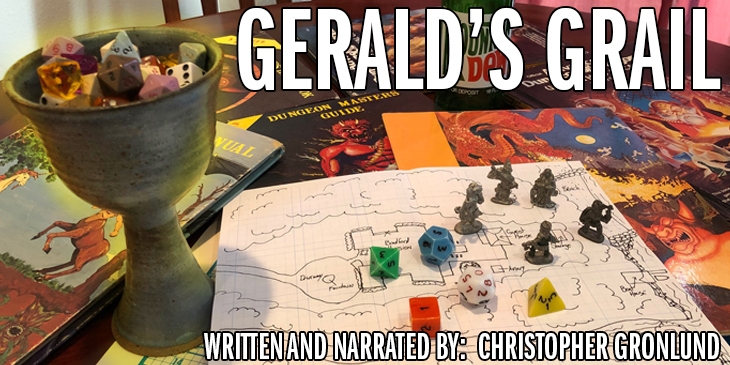
A faintly glowing clay chalice full of Dungeons and Dragons dice. A graph paper map and Dungeons and Dragons books are scattered around the table, along with other dice, pewter miniatures, and a glass Mountain Dew bottle.

Text: Gerald's Grail
Written and Narrated by: Christopher Gronlund

While knocking around an antique shop with his grandmother, a teenage geek finds something that changes his life in a most curious way…

Content Advisory: Bullying, violence (including passing mention of the Cambodian genocide of the 70s), teen tobacco and alcohol use, and — of course — swearing.

And if you’re so inclined, be sure to check out the Not About Lumberjacks Patreon. For as little as a dollar a month, all patron content is unlocked.

* * *

Credits:

Music: Theme – Ergo Phizmiz. Story – Lupus Nocte, Rocking for Decades, Ludvig Moulin, Christopher Moe Ditvelsen, Jon Bjork, Philip Ayers, and Cercles Nouvelles, licensed from Epidemic Sound.

Story and Narration: Christopher Gronlund.

Episode Transcript >>

Podcast: Play in new window | Download

Subscribe: RSS
Filed Under: Episodes Tagged With: Fantasy, Geralds Grail, Humor, Quirky

Gerald’s Grail – Transcript

May 30, 2022 by cpgronlund 1 Comment

[Listen]

[Sound of an ax chopping wood. Quirky music fades in…]

Christopher Gronlund:

I want to make one thing perfectly clear: this show is not about lumberjacks…

My name is Christopher Gronlund, and this is where I share my stories. Sometimes the stories contain truths, but most of the time, they’re made up. Sometimes the stories are funny—other times they’re serious. But you have my word about one thing: I will never—EVER—share a story about lumberjacks.

This time, it’s a story about a geeky teenager who, while knocking around an antique shop with his grandmother, finds something that changes his life in the most curious way…

And now, the usual content advisory…

“Gerald’s Grail” deals with bullying, violence (including passing mention of the Cambodian genocide of the 70s), and—of course—swearing.

Before we get going, I have an announcement! For six and a half years, I’ve been doing Not About Lumberjacks for free. In that time, some listeners have suggested I start a Patreon for the show. Well, now I have!

If you go to Patreon.com/cgronlund you’ll see it. That’s Patreon.com/c g-r-o-n-l-u-n-d.

Don’t worry, episodes of Not About Lumberjacks will always be free. I created the Patreon for fans of the show who wanted a bit more. Regardless of what those-so-inclined can afford, all Patreon content is unlocked. So, for as little as a dollar a month, you get the same access to bloopers, behind-the-scenes videos, and other bonus content that people paying more see.

If you’re like me, Patreon is more about supporting creators you love than bonus perks because you can pay more. I’m touched that there are those who recognize the time and money that goes into each story and want to compensate that effort. But…I also appreciate those who simply listen to stories and episodes of Behind the Cut.

Again, if you’d like a bit more than just the always-for-free stories, go to Patreon.com/cgronlund to see what I offer. That’s Patreon.com/c g-r-o-n-l-u-n-d.

All right—let’s get to work…

Gerald’s Grail

Gerald Healy sat at the head of the lunch table watching his best friend, Brian Kaminsky, roll up a new character for their weekend Dungeons and Dragons session.

“…And…an eleven after dropping the worst of the four dice. I still say we should roll 3d6 for each ability six times and keep the best roll. It’s in the Dungeon Master’s Guide.”

“When I started playing seven years ago, we didn’t even get to drop the worst of four,” Gerald said.

“My name’s Gerald, and I’ve been playing D&D since 1979,” Dave Strand said. “I agree with Brian. Or…they should give players the option to choose a standard array of numbers. Like 15, 14, 13, 12, 10, and maybe 8. To guarantee you’d always end up with a playable character. That would be cool.”

“That’s unlikely to happen,” Gerald said. “Besides, part of what makes the game fun is the randomness. It’s possible to end up with a really powerful character if you’re lucky.”

Akara Mok said, “Yeah, but none of us are ever lucky. That’s the problem.”

“Fine. If you all wanna go with Brian’s suggestion, we can start doing that.”

“Nah. You’re the Dungeon Master,” Dave said. “It’s your call.”

Gerald nodded. “Yeah, but it’s our game. We’re all in it together.”

“I’m good,” Brian said. “I just have the feeling I’ll be rolling up another new character before the weekend is over.”

“About that,” Akara said. “Are we playing all day tomorrow, or in the evening?”

“Gonna have to be a late afternoon or evening thing,” Gerald said. “I’m going out for lunch and running errands with my grandma.”

“Aww, that’s so cute,” Dave said.

The rest of the group looked at him.

“No, really. I’m not even being an ass—I mean it. Your grandma’s awesome!”

Gerald smiled. “Yeah, she really is.”

As Brian wrote an “11” in the box for his new character’s Charisma ability, a hand swatted Gerald’s dice from the table, sending them bouncing across the floor. Gerald jolted to his feet and looked Cory Bradford in the eye.

“What the hell, Bradford?!”

Cory poked Gerald’s ample belly and said, “Sit back down, Healy. It was an accident.”

The four friends who never seemed to leave Cory’s side laughed.

“Bullshit!”

Cory Bradford ignored Gerald and said, “What are you losers doing?”

Brian said, “Making a D&D character.”

“D&D. What’s that stand for: dickless and dumb?”

“No, Dungeons and Dragons.”

“No shit, Kaminsky. You don’t think I know that? Do I look stupid to you?”

“You look like an asshole,” Dave whispered under his breath.

“What’s that, Strand?”

“It’s Strahnd. Like Strahd.”

Cory took a step Dave’s way and smacked him in the side of the head. “Fuckin’ dork.”

Before anyone else could react, Akara leaped to her feet and slapped Cory in the face hard enough to get the attention of anyone not already looking at their lunch table. Cory Bradford reeled in shock. After composing himself, he took a swing at Akara, who ducked his blow. Gerald charged him, using his full weight to pin him against the wall. As Cory’s friends pummeled Gerald from behind and tried pulling him off their friend, Mr. Gunderson, the wrestling coach and one of the lunchroom monitors, blew his whistle.

“Healy!” he shouted. By the time he reached the table, the sides separated and withdrew to their respected groups.

“What the hell are you doing, Healy?”

“What?”

“Why’d you jump on Mr. Bradford?”

“He started it!” Gerald said.

Mr. Gunderson looked at Akara. “I saw her start it.”

“Only after Bradford hit Strand.”

“Strahnd,” Dave said.

“You need to hustle your butt to the office, Mr. Healy.”

“Why?!”

“Because I said so…”

Gerald shook his head. “Fine!”

As he passed Cory Bradford and his gang, Cory whispered, “This ain’t over, fat boy…”

* * *

As the group walked home from school, Brian said, “Did you get in trouble when you got sent to the office?”

“Nah,” Gerald said. “I think they’re just as tired of Bradford as the rest of us. The coaches look out for him, but I think most teachers and staff hate him as much as the rest of us do.”

“Good point.”

“That slap from Akara was righteous,” Dave said. “Coulda got us all killed, but it was awesome.”

“Some of my family didn’t make it out of Cambodia with the rest of us,” Akara said. “I will never not stand up to bullies.”

Brian nodded and put his hand on her shoulder. They walked half a block in silence until he said to Dave, “Have you checked out the new Maiden album?”

“Yeah. It’s good, but it’s no Powerslave.”

Brian looked at Gerald. “What about you?”

“I get the appeal, but they’re not my thing…”

“Says the guy still listening to Rush’s Power Windows on repeat,” Dave said.

“It’s a great album!”

“It’s even worse than Grace Under Pressure. Those keyboards, man!”

“You can laugh all you want, but mark my words: Maiden’s next album will have keyboards on it.”

“No fucking way! They’d never do that.”

Akara said, “You guys do know there’s other music out there, right?”

“Uh-oh,” Dave said. “Ms. Black Celebration’s about to go on about Depeche Mode.”

“What’s wrong with Depeche Mode?”

“They’re weird.”

“You’re weird!”

The discussion was interrupted by the revving of a car engine and the squealing of tires. A red Camaro IROC-Z pulled to the curb, followed by a blue Mustang SVO. Cory Bradford and his best friend climbed out of the Camaro; Bradford’s other three friends got out of the Mustang. Cory approached Gerald.

“We need to finish what we started earlier, Fat Boy.”

Brian said, “Please leave us alone, Cory.”

“Shut the fuck up, Kaminsky.”

Akara stepped to Brian’s side.

“I’m not afraid to hit a girl,” Cory said.

“And I’m not afraid to hit a little boy.”

Cory looked at the group. “She’s gonna get all of you hurt.”

“Just go,” Brian said.

Cory grabbed Brian’s face and mashed his cheeks. Before he could say anything, Akara kicked at his crotch, but missed her target and hit Cory’s inner thigh. With his free hand, he hit Brian and bloodied his lip. Cory was ready when Akara threw a punch. He blocked her blow and shoved her to the ground.

As Gerald began his charge, Dave threw a handful of dirt in the eyes of Cory’s friends and then picked up a stick. He swung it like a sword, keeping them at bay. Cory took Gerald to the ground with ease. He rolled him onto his back and pummeled his face. Dave looked back and forth between Cory and his friends, deciding that keeping more people out of the fight was the better option.

Akara tried pulling Cory off Gerald, but he wouldn’t budge. When she climbed onto his back, Cory let go of Gerald and flopped backward, smashing Akara to the ground.

“Hey!” Brian shouted.

Everyone stopped what they were doing and turned his way. Brian held a chunk of pavement from the side of the road in his hand.

Cory laughed. “I’ve seen you throw things, Kaminsky. Go for it.”

Brian held the rock over the back panel of Cory Bradford’s Camaro.

“I’m not gonna throw it. If you’re gonna beat the shit out of us anyway, I’m gonna fuck up your car’s paint job—I have nothing to lose. Or…you can climb back in and get the fuck out of here.”

Cory Bradford looked Brian in the eye. Brian raised his eyebrows and slightly cocked his head toward the car.

“All right,” Cory said. “Come on, guys.”

When Cory and his crew were gone, Brian, Akara, and Dave checked on Gerald. He was sitting up, running the tips of his fingers over his red, puffy face.

“How bad is it?” he said.

“We have matching fat lips,” Brian said. “Good thing your glasses fell off—you might have a black eye by morning. But it could be worse.”

They all helped Gerald to his feet.

He stared down the road and said, “I wish people were better than that…”

* * *

Brian was right about the black eye. The following morning, when Gerald woke up and stretched in bed, everything hurt more than usual. Struggling with Cory used muscles Gerald had long forgotten existed. His head throbbed and his lip hurt. In the bathroom, he examined himself in the mirror. A black eye and scraped elbow. All things considered, he fared better than others he’d seen Cory beat up.

As he made his way downstairs, his pain abated—minor agony gave way to the sounds and smells of his grandmother cooking breakfast.

“How are you feeling today?” she said.

“Worse in some ways, but better in others.”

She leaned a wooden spoon against the side of a pan full of scrambled eggs and surveyed his face and elbow.

“You’re sure you don’t want me to contact the school or his parents?” she said.

“I’m sure. He seems to cycle through the people he picks on. I think it was bad this time because I fought back in the cafeteria. He usually just makes fun of me and moves on.”

“That’s no excuse, dear. No one should be forced to deal with that.”

“I know. If he does it again, I’ll let you know.”

Gerald’s grandmother returned to the stove and finished cooking a breakfast of scrambled eggs, bacon, grapes, and toast.

Between bites, Gerald said, “Where all are we going today?”

“I’d like to wander around the old part of town, get some lunch, and maybe stop by the antique shop on the way back.”

“Sounds good…”

* * *

Avalon Antiques was a small home converted to a shop just south of the old part of town. Gerald enjoyed wandering the rooms, looking through an ever-changing inventory, as much as his grandmother. He seemed to always find some perfect little trinket to decorate his bedroom or dining room table on Dungeons and Dragons nights: old coins, skeleton keys, wooden boxes, glass vials and bottles, and a letter opener that looked like a dagger meant to be hidden in an assassin’s cloak. His greatest find was an old brass sextant and weathered hourglass the shop owner swore came from an old steamship from the 1880s. Nothing like that stood out on this trip to the shop.

Gerald was about to give up and see if his grandma was ready to leave when something in a back corner that would normally not catch his eye called to him. It was a simple clay chalice with a worn glaze, something he could use to hold dice or strap to his belt when visiting King Richard’s Renaissance Faire up in Wisconsin. It wasn’t as cool looking as some of his other finds, but it could serve an actual purpose at the table on game nights, unlike most of his other found baubles. He brought it to the counter and asked how much it cost.

The old man who owned the shop said, “I don’t remember seeing that.” He gestured for Gerald to hand it over. After examining the chalice, the man said, “You and your grandmother come here enough. You can take that with you.”

“You’re giving it to me?” Gerald said.

The old man nodded. “Consider it a frequent buyer’s bonus. I’m sure it will serve you well…”

* * *

Gerald sat behind his Dungeon Masters screen, surveying hidden notes and a map.

“The jagged stub of a large tower stands up from the razed walls. Two small black birds are perched on the tower top, about twenty-five feet up.”

“What do you do?”

Dave said, “I have Silvarius ready his bow and take a shot at one of the birds.”

“They’re probably just birds,” Akara said. “I say we check out the tower first.”

“Experience points are experience points,” Dave said. “That’s what Silvarius does.”

“Okay,” Gerald said. “Roll to hit.”

Dave shook a 20-sided die in his hand and rolled it onto the table.

“A twelve.”

“That misses,” Gerald said. He removed a six-sided die from the chalice he bought earlier at the antique shop.

“One, two, or three, they attack. Four, five, or six, they leave. Five. The birds fly off away from the party.”

Akara said, “Sovanara looks at the tower. What’s it look like?”

“One heavy door can be seen, barred and chained shut from the outside. Arrow slits are visible on either side of the door, but peering in reveals only blackness beyond.”

“Is there a lock on the chain?” Brian said.

“Yes.”

“Bautigan swings his battle axe at the lock.”

Gerald nodded. “Roll a d8.”

“A six.”

“The lock is damaged, but it’s still holding.”

“Bautigan swings again. A seven!”

“The lock breaks and falls to the ground,” Gerald said. “Now, what do you do?”

“We’ll all work at opening the door,” Brian said.

“Everyone roll a d6.”

Akara and Dave rolled ones—Brian rolled a two.

“All right, you all heave and pull and open the door. Great job!”

“It’s all in the reflexes,” Brian said.

Gerald laughed and then said, “Ol’ Jack Burton! This is probably a good time for a break if anyone needs one?”

“Yeah, all the pop I’ve been drinking has my teeth floating,” Dave said. “Be right back.” He made his way toward the bathroom.

While Gerald got up and stretched, Brian said, “Is that goblet new?”

Gerald shook the tension from his arms. “Yeah. Bought it today. Don’t know why. Guess I didn’t want to leave empty handed.”

Dave returned to the room with a two liter bottle of Mountain Dew. He refilled his glass and said, “Anyone else?”

Brian nodded. After Dave topped Brian off, he looked at Akara.

“Oh, no,” she said. “That stuff’s grody.”

“Gerald?”

“I put my glass up.”

Brian pointed to the chalice.

Gerald dumped the dice behind his Dungeon Masters screen and said, “Sure. Fill’er up!”

Once everybody settled back in, Gerald took a sip. The Mountain Dew tasted like a fountain drink—not something poured from a plastic bottle. The effervescence and rich flavors gave him pause before he turned back to the group and said, “So…what do you do?”

* * *

Even after opening his eyes Sunday morning, Gerald thought he was dreaming. Everything in his bedroom was in a crisp focus he’d never before experienced—even after getting new glasses. Each breath he took was open and deep, all without the use of an asthma inhaler. He felt his belly. While he was still big, when he stood up, no bones or muscles strained beneath his weight. He felt ready to run a marathon.

On his way to the bathroom, Gerald noticed the scrape on his elbow was gone, along with all the scars he’d collected over the years. He splashed cold water on his face in the bathroom sink. After patting water from his eyes with a hand towel, he looked in the mirror. There were no signs of the deep pock marks and pimples normally covering his face. He ran his fingers over his cheeks, savoring the smoothness of his skin. When he smiled, his crooked teeth were straight.

“What the…?”

He slapped his face to make sure he was awake—there was no sting against his cheek. Using both hands, he struck the sides of his face in rapid succession. No pain; no red marks.

He went downstairs to make sure his grandma had gone to church and called Brian.

* * *

Brian and Akara arrived sooner than Gerald expected. He was halfway through a bowl of S’Mores Crunch cereal when the doorbell rang. He let them in.

“So, what’s the big—” Brian started saying. He looked at Gerald’s face. “What happened? Where are your glasses?”

“I don’t need them anymore,” Gerald said. “I woke up and everything changed. No black eye—no zits. All the bruises and scrapes from the Bradford fight are gone. I feel great.

“I know it sounds impossible, but I think it’s the chalice. I didn’t say anything last night, but when I drank from it, everything tasted…more somehow. I felt different, like something good was inside the drink and fixing my body.”

“That’s not possible,” Akara said. “How could that happen?”

“I don’t know. But I think that chalice might be the Holy Grail.”

Akara laughed; even Brian shook his head. “Like, ‘We are the knights who say…Ni!’ Holy Grail?”

“No,” Gerald said. “The actual Holy Grail. That’s why I didn’t invite Dave over. He’d run his mouth and then everyone would know.”

“How the hell would the Holy Grail end up in an antique shop in town?” Brian said.

“Not sure. Things get lost and passed around. Legends come and go…and sometimes return. We live by a naval station—and the Field Museum’s an hour away. Who knows, but stranger things have happened.

“But look at me. There’s no normal way to explain this.”

“Get on the floor and do ten pushups,” Akara said.

“What?!”

“If you can do that, I might believe something’s going on. Maybe not full Holy Grail, but something more than what we understand.”

Gerald dropped to the floor and did ten perfect pushups. When he was done, he did ten more. He rolled onto his back and kicked his legs toward his head. Rocking back on his arms, he launched himself to his feet with a handspring. No sweat; no struggling for breath.

“Holy shit,” Brian said.

“Yeah, totally. The reason I invited Akara over is I wanted to try something. Your limp. From Cambodia. I wanted to see if the grail fixed it.”

She stared at Gerald a moment and then looked to Brian.

“That is, if you want to try it.”

She nodded. “Sure.”

* * *

Gerald pulled the bottle of Mountain Dew from the fridge and poured it into the grail.

“Does it have to be pop?” Brian said.

”I don’t know. It’s what worked last night. Figured we can test other things later, but it’s probably best to recreate last night.”

Akara reached for the grail. “I hate this stuff, but sure.”

She chugged the contents of the cup as quickly as she could. When she was done, she cocked her head to the side and smacked her lips.

“That’s good!”

Gerald said, “Like the best thing you ever drank, right?”

“Uh huh. Soooooo good!”

“How do you feel?”

“A bit tingly. Especially my ankle.”

“That’s what I felt, too. Like there was something good inside me.”

“Yeah…”

* * *

Akara slowly moved her foot in circles while Gerald and Brian played Super Mario Brothers.

“Feel anything yet?” Brian said.

“Not yet. It just feels good. Like it’s looser.”

“It might take a while,” Gerald said. “I felt good last night, but it wasn’t until going to bed that I felt even better. No idea when I was fully healed because I went right to sleep.”

“I think we should go to the antique shop when it opens,” Brian said. “Ask the owner about the grail.”

“He said he didn’t remember seeing it.”

“Yeah, but he’s old enough to be your grandma’s grandpa! Maybe asking more about it will help his memory.”

“Maybe. We’ll have to go later during the week, though. He’s closed on Sundays.”

“Damn, that’s right…”

* * *

The three headed out before Gerald’s grandmother returned from church and lunch.

Akara’s gait had improved, but her limp was still obvious. When they reached Viking Hobby Shop, they stepped inside.

Nestled in a back corner, among the myriad model trains the store was known for, were the role playing games. Gerald tried selling the group on other systems—Gamma World, Star Frontiers, Gangbusters, and Top Secret—but they always returned to Dungeons and Dragons. He looked through the modules and picked up Lankhmar—City of Adventure.

“What’s that?” Brian said.

“It’s based on some books I like.”

“Is it a module?”

“I think it’s more of a setting. A big city. Maybe they’ll come out with modules for it, but we kind of do our own thing anyway. I figure we can say there’s a cave in Greyhawk that leads here and we can go back and forth. I’m getting it.”

When they were done in the hobby store, they discussed catching the bus and wandering around Lakehurst Mall.

“I’m not in the mood for the mall,” Akara said. “We should just wander close to home today.”

They spent the afternoon meandering around town, ending the day in a convenience store that had a few arcade games in the back. Gerald and Brian got excited when they saw a new cabinet next to Joust.

“What’s Tron?” Akara said.

Gerald and Brian looked each other in mock amazement before Brian said, “We really need to get you caught up on some movies you’ve missed. Trust me on this one…”

By later afternoon, Akara’s limp was gone. She hopped around on her bad foot before falling into the grass and laughing. Brian sat down beside her.

“So it’s fixed?” he said.

Akara kissed him on the cheek and hugged him.

“As good as new!”

Gerald joined them in the grass.

“Maybe it’s not the Holy Grail, but it’s clearly something.”

“I think you’re right,” Brian said. “I can’t think of any other way to explain it.”

Akara slapped their legs. “Guys…” She gestured down the street with her head.

“Oh, shit,” Gerald and Brian said in unison.

Dave spotted them on the grass and shook his head.

“Are you guys blowing me off? I called you all and got no answer. Figured you might be here or the mall.”

“We’re not blowing you off,” Gerald said.

“What’s wrong with your face? Where are your glasses? What the fuck is going on?”

Brian patted the ground beside him. “Sit down—you’re not gonna believe this…”

* * *

After telling Dave about the grail, they walked back to Gerald’s house and sneaked into the kitchen.

“Gerald?” his grandmother said from the den.

“Yeah, grandma.”

“Don’t spoil your appetite. Dinner’s in the oven.”

“I’m just getting something to drink. Brian, Akara, and Dave are with me. They have to get some books for school before they leave.”

He grabbed the bottle of Mountain Dew from the refrigerator and went upstairs to his bedroom.

Brian was the first to drink from the grail.

“You’re right. I feel something. Tingly.”

After Dave finished drinking, he agreed. “Yeah.”

“I wonder how long it lasts?” Brian said.

“Dunno,” Gerald said. “We’ll see if it wears off on me since I drank from it first. If it does, then we’ll know when to have another drink.”

“If I have to do it again, I’m trying water,” Akara said. “I don’t know how you guys can drink that stuff.”

“We know this works,” Dave said.

“If it’s the Holy Grail, anything should work. So, I’ll try water next time.”

“We need to promise none of us will talk about this,” Gerald said. “I know my grandma’s gonna ask about my face. I’m gonna tell her I woke up like this. It’s not a lie. We can’t let anyone know about the grail—no matter what. Promise?”

“Promise.”

“Excellent. I’ll see you guys at school tomorrow.”

* * *

The following day at lunch, Gerald and his friends talked about how they were feeling.

“My ankle feels great,” Akara said.

While nothing physical impeded Brian and Dave, they admitted they’d never felt better.

“I feel like I can just go run as long as I want,” Brian said. “All day long.”

“Same here.”

They stopped talking when Cory Bradford and his friends wandered up to the table and surrounded Gerald.

“How’s the eye?” Cory said.

Gerald looked up and smiled. “What about my eye?”

Cory examined Gerald’s face, looking for any sign of what he did to it Friday after school.

“I wailed on you, fat boy. Are you wearing makeup?”

“No. I guess you’re just not strong enough to leave a mark. Maybe work at that next time.”

Akara, Brian, and Dave laughed, adding to Cory’s fury.

“You think you’re funny?”

“No more than how funny you look. So yes, I think I’m funny. Hilarious, even.”

Cory took a swing, but Gerald caught his fist in his hand. He stood up, grabbed Cory by the shirt, and twisted the fabric around his hand. Even Gerald seemed surprised by how easy it was to lift Cory off the ground like a little kid.

“I think it’s in your best interests to leave us alone from now on,” Gerald said.

Mr. Gunderson blew his whistle and started for the table. Gerald put Cory down.

“This isn’t over fat boy,” Cory said.

“Are you not smart enough to come up with a better insult, Bradford? It’s always the same thing with you.”

“You’re dead after school.”

“Sure. Fine. Where do you want to do it?” Gerald said, loud enough for people at other tables to hear him. “If you want to fight, I’ll fight you. Just tell me where.”

Gerald saw fear on Cory’s face before he toughened up and said, “Behind the football field.”

Gerald put Cory down and said, “Cool. Seeya then…” Then he turned on his heel and walked away from Mr. Gunderson.

“Yeah, yeah…I know. Go to the office, Healy…”

* * *

Throughout the day, hype for the after-school battle grew, to the point that after Gerald’s last class—English—his teacher, Mr. Olander, pulled him aside after the bell.

“I heard you plan to fight Cory Bradford. Is that true?”

“It is.”

“You know you don’t have to. We can head to the office and take care of this.”

“Maybe. But I remember when we read Hamlet. ‘This above all: to thine own self be true. And it must follow, as the night the day, Thou canst not then be false to any man.’”

“Two things—no, three. First: I’m glad the things you read in my class stick with you. Second: that was said by Polonius who is later referred to in his death as a ‘foolish prating knave.’ Third: Is fighting true to who you are? Much of Shakespeare’s work is about the destruction that comes from violence.”

“This is something I have to do, Mr. Olander.”

“I understand. You won’t mind if I watch from a distance, though? Just in case?”

“That’s fair.”

* * *

A crowd had already gathered on the field behind the football stadium when Gerald arrived. His three best friends trotted up to him.

“Are you sure about this?” Brian said.

“Yeah. I feel great!”

“You’re not immortal,” Akara said.

“I know. But I have to do this.”

 Gerald broke away from his friends and stepped up to Cory Bradford.

“We can shake hands like gentlemen and call this done before it begins,” Gerald said. “Or…settle it your way.”

Cory swung at Gerald with all his might. Gerald backed out of the way and grabbed Cory from behind as his body spun around from the blow’s momentum. Gerald brought Cory to the ground and put him in a half nelson. He drove with his body, rolling Cory on his back. With a free hand, Gerald slapped the ground three times.

“One! Two! Three! Ohhh! The state wrestling champ just got pinned by a sophomore!”

Gerald stood up and offered Cory his hand. Cory accepted and used it to launch himself at Gerald in a punch.

Gerald ducked the blow, and Cory almost crashed to the ground. He turned back toward Gerald and came at him swinging.

Gerald looked like Muhammad Ali as he bobbed his head and ducked, avoiding every punch. He shook his head and mocked Cory, sending him into even more of a frenzy where every blow missed its mark and left Cory off balance. With a tap of Gerald’s foot against Cory’s butt or a slight nudge to his back, he sent Cory to the ground repeatedly.

“Mister Bradford,” Gerald said. “I beseech you to stop this madness before you hurt yourself or suffer further humiliation in front of your compatriots!”

Cory spit at him, but missed. When he charged, Gerald turned and started running. He stayed just out of Cory’s reach, even when Cory accelerated to full speed. Gerald deked and dodged, laughing and taunting as he drew Cory deeper into the field. When Cory could run no more, he bent over and vomited—Gerald running circles around him as he heaved. When Cory was done, Gerald put his hand on his back.

“All I’ve ever asked—all that any of us have ever asked—is that you leave us alone. I don’t know what benefits you get from preying on those weaker than you, but I hope this afternoon makes you reconsider some things.”

On his way back to his friends, Gerald spotted Mr. Olander by the fence near one of the end zones of the football field. He flashed a thumbs-up to his teacher and rejoined the crowd.

* * *

As if the effects of drinking from the grail wasn’t enough, the rush that came from having new, adoring fans made Gerald feel like a knight returning from battle. While none of Cory’s friends congratulated him, others still within the circle of popularity patted his back as he walked by.

The high of the moment and swell of popularity carried through to the next day. When the bell finally rang at the end of English class, Mr. Olander held Gerald up.

When the room cleared out, Mr. Olander said, “Your handling of Mister Bradford yesterday was rather clever.”

“Like I said, ‘To thine own self be true.’”

“Point taken. What I’d like to know is how someone I’ve seen get out of breath walking halfway across my classroom to hand in a test can suddenly humiliate one of the better athletes in the state. Are you taking any drugs?”

“No!”

“I’m on your side, Gerald. If you are, know they can hurt you. Especially anything that can make you run like that.”

“I’m not taking drugs. I promise. I’m not even taking vitamins. I guess I just had enough of Cory and adrenaline let me do what I needed to do.”

Mr. Olander said, “All right. But please, know that you can always come to me if anything’s bothering you.”

“I know. Thanks.”

* * *

“Mister Olander knows something’s up.”

“How?” Brian said.

“He saw the thing with Cory yesterday. He thinks I’m on drugs.”

Dave laughed and said, “Did you learn nothing from Nancy Reagan?”

“This is serious. My grandma keeps asking about my face, and now Mr. Olander knows something’s up. What about your parents, Akara?”

“I’m faking my limp at home. If I didn’t, they’d keep at me until they found out what happened.”

“Speaking of that, we need to find out more about the grail. I’m stopping by the antique store before heading home.”

* * *

Gerald’s heart sank when he saw the CLOSED sign displayed in the window. He looked inside at the dark store before knocking.

“Maybe he’s in the back.”

“Why would he turn the lights out?” Brian said.

“I don’t know.” Gerald tried rousing the owner with a second—and then third—round of knocking.

“Maybe he died,” Dave said, causing all heads to turn his way. “I mean, he’s old…it could happen.”

Akara said, “Or maybe it was a slow day and he went home early.”

“That’s gotta be it,” Gerald said. “Or maybe he had to run an errand. I’m gonna call my grandma and let her know I’m sticking around town a bit. See if he comes back. Anyone wanna hang out?”

“I have homework,” Akara said.

Brian nodded. “Me too.”

“Dave?”

“Hate saying it, but I have a lot of homework today, too. My parents have been riding my ass since my last report card.”

* * *

Gerald swung by all his usual stops: Viking Hobby Shop, Spender’s Books, and The Record Bin. He bought nothing—just looked at things he might pick up with money from future allowances.

When the sun began sinking toward the horizon, he returned to Avalon Antiques. Gerald knocked a couple more times, but the store remained dark and still. He turned away from the door and headed home for dinner.

* * *

When Gerald opened his eyes Wednesday morning, everything ached. His room was a blur; each breath an effort. When he stood up, his body strained beneath his weight. On the way to the bathroom, he noticed the scrape on his elbow from Friday’s fight with Cory had returned. He looked in the mirror, horrified to see a black eye and cheeks swollen with acne.

After splashing water on his face, he returned to his bedroom.

The grail was gone!

He lumbered downstairs, where his grandma was fixing breakfast.

“Grandma?” he said. “The chalice I bought at the antique store on Saturday. Have you seen it?”

She looked at his face and said, “Are you okay, dear?”

“Yes. I mean, maybe. The grail—have you seen it?!”

“Not since Saturday.”

He looked around the first floor of the house, finding nothing. When he returned to the kitchen, he said, “You’re sure you haven’t seen it?”

“I don’t make it a habit of going into your room and looking around. I’ve not seen it down here. Was it there last night?”

“I don’t know. I went straight to bed after watching Moonlighting with you last night. I was feeling really tired. Can you think of anything that could have happened to it?”

“One of your friends came by yesterday. He said he had to get a book for school from your room. Maybe he did something with it?”

“Dave?”

“No—”

“Brian?”

“No, let me finish. It was someone I’ve not met. A big blond kid in a letter jacket.”

That was the last thing Gerald wanted to hear…

* * *

“It has to be Bradford!” Gerald said to the others as they walked to school.

Brian said, “Yeah, but how could he have known?”

They all turned toward Dave.

“What?!”

“Did you say anything about the grail? To anyone?”

“Why do you think it’s me? How do you know it wasn’t Brian or Akara?”

“Did either of you mention anything about the grail to anyone?” Gerald said.

“No,” they said in unison.

They looked back at Dave.

“I only told Shane Kupfer. Not even about all it does. He promised not to tell anyone.”

“Doesn’t he have a crush on Cory’s sister?” Akara said.

“Shit!”

“This!” Brian said. “This is why we didn’t call you on Sunday! We knew you’d end up blabbing about it!”

Gerald waved his right hand at Brian. “What’s done is done. I suppose it was stupid to think we could hide it. My grandma knows something’s up. Hell, Mr. Olander knows something’s up. I just need to make sure it was Bradford…”

* * *

Before homeroom, Gerald spotted Cory Bradford in the hallway. Still emboldened a bit by the memory of Monday’s humiliation, he approached him.

“Hey, Cory,” he said. “Did you swing by my house yesterday for any reason? My grandma said someone stopped by to get something from my room, and her description sounded a lot like you.”

Cory’s slow grin spread out wide enough to reveal his sparkling white teeth. He grabbed Gerald’s shirt, twisting the fabric around his fist. With no apparent effort, he lifted all 325 pounds of Gerald off the ground with one hand.

“I have no idea what you’re talking about. But I know this. You’re going to meet me in the field behind the football field after school today, and I’m gonna hurt you in so many ways…”

He let go of Gerald, who lost his balance and fell when he crashed back to the floor, causing those around him to laugh.

When the crowd dispersed, Brian stepped to Gerald’s side. “You need to tell someone about that. Mr. Olander, Dean Green…someone who can stop it. He’s bad enough without the grail.”

“If I were you,” Dave said. “I’d fake being sick. Figure out a way to get the grail back.”

Gerald shoved his friends aside and said, “I don’t think I need to fake it!” He rushed to the bathroom, barely making it to a stall before giving up his breakfast.

* * *

Brian, Akara, and Dave were walking home when they heard something from a nearby bush.

“Psst! Guys.”

“Gerald?” Brian said.

“Yeah.”

“What are you doing?”

“Hiding.”

“Yeah, I know. But why?”

Dave kicked Brian’s foot. The sound of Cory Bradford’s Camaro roared as it got closer. It stopped at the side of the road. Over the music, Cory shouted, “Where’s Lardass?”

“Who?” Brian said.

“Don’t make me come over there, Kaminsky. You know who I’m talking about!”

“He went home early today. Sick.”

“Yeah. Well tell him when I see him, what I’ll do to him will now be even worse than if he showed up today.”

When the car got out of view, Gerald said, “That’s why I’m hiding.”

He climbed out of the bushes and ushered his friends to follow him.

“We need to stay off busy roads. And move slow, ‘cause I can’t keep up.”

“Sounds good to me,” Akara said. Her limp was returning.

“Safe to say the grail’s effects last about three days,” Gerald said.

Brian nodded and said, “Yeah. We need to get it back.”

“I have a plan,” Dave said. “I’m sorry I ran my mouth—I didn’t mean for this to happen. So, I’ve been thinking. Cory’s having a party Friday night. That means doors and windows will probably be unlocked. We can sneak in and take it back. If we get caught, just say we’re there for the party like everyone else.”

“We kind of stand out as not being the kinds of people Cory invites to his parties,” Akara said.

“Yeah. But it’s a Halloween party. We just dress in our costumes for King Richard’s Faire, and we’re good.”

“They’d still see our faces,” Brian said.

“So, we wear masks, too.”

“Or,” Gerald said. “we swing by the antique store and see if we can find anything there…”

* * *

Gerald was happy to see the OPEN sign in the window of Avalon Antiques and find the door unlocked. He and his friends stepped inside.

“Good afternoon,” the old man behind the counter said. “Oh, it’s you my young friend. How are you?”

“Fine. Well, not really.”

“I see. And the chalice? How is it serving you?”

“It was great…until someone stole it.”

Gerald braced for the old man’s anger; at the very least, his disappointment. Instead, calm as always, he said, “I suppose you and your friends have a plan to retrieve it?”

“We do.”

“And do you have a plan for what you will tell the people who have it? So, they do not discuss it with others?”

“We don’t. We’ve not planned that far ahead. We stopped by yesterday to talk, but you were closed.”

“I was. I had a timely appraisal that needed to be done.”

“Something special, like the chalice? It really is the Holy Grail, isn’t it?”

“You are a wise young man. And I suspect you have wise friends.”

“Why did you entrust me with the grail, sir?”

“Perhaps because not many people your age would have answered in such a manner. But a better reason: I am an old man, and have no need for such a thing anymore. I was curious to see what you might do with it.”

“I ended up losing it. I’m sorry.”

“Don’t be. It is not lost. You are an honorable group of friends, and I trust it will return to better hands soon enough.”

“Excuse me,” Dave said. “Sir. Do you have any masks for sale?”

He pointed to a long, wooden mask on the wall.

“Do you have anything more…inconspicuous?”

“Feel free to look around. See if something gets your…attention.”

They milled about the store, looking at old clothing and aged trinkets. Nothing in the store was cheap, and it all looked like it came from another time.

Akara took a bit of brocaded silk fabric from a short cloak between her fingers, savoring the feel between her index finger and thumb.

“What can you tell me about this mantle?” Akara said.

“It seems to be to your liking,” the old man said.

Dave picked up a white-hilted dagger from a shelf and admired it.

“You need something that will hide your face,” Brian said.

The old man said, “I think that is a fine choice.”

A chainmail tunic caught Brian’s attention. It would be the perfect accompaniment for a knight’s costume he’d been slowly piecing together. He lifted the armor off the old dress form in the corner, marveling at how light it was.

Gerald was drawn to a blue stone nestled among others in a small wooden box. It felt cool to the touch and filled him with a feeling of safety. When he approached the counter, his friends followed.

“Those look like fine choices,” the store owner said. “Quite fine, indeed.”

“How much is this dagger?” Dave said.

“Take it for now. See if it assists you during this endeavor, and then we can discuss things further. The same for all of you.”

“Are these magical, like the grail?” Gerald said.

“I think you will find they all serve their purposes when needed.”

“So that’s a yes?” Dave said.

“It is not a no. Let us leave it at that.”

“Why are you giving us these things?” Brian said.

“I am not giving them to you, my dear boy. These particular items cannot be possessed—only used by those with the right hearts. Perhaps they will aid in the cup’s recovery—perhaps they won’t. It is up to you to find out.”

He carefully placed each item in bags and said, “I trust you will do your best to ensure these do not fall into the hands of others?”

They all nodded.

“Good. May they serve you well.”

As they were leaving, Akara turned back and said, “What’s your name?”

“Feel free to call me Mr. Percy.”

* * *

On the walk home, Gerald developed a plan.

“I can probably get away with faking sick tomorrow after going home early today. And then I’ll ditch school Friday. I’m not giving Bradford the chance to kick my ass before we do this. We can meet at my place around six. My grandma will likely be doing Halloween stuff at her church. And if she’s home, we’ll just tell her we’re going to a party. It wouldn’t be lying.”

* * *

They gathered at Gerald’s house on Halloween Eve just as the sun was going down. Gerald turned off the porch light and ignored knocks from the most determined trick-or-treaters.

“There’s a Ferentino’s pizza in the kitchen if anyone’s hungry?”

Dave was the first to get a slice.

“I already ate,” Akara said.

“Same here,” but it didn’t stop Brian from joining Dave in the kitchen.

Gerald followed his friends. “We look ready to storm the Temple of Elemental Evil.”

“Like a D&D party come to life!” Dave said.

“Dude, don’t talk with your mouth full.”

Dave opened his mouth even wider and rolled half-chewed pizza around with his tongue.

Gerald said, “We need to focus, guys. Dave’s been to Cory’s house once, with Shane Kupfer. What do you remember about it?”

He chewed and swallowed before saying, “It’s big.”

“And…?”

“They’re right on the lake. There’s a creek that runs along the side of the house. They have a big pool and backyard. Trees everywhere, so it shouldn’t be too hard to sneak up to the house. Once inside, things are pretty open. It might be hard sneaking around. I’ve never been upstairs, but there’s a bigass double staircase when you step through the front doors.”

“Do we all agree, then, to follow the creek and stay under cover of the trees?” Gerald said. “Survey the house when we get there and adjust our plans when we see what we’re facing?”

“Sounds good to me,” Brian said.

Akara and Dave nodded in agreement.

* * *

They skulked along the creek beside Cory Bradford’s house until finding a shallow section small enough to leap across.

“My ankle’s back to normal,” Akara said. “I can’t clear that.”

“Maybe there’s another place to cross further down,” Gerald said.

The music and shouting from Cory’s party covered the sounds of the group lumbering through the dark cover of trees. Eventually, they came to a section close to the lake where the creek widened enough to hold a small sandbar with a tree growing from it. An old tire swing hung from one of the branches.

“I can jump across,” Brian said. “If Gerald and Dave hold you up, you should be able to catch the tire swing when I push it your way.”

“Can you clear it in that armor?” Gerald said.

“Yeah. It’s so much lighter than it looks.”

Brian leaped across and, on the second try, Akara caught the tire swing. She swung across, where Brian caught her. Dave and Gerald jumped the creek, with Gerald coming up short and soaking his right foot.

“Shit!”

They repeated the process on the other side of the sandbar and made their way back toward Cory’s house.

From what they could make out in the backyard, it seemed like most of the party was there. A large bonfire sent sparks into the dark sky. Teenagers chugged beer in the fire’s glow. Music blared from an outdoor sound system near the pool, which was already covered in anticipation of winter. They made their way to the side of the house through the trees. A small patio gave way to French doors.

“I’m willing to sneak up and check the doors,” Dave said.

Gerald grinned. “I feel like I need to tell you to roll percentage dice to see if you make it.”

“I’ll be sure to do my best Silvarius impersonation.”

Dave left the safety of the trees and raced across the manicured lawn to the patio. When he stepped into shadows, he seemed to disappear completely. It was only when he checked the doors that he appeared in the glow from the inside lights. He tried the handles and gave a thumbs up to the group.

Akara was next to go. She pulled up the hood on the mantle and disappeared from view.

“No fuckin’ way,” Brian said. Gerald shook his head in amazement.

Before they started across the lawn together, the doors opened. Two of Cory’s friends stepped out and lit cigarettes. Dave disappeared into a shadow mere feet from the two. They had no idea where Akara was. The two party revelers eventually snubbed out their cigarettes and returned to the house.

When Brian and Gerald made it to the patio, Dave whispered, “Where’s Akara?”

“Right here.” She removed the hood from her head and appeared before them, startling Dave. “What’s going on, guys?”

“It has to be like the grail,” Gerald said. “The things we picked out at the antique store are real. When we were running across the grass, Brian’s chainmail didn’t make a sound. These are real magic items!”

“There’s no way,” Akara said.

“And yet, here we are,” Dave said. “So, now what?”

Gerald pointed the way. “I say we head in and go to the stairs.”

* * *

While much of the party was in the backyard around the bonfire, the interior of the house was a refuge for those wanting to get in from the chill of the night and get on the backside of speakers. Classmates the group only saw passing in the halls bunched together according to social standing. Gerald and his friends made their way to the front of the house, where a marble entry room gave way to two massive stairways leading to the same landing at the top. Velvet ropes turned away anyone thinking about making their way upstairs, but the addition of signs taped to the ropes reading KEEP OUT OR ELSE! – CORY warned anyone thinking about breaching the barriers that there would be serious repercussions for not doing as told.

Brian opened one of the front doors, ensuring no one was about to enter the mansion, while the others kept an eye out on the ground floor beyond the stairs. On Brian’s go, they stepped over the ropes and made their way upstairs.

Beyond the landing, a long room thrust into dim lighting. The grand hallway looked like a room from the Field Museum, down to lighted cases full of artifacts on each side. In the middle of the room, on a marble slab, was a dinosaur skeleton. The long creature was no taller than a human, but its menacing pose looked like it could break free from its supports and attack, or join the group sneaking around the mansion. Gerald read from a plaque mounted on the slab.

“Thes-ul-uh…Thes-kel-oh-sore-us.”

“Holy shit!” Brian whispered. He pointed to a T-rex skull in a glass case behind Gerald’s dinosaur.

“Are these real?” Akara said.

Brian leaned in for a better look. “Looks like it.”

“Check the cases,” Gerald said.

He and Dave walked along one side of the room, while Akara and Brian inspected the other side. The grand hallway in Cory Bradford’s house was a tiny museum. When asked what his father did for a living, Cory told classmates, “He’s an international businessman,” as if that said everything. Looking at Mr. Bradford’s collection, it seemed part of his international pursuits put him in touch with ancient artifacts and art. Dave stopped before a painting.

“What’s up?” Gerald said.

“That might be a Rembrandt.”

Gerald looked at the landscape. “How do you know?”

“Before my mom started appraising art and opened her gallery in the city, she worked in a museum in Montreal right after I was born. She talked about a robbery. She has some photos she took, and I swear that’s one of the pieces.”

Gerald looked at the other items Cory’s father had on display. “I wonder how much of this is stuff the Bradfords shouldn’t have…”

Their inspection didn’t turn up the grail. The group came to a point at which a hallway went to the left, and another to the right.

“We’ll go down here,” Brian said. “You guys go that way.”

“We shouldn’t split up the party,” Gerald said.

“We need to get in and out of here as fast as we can.” Brian and Akara started down the hall. Dave tugged on Gerald’s arm, leading him the other way.

“I’ll check the left side—you check the right.”

* * *

The first room Gerald came to was a bedroom. It was hard to make out anything in the dark hallway, but—judging by the smell of perfume and hair spray—he guessed it belonged to Cory’s sister. Next was a bathroom, where the smells of Cory’s sister’s room mingled with the odor of the cologne Cory splashed on each morning before coming to school. At the end of the hall was another bedroom. Gerald poked his head inside, but the light from the grand hall barely made it back to where he was. He reached into his pocket, pulled out a flashlight, and pointed it toward the floor. He turned it on, using his free hand to further try blocking the light.

He had found Cory’s bedroom. Band and model posters lined his walls: Paulina Porizkova flanked by Van Halen and the Scorpions; Cindy Crawford and John Cougar Mellencamp representing the Midwest; Elle Macpherson hanging out with AC/DC and Mötley Crüe. Gerald moved to Cory’s desk and dresser, hoping to spot the grail on top of one for a quick grab-and-go, but it was nowhere to be seen. The surface of Cory’s nightstand was also a bust. Gerald did his best to shield the light as he opened the nightstand drawer.

“Psst!”

Gerald instinctively shined the flashlight toward the bedroom doorway, flashing Dave in the face.

“Dude!”

“Don’t sneak up on me like that.”

“I didn’t find Cory’s bedroom.”

“Well, I did.”

“Did you find the grail?”

“Not yet. Gimme a sec.”

“That’s cool—I need it. I can’t see shit right now.”

Gerald checked the inside of the nightstand and all the drawers in Cory’s dresser. Nothing. He opened the closet and stepped inside. In time, he found the grail placed on a shelf. When he turned to leave the walk-in closet, Dave charged in, doing his best to quietly close the door behind him. A moment later, the light in the bedroom clicked on. Gerald turned the flashlight off and set it on the shelf beside the grail. He reached into his pocket for the blue stone, holding it tightly in his off hand.

“If anyone’s up here, you’re not gonna like what happens next, Cory said.

His feet cast a shadow at the bottom of the closet door.

“Stay here,” Gerald whispered to Dave. He opened the door and stepped out with the grail. Cory, dressed like Tom Cruise from Top Gun, greeted him on the other side.

“Healy?! What the fuck? I’ve been looking for you.”

“I know. I’ve been looking for this.”

“You’re dead.”

Cory grabbed Gerald by his shirt and twisted the fabric around his fist, as though picking up where he left off in the hallway at school days before. He grinned and lifted with all his might, but Gerald barely budged. Cory winced in pain.

“Oww!”

That’s when Gerald used his size to his advantage, shoving Cory back into two of his friends. He drove forward until the three crashed onto the top of Cory’s bed. He turned and broke through Cory’s other two friends and ran as fast as he could down the hallway. From the other wing of the house, he saw Brian and Akara. He waved them on toward the mini museum.

“Go, go, go!!!”

* * *

Cory and his friends quickly gained ground on Gerald. They closed in on him as he reached Cory’s sister’s bedroom. And then…they all went down.

When Gerald reached the light of the Grand Hallway, Dave seemed to appear beside him.

“I bought us a little time!”

Akara and Brian were already heading down the stairs when Dave and Gerald joined them. Cory and his friends hadn’t given up—three of them raced down the other side of the stairway, while Cory and his best friend started down behind the group.

When they reached the bottom, Cory’s friends had blocked the front door, driving the group deeper into the house. Brian shouted, “Go! I’ll hold them off!”

He unhooked one side of the velvet rope and wielded the support like a club.

Brian fought like a 10th level fighter, using his opponents’ momentum against them and sending them to the ground with a nudge of the post.

As the rest of the group made it to the back of the house, Cory shouted, “Stop them!”

Akara pulled her hood and disappeared, but Gerald could still hear her beside him as they ran past the swimming pool. As Gerald neared the bonfire, one of Cory’s friends stuck his leg out and tripped him. It seemed to happen in slow-motion, Gerald falling to the ground while the grail slipped free from his hand and tumbled into the fire. He continued his momentum, crawling closer to the flames on all fours, still clutching the stone in his left hand. He looked around and didn’t see his friends. The person who tripped him tried rushing forward with a kick, but the heat from the fire kept him back. Gerald’s classmates looked horrified as he reached in and grabbed the grail.

It didn’t burn. He thought, perhaps, the pain was so traumatic that his body blocked it, but his sleeve and hand remained unscathed. He stood up and pushed against some of the larger logs, toppling the bonfire and sending people fleeing. He stepped through the flames; when he exited the other side, he heard Dave calling for him at the back of the property. He raced beneath the canopy of trees, his lungs aching like when he was forced to run laps in P.E. Cory’s backyard opened to a small beach next to a boathouse. Dave struggled to unmoor a rowboat while Akara kept watch.

When she saw Gerald, she said, “Where’s Brian?!”

Gerald turned back toward the house, where Cory and others worked to stomp out the toppled bonfire.

“I don’t see him.”

Something moved through the trees along the creek spilling into Lake Michigan. Gerald stepped between the noise and his friends. A figure broke clear of the strip of forest near the boathouse.

Gerald squinted in the dark. “Brian?”

“Hey, guys.” He joined his friends beside the rowboat. “What are you doing?”

“I’m not going back through all that,” Dave said. “ and I’m not letting them catch up to us along the shore.” He tossed the rope in the boat. “Get in.”

Akara took a seat in the bow, and Brian took his place in the middle, manning the oars. Gerald and Dave shared a spot in the back, with Dave giving the boat a final shove free of the sand as he climbed aboard. Brian rowed with the strength of a small outboard motor. They were about fifty yards out from shore and heading south when Cory and his friends made it to the beach. They started down the shoreline, but when beach gave way to rocks, they gave up the chase.

* * *

As they rowed south, the sounds of Cory’s party faded. The soothing cadence of the oars cutting through the water helped relieve the tension concentrated in Gerald’s shoulders.

“This isn’t over,” he said. “Bradford will come back for the grail.”

Brian slowed the rhythm of the oar strokes. “He might still give us grief, but when I had him on the ground, I told him if he said or did anything about it, I’d make sure it was known that his father has a collection he likely shouldn’t have. And if he does that, I’m sure other things he’s done aren’t clean.”

“You had Cory on the ground?” Akara said.

“Yeah. All of them. It had to be this armor.”

“None of this makes sense,” Gerald said.

Akara pulled on the hood from the mantle. She didn’t disappear.

“It’s not working right now,” she said. “Brian’s slowed down the boat. Maybe we imagined it?”

Dave shook his head. “Or maybe it was stress? Maybe the powers kick in only when they’re needed.”

“Maybe…” Gerald said.

Brian turned the boat toward the shore when they reached the city beach. They dragged it up on the sand and started toward home.

* * *

On Saturday morning, Gerald, Akara, Brian, and Dave were at the front door of Avalon Antiques shortly before it opened. Gerald knocked and looked inside. The owner shuffled to the front of the store and let them in…locking the door behind them.

“Good morning.”

“Good morning,” Gerald said. “We have some questions.”

“Questions are always good. How can I help you?”

Gerald removed the grail and stone from a bag and placed them on a wooden table. “What are these?”

“You’ve already discovered what the chalice is. The other items have also been around for some time and serve their purposes.”

“We decided these should remain here.”

The others placed their items on the table.

The old man said, “That is the conclusion I hoped for.”

“How old are you?” Akara said.

He pointed toward the grail. “As old as I’ve always wanted to be. You’re welcome to stop by and use that any time. All of you.”

“This still doesn’t make sense,” Gerald said.

“That is understandable. We’ve lost many old stories and items along the way. The world is not like it once was. It is heartening to see younger people like you still willing to believe.

“When I was your age, it was expected that one begin plying a craft or prove themselves in some other manner. I cannot offer you an apprenticeship in a traditional sense, but I can offer you an after-school job here in the store. And, eventually, I can teach you how to recognize the things most of the world has forgotten. Then, perhaps, it will all make sense.”

“I’d like that,” Gerald said.

“I hoped you would. You can come by Monday to formalize the agreement, and begin working on Wednesday. Now, go enjoy the weekend. And if you’d please, on the way out, leave the door unlocked and turn over the open sign.”

* * *

Epilogue

(Where Are They Now)

Cory Bradford remained an asshole, but he did give Gerald and his friends a wider berth following that Halloween Eve. After attending Notre Dame on a football scholarship, he followed his father’s footsteps into “international business.”

Dave Strand joined the Army after graduation, and took part in Operation Desert Storm. After serving, he returned to Northern Illinois and opened a collectible music store that’s still going strong today.

Brian Kaminsky and Akara Mok dated throughout high school and college. They later married and settled near their hometown, where Akara teaches high school biology and Brian works as the research librarian in their city’s library. They have one child, a son named Arthur.

Gerald Healy worked part time at Avalon Antique Shop throughout his schooling. After college, he worked there full time, putting his PhD in history to use in ways no scholar would have imagined. When Mr. Percy passed in the year 2000, he left the store and its many artifacts to Gerald. Even today, at least once a month, he meets up with Brian, Akara, and Dave at a round table in the back on the shop, to catch up on life, play Dungeons and Dragons…and show off his latest acquisitions.

[Quirky music fades in…]

Christopher Gronlund:

Thank you for listening to Not About Lumberjacks.

Theme music, as always, is by Ergo Phizmiz. Story music this time was by Lupus Nocte, Rocking for Decades, Ludvig Moulin, Christopher Moe Ditvelsen, Jon Bjork, Philip Ayers, and Cercles Nouvelles, all licensed through Epidemic Sound.

Sound effects are made in-house or from Epidemic Sound and freesound.org. Visit nolumberjacks.com for information about the show, the voice talent, and the music.

And if you want bloopers reels, behind-the-scenes-videos, and other additional Not About Lumberjacks content, check out Patreon.com/cgronlund for more details. That’s Patreon.com/c g-r-o-n-l-u-n-d. For as little as a dollar a month, you help the show and get access to all bonus content.

In July, I think it’s finally gonna be that murder mystery set in a bog in northern Illinois. (I seem to have a certain affinity for that part of the country, it seems…)

Until next time: be mighty, and keep your axes sharp!

Filed Under: Transcript

Behind the Cut – Revisions

March 19, 2022 by cpgronlund 3 Comments

Left side of image: cross section of a cut tree stump. Text reads "Behind the Cut - The Not About Lumberjacks Companion."

Right side of image: Books on a table in front of a window. Text reads "Revisions - Commentary by: Christopher Gronlund."

It’s not uncommon for people to assume stories are a reflection of the author — especially stories in which an author features a writer as a protagonist. “Revisions” is about a writer who was raised by a single mother. Some people who know me mentioned they felt it was heavily influenced by my mother.

I discuss where my life is similar to the protagonist in the story and…how our situations and views greatly differ.

* * *

Episode Transcript >>

Podcast: Play in new window | Download

Subscribe: RSS
Filed Under: Behind the Cut, Episodes

Revisions

March 5, 2022 by cpgronlund 4 Comments

Piles of open books in front of an interior window looking out to greenery.

Text: Revisions
Written by: Christopher Gronlund
Narrated by: Cynthia Griffith

An author tries to finish construction on her recently-deceased mother’s home while writing her second novel — the follow up to a New York Times Best Seller.

Content Advisory: Death of a parent and struggles with self doubt. (For once, no swearing!)

And if you’re so inclined to pitch in and help the farm animal sanctuary I mention in the intro, check out The Farm Micro Sanctuary on Patreon, or on their Facebook or Instagram accounts.

* * *

Credits:

Music: Theme – Ergo Phizmiz. Story – Johannes Bornlöf, licensed from Epidemic Sound.

Story: Christopher Gronlund.

Narration: Cynthia Griffith.

Episode Transcript >>

Podcast: Play in new window | Download

Subscribe: RSS

Filed Under: Episodes Tagged With: Literary, Revisions

Revisions – Transcript

March 5, 2022 by cpgronlund 1 Comment

[Listen]

[Sound of an ax chopping wood. Quirky music fades in…]

Christopher Gronlund:

I want to make one thing perfectly clear: this show is not about lumberjacks…

My name is Christopher Gronlund, and this is where I share my stories. Sometimes the stories contain truths, but most of the time, they’re made up. Sometimes the stories are funny—other times they’re serious. But you have my word about one thing: I will never—EVER—share a story about lumberjacks.

This time, it’s a tale about an author trying to finish construction on her recently-deceased mother’s home while writing her second novel—the follow up to a New York Times Best Seller.

And now, the usual content advisory…

This is where I normally warn you about a story’s rougher edges, but “Revisions” is pretty tame compared to most Not About Lumberjacks stories. It deals with the death of a loved one and the narrator’s self-doubts, but that’s about it. There’s not even swearing in this one. I’d go as far as calling “Revisions” an all-ages story, but it would probably bore most kids.

Speaking of wholesome things, I want to chat a moment about The Farm Micro Sanctuary. Based in Larwill, Indiana, this 501(c)3 non-profit sanctuary provides a safe haven for at risk farmed animals, educates the public about the repercussions of animal farming, and strives to promote compassion for a healthier planet.

My wife and I sponsor one of their goats, the impish Arlo Goathrie, who’s currently in training to serve as an animal ambassador for public education.

Learn more about the sanctuary at patreon.com/theFarmMicroSanctuary, or do a search on Facebook or Instagram for Lopin’ Along at the Farm Micro Sanctuary to follow what they’re up to.

And one more quick thing before getting to the latest story…

If you listen to Not About Lumberjacks and have thought, “I like Christopher’s short fiction, but it would be cool to listen to something longer,” well: I have you covered! New to the menu on nolumberjacks.com is a section for novels. Right now, the only thing there is my first novel, Hell Comes with Wood Paneled Doors. Hell Comes with Wood Paneled Doors is a humorous coming-of-age story about a family traveling cross country in a possessed station wagon. But I plan to release a novella and more novels soon-ish.

All longer works shared from the Novels menu option will have their own subscription feed, so the main story feed will remain solely for the short fiction I’ve been sharing for years. I hope you enjoy my longer stories as much as the shorter tales…

All right—let’s get to work…

* * *

REVISIONS

FEBRUARY 17, 2021

This house is the book of my mother’s life, and I am lost within its pages. It is here, beneath a spiral staircase, where my mother decided to bring all its curves together—a point of stability in an otherwise chaotic world. Three stories above me, exposed beams in the ceiling form a starburst from the glow of the huge skylight holding me in its gaze. This house is an unfinished cathedral, a testament to my mother and her perfectly tangled life. As I listen to the north wind blow outside the safety of her dream home, I think about all the work ahead.

I have no idea what I’m doing—no idea why I believe I can finish what a brighter mind started. I don’t even know how to clear hair from the drain in the bathroom sink, but I’ve now convinced myself I have it in me to manage contractors, to even do much of the work myself and finish the house my mother saw only in some imagined glory.

I know that feeling, seeing a perfect thing in your head waiting to be shaped, a vision so strong you want to make it whole and take its place in the world. I wonder if my mother viewed this house like I view the books I write: a thing beyond the imaginations of many people, but also, something never seeming to live up to the perfect versions in our minds. Somehow my mother found a shortcut to creating a physical masterpiece of a home, but I’m sure she saw flaws where I see perfection. How I wish I carried a fraction of her confidence.

When I finished and sold Standstill, my mother said, “See? I told you you’d written something beautiful.” And when I protested, mentioning all I still wanted to fix, she compared it to this house and said, “Every perfect thing has its flaws if you’re intimate with its construction. What matters is what others see…and that it’s no longer taking up space in your head.”

She was right—she was always right. I need to get this house, and this book, out of my head.

* * *

MARCH 8, 2021

It’s never been lost on me how fortunate I am: raised by a mother who encouraged me to be myself, while other parents insisted their children pursued futures already decided for them. In those demands came a security I didn’t have for much of my life. I watched friends marry, have children, and accumulate funds in 401Ks while I worked odd jobs so I had more time to write. We grew apart, our differences amplified by the passage of time and the paths we walked. I’d be lying if I said I never felt like a failure. I worried about a future devoid of savings and security, stuck working a mishmash of jobs until one day I could work no more. By my mid 20s, I’d already sold myself on a bleak end in which the very thing I loved—writing—became my undoing.

Through it all, my mother believed in me. But that’s a mother’s job if you’re lucky. Still, on my thirtieth birthday, I sold a story to Tin House. Other literary journals followed: Granta, Ploughshares, and The Kenyon Review. I somehow turned that string of successes into a part-time instructor of English position at Ohio Wesleyan University—where I taught creative writing until my first novel found its way onto the New York Times Best Seller list for half a year. I would have loved sharing that success with my mother, but by then she was gone, reduced like so many others who one day found a lump that never stopped side-stepping the best efforts of modern medicine. She would have loved my rocket-ride to the top.

I’ve read that astronauts have a hard time coming back from space after long missions. I don’t know if I can compare my successes to that, but coming down from the rush of a successful book feels empty without my mom being there with her reassurances that everything will be okay. Now I’m stuck with the daunting task of doing it again with another book—this time, under the scrutiny of critics waiting to feed.

I’ve considered paying back the advance on the second book and living in this house as-is, a silent existence until I am no more.

* * *

MARCH 12, 2021

My mother and I couldn’t have been more different. Where she was outgoing, I was reserved. Where I was cautious, she took every chance that crossed her mind, savoring the experience no matter how things turned out. Her independence shined like the sun, its warmth one of her traits I absorbed. She once told me we were lucky my father ran when he found out she was pregnant because he’d have only gotten in our way. I have no reason to doubt that; I cannot imagine any life but the one my mother and I lived.

She fell somewhere between beatnik and hippie, a free-spirit content to meander where the winds of her life blew. That didn’t stop with my arrival—I was raised on the road, living in campgrounds and national parks, communes and squatted buildings. She carried me like a backpack across Europe and South America, let me roam free in Alaska and the Caribbean. At some point along the way—whether it was her belief that I needed a proper education or that she hoped in it I’d see a regimented life mandated by others might not be to my liking, she settled down and put me in school. One day I was living on Saint John in the Virgin Islands, and then in what I later found out was a house my mother inherited from the grandparents I never knew, in Columbus, Ohio. She funded our adventures through odd jobs along the way and rent collected on that old house, until we moved in.

While I toiled away in school, exposed to the ways of rote learning, my mother landed a job as a keypunch operator for an insurance company. A high school dropout, my mother was given the opportunity to attend night school at a community college—paid for by her job. Soon, the novels she loved reading gave way to books about programming languages: COBOL, Pascal, and BASIC. By the time I was in junior high school, she’d started a small software company with a work friend. Shortly before I graduated high school, they sold the company to IBM, and I was told we’d never have to worry about money again.

With me on my own, I figured my mother would return to a life of traveling, but she found a new obsession: building a house with her hands. She had a simple plan: construct a cob home that was large enough for her and a guest or two, and then take what she learned and build a bigger place—more space for more guests. But as we all know, sometimes things don’t go as planned.

* * *

MAY 26, 2021

This house and my novel-in-progress are not good companions. They have conspired against me, one serving as an excuse to not devote time to the other. When I should be writing, I’m reading books and websites about tiling, flooring, and basic plumbing—tasks I’ve convinced myself I can do on my own. When I should be working on the house, I reread fragments of my broken manuscript, making tiny changes instead of progress. It’s amazing how little one can accomplish pursuing small tasks: tracking the house’s to-dos in a spreadsheet, fixing typos in the manuscript, and insignificant pursuits giving me a sense of completion, even though I begin my days in the same place as the day before. I could spend the rest of my life piddling about and never finish either.

When I taught, I always told my students to finish what was on their desk before starting something new. While some people do well moving between two projects, most people I know—myself included—end up giving neither project appropriate attention. Everything suffers—especially the artist.

As driven as my mother was, she made few demands on me. She seemed to recognize that forcing me to do something was a sure-fire way to get me to not do it. I always admired the speed at which she accomplished things. My mother was a targeted shopper, never content to linger unless window shopping was the goal. If we were there for something specific—whether it was new school year clothes shopping for me or picking up groceries—we moved with a plan, dividing and conquering the aisles like commandos. She seemed to cook Thanksgiving dinner in half the time as others, but with better results. It was like she could stop time when needed, and come out on the other side ready to do more.

I plod along, procrastinating and stressing until running out of time. I wake up in the middle of the night with a racing mind that remembers everything I need to do at three a.m., but jettison those waking to-do lists like lost dreams when it’s time to get up. I only finished Standstill’s edits because it had a deadline attached to money. That motivation doesn’t seem to be helping this time around. When I sit down to write, I think about all the things left undone in this house. I let the sound of contractors allow me an out: “How can I write with all this noise and commotion?” Then, when I give in to the house, my mind wanders to the book.

Lost in the fog of competing projects, I sit and wait for the sun to burn it all away, but it only gets darker each day.

* * *

JULY 3, 2021

While my mother and I struggled, I was always happy—well, as happy as happy is for me. Before settling into school, I had few other children with which to compare my life to. Living in tents, shared spaces, and an old VW Bus seems normal when it’s all you know. When we settled into my grandparents’ old house, I remained a loner, turning away friends because I found books easier to understand. If I wanted something, my mother provided—so in my mind, we had it as good as everyone else. It wasn’t until high school that I realized what a strange life I had lived.

Somewhere along the way—most likely from one of my mother’s many friends and the varied jobs they worked—she brought home a pair of sneakers with the American Airlines logo on them. A group of “popular” kids teased me about it, trying to shame me for not wearing brand name shoes. The weird thing is their taunting didn’t hurt: I felt sorry for them, and I told them as much. Out came what I now know was a defense of my mother, talking about how I’d traveled all over the world, while I guessed some of them would never leave their hometown. I mentioned the artists, musicians, and actors I knew—friends my mother accumulated along the way. My mother and I could go anywhere, and people would help us—I asked those taunting me if they were so fortunate.

I won’t say that day led to me becoming popular, but I mentioned enough about my life in my rare moment of speaking up that I was at least viewed as the quiet cool kid who knew famous people and had adventures none of them would have in their lifetimes. With that new visibility, though, came attention to my writing.

I always carried a notebook and a pen. Before classes, and throughout lunch, my face was in those pages. When classmates found out I was trying to write a book, my reputation as the “interesting” girl everyone seemed afraid to talk to grew. In time, a braver soul among my peers asked me when I’d be done.

“I don’t know,” I said.

They all looked disappointed.

With that classmate’s question and my answer, doubt pushed its way before confidence. Trying not to think about it only made matters worse. I asked my mom what she thought about the slow pace at which I wrote.

“All things take their own time…depending on the times.”

I didn’t understand.

She continued: “I’ve never written a book, but I imagine a good book takes time on its own terms. Maybe you can hurry things along, but I imagine it would result in not writing the book you want to write. You know I love how much you think about things, but right now, just enjoy writing for its own sake. If you’re lucky, the day will come when you’ll miss working at this pace, with no expectations but your own.”

I still can’t explain why I was such an unhappy child when I had all I needed and a mother who was always there for me. If I had to analyze my younger self, I suppose my problem was expectations exceeding my abilities. I was well-read enough to know what was possible, but those words were out of reach.

I grew up believing introspection was a curse…and as I sit here today with a late manuscript, I’m not so sure I was wrong.

* * *

AUGUST 19, 2021

Somewhere along the way, the thought of writing books became more practical than a passion. When I saw my mother sell her company, and the money she had to live on without a care, that’s what I wanted—even though my mother’s money was also mine. It was important to do something on my own—not just take what was given to me. Maybe I’d not have a long career as a writer, but I wanted something big I could point to that allowed me to say, “I did that.” I knew what I was writing would not be that thing.

It was freeing when I finally came up with the idea for Standstill. No longer did I obsess over every word being perfect, building to each new sentence that followed. It’s a nice thought, but one not steeped in reality. I had a basic idea: a woman stops time with a magic watch so she can spend more time with her gravely ill husband. It allowed me to write the literary passages I dreamed of writing, but also have fun along the way. I was so fixated on being accepted by the “serious” writing community that I’d forgotten why I wrote in the first place.

I wrote Standstill when my mother was sick, and the parallels of the story are not lost on me. How I wished I could stop time and kept it just the two of us, like when I was little and we had nothing but time to wander. I was in a race against every second writing that book, and that allowed me to break through all that previously stifled me.

My mother was the second person besides me to read Standstill. I was in her hospital room when she finished reading; I watched her weep when she was done. I felt bad, like I’d driven home that soon she’d be gone and I’d be alone.

She smiled and said, “I’m not crying about my time coming to an end. I’m crying because I’m happy for you. Finishing a book was a long time coming, and I’m glad this is the book you wrote right now.”

I wonder what she’d think about my latest book, Ellie’s Second Chances—a story about a woman who gets to travel back in time and change three moments in her life.

I’m sure she’d say it’s a silly notion—that we should accept there are things we’d always change no matter how many do-overs we’d get. She’d say, “The moments we’d change are likely the moments that define us. What matters is what we do in their wake.”

* * *

SEPTEMBER 16, 2021

I keep two photos on the desk where I write. The first is a photo a friend took of me at the release party for Standstill. It’s an image of me lost in the middle of a room full of smiling people. When I was given the photo, my friend said, “I love how everybody is turned toward you. That was your moment. I know you wished your mother could be there, but you had quite a turnout of other loved ones celebrating your success.”

I looked at the photo, admiring the blur of hands and smiles, a tunnel of souls with me standing at the end in perfect, still focus as though I were on the outside looking in at my own party.

I thanked my friend and said, “Yes, it would have been nice if my mom could have been there. I didn’t miss her that evening, though—at least not in that moment. I remember what I was thinking when this was taken. I looked around at everyone gathered in celebration of what I’d written and thought, ‘This is as good as it will ever get…’”

The other photo on my desk is an image of my mother standing in front of the piles of mud that would later become her first cob house. When you hear “cob house,” you probably think, “quirky hippie hut,” or maybe something resembling an adobe home in New Mexico. But the first house my mom built was neither or those things.

If a stranger were to break through the hedges and trees and wander onto the property today, they might convince themselves they stepped through a portal and into an old English garden—her first home serving as a quaint thatched guest house for those visiting the main estate. But the day the second photo on my desk was taken, all those things only existed in my mother’s mind’s eye. She stands among friends, all smiling and covered in mud and straw from mixing cob all day. There was so much laughter—and not a soul present who doubted my mother’s ambitions. She stands in the center of the group, smiling and holding a glass of cheap jug wine, her smile brighter and more beautiful than the blazing sunset behind her.

* * *

SEPTEMBER 27, 2021

Somebody reading this might think my mom was a perfect person, but she was not without her faults. She ran away from many of her problems and, sometimes, people. Those trips to national parks were moments she loved, but it was also an easy way to hide. The amount of times life seemed anchored, but we ended up moving abruptly, would make a military brat feel settled.

I’d never call her an alcoholic, but there were times she hid in the bottoms of bottles. Sometimes she chewed through men. And while she never so much as raised her voice at me—let alone hit me—there were times I knew to leave her alone…sometimes for weeks.

Near the end of her life, she apologized for the bubble of instability in which she raised me. I told her I didn’t mind—and I meant it. Left with time to myself, I read and wrote. I’d not be who I am today had I been raised by someone more involved in their child’s life. She was always there when I needed her. The trust extended to me did not go unnoticed—I recognized how fortunate I was in many ways.

Still, she insisted she could have done a better job as a parent, but I imagine all parents feel that way. I’m sure we can all have done more with the time we’re given—and even the days ahead for those of us fortunate enough to wake up tomorrow.

* * *

OCTOBER 31, 2021

I’ve found myself relying more on contractors than doing the work on the house I set out to do on my own. I suppose, much like everyone seems to believe they have a book inside them ready to come out, many of us also think we can do the work of people more skilled than us. I don’t know anyone who believes they can sit before a piano and play a concerto on their first try, but I’ve met so many people who have told me they plan to sit down one day when they have the time and write a book. As though it were that easy. But here I am, doing something similar.

It’s not lost on me how ridiculous it is to think I can pull this off. I tell myself building a house is not entirely unlike writing a book. Words form sentences that form paragraphs; nails and screws and boards form walls. Enough paragraphs, and you have a chapter; enough walls, and you have a room. Enough chapters, and you’ve written a book; enough rooms, and you’ve built a house. But there’s an art to putting 100,000 words in enough order to become a book, and even more effort to have a polished story. I may have gleaned some building tricks through osmosis, simply from helping my mother over the years, but I know a simple oversight could mean a leak that destroys a room. Something not wired right can reduce a house to ashes.

I don’t reread my stories when they’re published because I always notice things I want to change. It’s one thing to change a word or two—even a paragraph here and there, but that’s not so easy to do with a house. Adding or removing a door is not like highlighting it and pressing delete. And so, I’ve only been doing updates to the house I’m comfortable doing; I’m no longer spending my days researching bigger tasks better left to more capable hands.

I don’t know if this means I’m resigned to finish Ellie’s Second Chances, but it feels like something’s about to give…

* * *

NOVEMBER 17, 2021

Today is the three-year anniversary of my mother’s death. My mother died a month before Standstill was released. I wanted the world to stop—I wanted time to get my head around the year and a half that had passed: edits on the book, a cancer diagnosis, and then my mother fading more each week as anticipation for my first novel grew. She never got to hold the hardback in her hands, but the printout I gave her—and then the advanced reading copy—was never out of her reach. She apologized profusely for getting sick during such an important part of my life. (As though she did it by design.) She reminded me the world stops for no one and that she hoped I’d be able to enjoys Standstill’s release despite the circumstances.

In a strange way, my mother’s passing took an edge off the anxiety I’d have likely faced if the release were my only consideration. I cannot imagine all my thoughts directed at the book finally seeing its place on shelves. While my mom felt terrible about dying just then, it allowed me an excuse to withdraw from some of my responsibilities. My publicist did a great job nudging me toward the book while still giving me space to grieve. By then, I’d prepared for my mother’s passing. I’d be lying if I said I didn’t use it as an excuse  to avoid things I should have attended to.

I know there will be a day the next book is out there, and I won’t have such a readily available excuse to retreat when I want. Perhaps I can fire the contractors and return to trying to finish up the house myself. Anything for a distraction.

* * *

JANUARY 1, 2022

It’s a new year, and I saw one of those, “I’m gonna be the best version of me!” posts on social media. It’s a weird world when people talk about re-branding their identities. I’ve always had a hard time trusting people like that; to me, it says, “I have been trying to be something I am not all along. I didn’t get the results I wanted, so now I will attempt to be someone else.” And they keep at it until something sticks and they end up several degrees removed from who they really were. Who they really are, deep down. They become stuck pretending to be someone they are not. It sounds exhausting.

But I suppose we all pretend. We say we’re okay when we are not. We pretend to like jobs we hate. We bite our tongues to make peace. We are social creatures struggling to fit in.

When Standstill was nearing publication, my publicist presented a list of things that worked for other authors: dinners with booksellers, speaking opportunities at conferences, and plans for the types of essays in publications that help sell novels. Even starting a podcast. Can you imagine—a podcast?!

Still…by choosing to write the kind of book I wrote, I knew what I had signed up for. While Standstill may not be a beach read, it was written with commercial aspirations. By writing such a story, and ending up with a two-book deal, I understood what came with it. And so, I dined with booksellers, talked to packed rooms at conferences, and saw my essays about grief and moving on with life published online and in print. I even agreed to be interviewed on several podcasts.

While the thought of being a brand turns my stomach, I’ll soon be dusting off my smile and practiced poise. I’m seeing an end to these revisions, and my house is in order. There’s still work to be done, but maybe there’s something to the new year/new me thing after all…

* * *

FEBRUARY 8, 2022

I sometimes wonder if I’ll ever hear from my father. I’m not famous, like a celebrity abandoned by a parent who later returns, offering to catch up—when what they really want is money. With few exceptions, best-selling novelists are not household names. Say the name Anthony Doerr to most people in the U.S., and they’ll say “Who?” despite him winning the Pulitzer Prize a handful of years ago and a book that sat on the New York Times Best Seller list for one-hundred and thirty consecutive weeks.

I suppose it’s natural to think about the man you’ve never met who is responsible for one half of your existence. Hell, John Irving has made a career writing about missing fathers. Not knowing mine has never bothered me. There’s no void in my life; perhaps because my mother did a good job explaining to me his actions were not our fault. Leaving was on him.

I used to think about being famous, back when we had literary paperbacks as impulse buys at grocery store checkout stands. I remember my mother picking up The World According to Garp at a Jewel grocery store when we were knocking around northern Illinois one year. I wanted that: my book right there next to candy bars and gum and magazines. Back then, if you broke in, you were almost guaranteed an audience. Now, it’s all so splintered.

When I used to imagine my books being on display with John Irving, Alice Walker, Amy Tan, and Tom Wolfe, I also imagined my father seeing my books in stores and tracking me down. In those fantasies, I told him to go to hell and leave my mother and me alone. Now, when I imagine meeting him, it already feels like a sad memory. I can only imagine him appearing with the hope of me giving him money or to be absolved of some guilt he’s carried with him for years.

I don’t care to meet him, but if he ever shows up, I’d not close my door to him.

At the same time, I can’t imagine leaving it open…

* * *

FEBRUARY 20, 2022

I got the idea to start this journal when I found several notebooks my mother kept. She had one for the house, one for the software she continued writing, even after selling her company, a travel journal, and a general notebook chronicling her thoughts and moments in life worthy of capturing. Her notebooks rarely deviated from their intended purposes.

I set out to make this journal solely about the process of writing Ellie’s Second Chances. I figured I’d be able to go back through it and pull bits for essays or interviews. I even thought, if I ever did do a podcast, I could chronicle the process of following up a bestselling book with ease. But much like the stories I’ve written, this journal has changed as I’ve filled its pages. It’s now mostly about my mother and this house; about me and this latest book.

Maybe there’s a story worthy of writing in there somewhere…

* * *

MARCH 28, 2022

It’s been a while since I’ve written here…

I finally turned in Ellie’s Second Chances!

There is still plenty of work to be done, but the hardest part is now behind me.

I don’t know why I complicated things so much. I had a list of things to fix from my editor—in some sections, she practically wrote what I needed to swap out. But there’s something about revisions and me.

I know other writers crave revisions. And I cannot deny that it is in those later passes that everything comes together. But, like so many other things, just getting to that point is such an effort, and all I want to do is hand over a rough draft and call it done.

I always told my students to learn to love revisions. I went as far as comparing the act of revising stories to life—whether working on a book, or yourself, always striving to improve things. But as I’ve gotten older, I know there comes a point at which you’ve become a better person if you’ve done things right, and you deserve to go easier on yourself. Even let some things fall through the cracks.

My mother used to talk about the importance of breathing, how there is so much power in a simple breath. I learned to appreciate simple things when I was young, and perhaps I came to resent that it’s not enough to just be. To make it in this world, you have to keep moving. And we move so fast that our breathing often ends up shallow and rapid. There’s always so much more to do.

For now, though, I can sit back and enjoy what I’ve done. I can put some final effort into this house. I can decide if this book will be my last. Not the last novel I will write—I can never stop writing—but the last one I’ll work to see published…

* * *

APRIL 9, 2022

I am writing this from a backcountry campsite in the Great Smoky Mountains. While I was never as into nature as my mother, this is the first place I remember camping. It was with a large group of her friends in the frontcountry during a Fourth of July weekend. I remember thinking how enchanting it was to sleep outside. Little did I know how much of my childhood would be spent in camping tents and yurts; inside huts and hand-made cabins. The novelty wore off quickly; or rather, it became a normal way of life that eventually lost its charm. This is my first time camping in years.

The house is almost finished. I did all I could, and now it’s like a final episode of This Old House, where tradesmen run through their punch lists, wrapping everything up. I wanted to step away from it all and return to something that felt new again. In the past three and-then-some years, I’ve come to know that house and my second book all-too-well. I want those things to once-more seem as magical as sleeping in a tent beneath the stars. I want to revel in the rewards of monotony.

When I was younger, I believed every moment spent on my dreams would feel like living on another plane of existence. At the very least, to write novels and inhabit a beautiful home would be like living in the clouds. How quickly I realized it’s all still work. (But in the end, isn’t everything?)

If my younger self could see me now, she’d be impressed. To balance the dreams of youth with the responsibilities of adulthood is, perhaps, life’s greatest accomplishment.

* * *

APRIL 18, 2022

I stand in the heart of my house with another book behind me. And what is a book, but a tangle of stories unwound and laid out in something resembling order. This house is no different, a place where my mother’s stories echo—where so many of my stories are yet to be written. I don’t know what it is about the wooden spiral staircase in the center of it all, rising up several stories to a window to the sky, that captivates me. Were I to ever write a book brought together to such a perfect conclusion like the house my mother started—that I helped finish—it’s possible I’d never write again. That thought crossed my mind many times in recent years: if not giving up on my second book, at least never writing a third. But each time I sit on these stairs and look up, nothing seems impossible.

The first house my mother built stands solid on the other side of the garden, but this home is her masterpiece. My first two books are solid, but my obligations to others are done. What comes next may not be my masterpiece, but something changed while writing Ellie’s Second Chances and finishing the house. I don’t believe in ghosts, but I carry the spirit of my mother inside me. To not challenge myself would waste that energy.

Today, as I listen to the north wind blow outside the safety of my home—at least for some time—I can finally rest. But when warmer breezes find their way back home, I will draw a deep breath, slowly let it out, and begin again…

* * *

[Quirky music fades in…]

Christopher Gronlund:

Thank you for listening to Not About Lumberjacks…Theme music, as always, is by Ergo Phizmiz. Story music this time is by Johannes Bornlöf, all licensed through Epidemic Sound.

Even though I opted for no sounds this time around, sound effects are usually made in-house or from Epidemic Sound and freesound.org. Visit nolumberjacks.com for information about the show, the voice talent, and the music.

In April, it’s a story about a geek who, while knocking around an antique shop with his grandmother, finds something that changes his life in a most curious way…

[Quirky music fades out…]

[The sound of a chopping ax.]

Until next time: be mighty, and keep your axes sharp!

Filed Under: Transcript

Chapter 21 – Salvation at the Rim of Hell – Transcript

January 30, 2022 by cpgronlund Leave a Comment

[Listen]

Surf music plays. A male voice says:

Christopher Gronlund presents Hell Comes with Wood Paneled Doors. Read by me, the author, Christopher Gronlund.

CHAPTER TWENTY ONE

“Salvation at the Rim of Hell”

            “Garsh, it sure is purty,” Aunt Margie said. “I can see why Maw always came here.”

            “Yeah…” Mom said. She was pointing things out to Lucky, who even seemed mesmerized.

            We stood at the edge of the Grand Canyon in awe.  Mom and Aunt Margie didn’t smoke and even the twins appreciated the view, although they couldn’t separate themselves from a bag of fresh marshmallows. We all just stood there staring at the big orange hole in the ground my grandmother loved so dearly.

            Looking at that big hole, I realized what Dad meant when he told me there are things bigger than our thoughts you just can’t explain. I understood why he did the backflip from the top of the Cadillac; I wanted to leap into the canyon for no other reason than I was overwhelmed by a feeling that I couldn’t explain.

            “Remember how she said it’s like it takes your soul down to the river and cleans it?” Aunt Margie said. “I think I see what she means; it is healing.”

            “It’s gorgeous!” Mom said. For the first time I can remember, Mom was humbled by something. The beauty of the canyon transcended things like pink lawn flamingos, bingo cards, and themed casinos. At that very moment, she probably would have admitted the canyon was as beautiful as the King of Rock n Roll himself!

            “So what do you guys think?” Dad said.

            “It’s great,” the twins said.

            I was practically moved to tears. The best I could get out was a long, “Wooowwwwww…”

            “How about a picture?” Dad said. He ran off to get his tripod and camera before any of us could answer. He set everything up, framing us through the viewfinder.

            “Okay, everybody get together,” he said.

            We huddled together, putting our arms around each other like a real, fully-functioning family. Elvis didn’t make any smart-alec remark when I put my arm around him—he simply wrapped his arm around me and smiled for the camera. Olivia didn’t make any sour faces, and even Lucky behaved. The canyon did something to us and I felt that everything from that moment forward would be different in some way, like we’d all get along and be a model family.

            Dad triggered the camera’s auto-timer and rushed into the picture beside my Mom. “Say cheese!” he said.

            “CHEESE!”

            The image the camera captured is one of my most prized possessions; Dad had finally—after years and years of trying—snapped his perfect family photo! We looked happy standing there as the morning sun poked out through the dark clouds in the distance, covering everything in the kind of lighting you only seem to see in movies. In the years that followed, when the twins acted up; when Lucky was on a tear; or when Mom and Dad were arguing, all I had to do is look at that photo and remember that deep-down where it counted, we were a family.

            “Well, I suppose it’s time to do what we came for: scatter Mama’s ashes just like she wanted,” Mom said. It seemed a fitting event for Grandma’s fiftieth trip to the canyon.

            “I’ll go get the urn,” Dad said, pointing to approaching clouds. “Need to get moving because it looks like rain.” As he trotted back to the Inferno, a few fat drops fell here and there. He came back with the urn and one of the garbage bags from Clyde McAllister’s Civil War Museum and Alligator Village. He covered the camera with the bag and handed the urn to Mom.

            Mom set Lucky on her shoulder and carefully took the lid off the urn so the wind didn’t blow its contents free. Aunt Margie reached out and they both held my grandmother’s cremains. I figured someone would say something special, but seeing the two of them sharing in one of the most special moments of their lives, I realized words would have only ended up getting in the way. They stepped to the rim of the canyon and I thought I was going to see a perfect moment. I should have known better.

            Mom tugged at the urn and said, “Are you gonna let go?” to Aunt Margie.

            “Are you gonna let go?!” Aunt Margie said, standing up to her big sister. Sibling rivalry was turning a beautiful moment into something ugly.

            “I’m the oldest!”

            “Only by ten minutes!”

            “Still, it’s the way Mama would have wanted it,” Mom said.

            Aunt Margie wasn’t about to give up. She tugged a little harder and said, “She woulda wanted me to scatter them. She liked me best!”

            “No she didn’t!” Mom said, pulling the urn back to her side.

            “Yes she did.”

“You’re wrong as usual, Marge. She told me she liked me best.”

“Look me in the eye and say that, Mary.”

“No!”

            “You can’t because you’re a liar! Maw did so like me best!”

            “Did not!”

            “Did to!”

            I couldn’t take it anymore! We were there to give Grandma a fitting send-off, not watch two grown children fight over their mother’s mortal remains and argue which one was more loved. I didn’t pack into the back seat of the Inferno only to drive cross-country just to see my mom and aunt fight.

            “Both of you!” I yelled. “Stop it!”

            “Leave us alone, Michael,” Mom said. “You don’t understand!”

             “What’s to understand about two greedy sisters who are too dense to see that maybe their mother loved them both equally?!”

            “He’s right, you two,” Dad said.

            They both shouted, “Shut up!”

            I tried reasoning with them. “What about the car? You guys keep fighting and the car’s gonna do something.”

            “Screw that piece of shit car!” Mom yelled. “I’m here to dump my mother’s ashes and damnit, I’m gonna dump them if I have to throw my little sister in to do it!”

            “You’re both doing a disservice to Grandma!” I said.

            “She’d understand, Michael” Aunt Margie said. “And she’d want me to dump her ashes!”

            “No she wouldn’t!” Mom said. “She’d want me to dump them, you white trash bitch!” Like Mom wasn’t white trash!     

            “Don’t call me names, Mary!”

            Mom was going for the jugular. “I’ll call you whatever I want, you hillbilly sow!”

            “That’s why Maw liked me best,” Aunt Margie said, almost crying. “I’m not mean, like you.”

            “You guys, shut up!” I yelled. The twins joined in the argument.

            “You shut up, Mister Michael Know-It-All!”

            Dad had enough. “EVERYBODY, SHUT THE HELL UP!”

            With that, the clouds grew to a deep bruised color, unable to hold their contents. Sheets of rain broke loose and were driven down by the hard wind. Lucky was almost knocked from Mom’s shoulder and into the canyon, but he took shelter in Mom’s blouse. Mom, Dad, Aunt Margie, and the twins kept yelling at one another; I was the only one who was thinking about the car. Before I could say something, the car had everyone’s attention, though.

            “RRRAAAAAARRRRRRRRRRRRR!!!!” The sound was half mechanical, half unholy! A deep growl punctuated the engine’s revving; we all looked at the Inferno, which was rocking back and forth, feeding off our anger! When Mom slapped Aunt Margie across her face, it finally happened. With a squeal of tires, the Inferno bore down on my family. Dad instinctively pushed the twins and me free from the charge, but Mom and Aunt Margie stood directly in the way! For the first time ever, Lucky abandoned Mom, leaping from her blouse and rushing to safety. I looked up just in time to see Mom and Aunt Margie pull at the urn so hard, they lost their grips and fell back, out of the Inferno’s path.

            BAM! Mom and Aunt Margie were safe, but the Inferno slammed into Grandma’s urn, sending her ashes scattering over the edge of the canyon. The only good thing was the car went over with Grandma’s cremains and exploded on the canyon’s floor, sending a huge fireball all the way up near us, reminding me of my nightmare. We got up and looked. Grandma’s ashes floated on the heat thermals from the burning car and were scattered across the canyon on the winds. When she was gone, we all watched the Inferno until the fire went out. I tried thinking of something to say, but was speechless.

            The twins were the first to speak: “At least the car’s gone.”

            “So’s all our stuff,” Mom said.

            I lost it! We were all almost killed by an act of greed and all they could think of was the car finally cashing it in with all our stuff! “Forget the car!” I shouted, “do you really think that solves our problems?! Look at us! We just had a possessed station wagon scatter Grandma’s ashes into the Grand Canyon because two grown women were too stubborn to give their mother a proper send-off, like she wanted. And what about Dad’s soul, now? How’s he gonna get his soul back now that the car’s been destroyed by our stupidity and greed and not by an act of God? You two make me sick!”

            Mom turned my anger toward Aunt Margie. “It’s all your fault.”

            “It’s all your fault,” Aunt Margie said.

            The twins saw a chance to take another dig at me. “You make us sick, Michael Barfbag!”

            I gave up trying to be the level-headed one; the car was gone and so was Dad’s soul. I was going to drop to their level, and family be damned if I was going to care about what I said. I turned to the twins. “Shut up, you fuckin’ retards!”

            “You shut up!” Olivia said, stepping toward me. I punched her in the arm. When Elvis charged me, I was ready. I kicked him between the legs and started pounding on him. All I remember is his bloody nose, Olivia screaming and kicking me, and my grip on his shirt so tight that Dad couldn’t pull me off. We all fought each other: me taking on the twins; Mom and Lucky working over Aunt Margie. No matter how hard Dad tried, he couldn’t pull me off Elvis.

            BEEEEEEEEEEEEEPPPPPPPPPPPPPPPPPPP!!!!!!!!!!!!!!!!!!!!!!!!!!!!!!!!!!!!!!!!

            The Inferno!

            BEEEEEEEEEEEEEPPPPPPPPPPPPPPPPPPP!!!!!!!!!!!!!!!!!!!!!!!!!!!!!!!!!!!!!!!!

          We all turned to see it right back where we left it, revving its engine!

            RRRAAAAAAAAAAAAAARRRRRRRRRRRRR!!!!!!!!!!!!!!!!!!!!!!!!!!!!!!!!!!!!!

            “Oh…shit…” the whole family said in unison, like the twins. The twins started crying and were quickly joined by Aunt Margie. Mom prayed, and Dad stepped in front of us all, as though that would protect us from a car sent to wreak hell on our family. I pushed my way past him, remembering what Brother Rob said. I had a mission; my name and the situation was all the proof I needed to summon some confidence.

            “Okay…everybody just be cool. Remember…get along,” I said.

            Mom and Aunt Margie shut up, but still continued shooting dirty looks back and forth. The car kept revving.

            “Even your thoughts, guys! You gotta get along!” I shouted over the wind and rain. Lightning hit a nearby tree, splitting it in half.

            “Just get along,” I said.

            Lightning flashed and thunder crashed. I could make out a swirling cloud directly above us. Something big was about to happen.

            “Just get along…”

            I was asking too much, apparently. “Who died and made you God?” Olivia said. Elvis quickly recovered enough to laugh.

            I was at the end of my rope. “Why the hell do I even try?”

            “YAAAHHHHHH!!!!!!!!!!!!!!!!!!!” I shouted as I charged the Inferno. I threw myself onto the slippery hood!

“Take me, damnit!” I shouted. “Take me and spare my messed up family!” the Inferno bounced up and down, trying to throw me, but I got a grip on the windshield wipers. “Take me and spare my brow-beaten father who works his ass off for a family that doesn’t appreciate him! I love him, damnit!”

            The right wiper broke free as the car shook violently—I gripped the left wiper so tightly, it drew blood. “Take me and spare my hillbilly aunt!” I yelled skyward. “She may eat crap that turns my stomach, but she’s got a big heart!” I felt the hood pop open beneath me. Green goop spewed from the radiator and through the cracks in the grill. “Take me and spare my overbearing mother! Her bark is worse than her bite and I know, no matter how many times she threatens us with that damn sauce ladle, she’d never do anything to hurt us!”

            The Inferno levitated! I didn’t know if I was hurting it, or simply pissing it off, but either way, something was happening. “Take me and spare Mom’s rat-dog, Lucky! I don’t care if he pukes on everything I own! If he makes Mom happy, I can live with him, damnit!” The Inferno spun in circles; I held onto the left wiper blade for my life, like a bull rider in a rodeo! “Take me and spare my freaky brother and sister! I may not get along with them and they may torment me ‘til the day I die, but damnit, I really do love them!”

            The Inferno did everything it could to throw me: spinning in circles, jolting up and down, and spewing steam and hot green goop from the engine. I looked toward the heavens. “Are you listening to me?! Huh?! Damnit, I’m talking to you!”

            Nothing.

            “Listen to me, damnit! Prove to me you’re up there!”

            Nothing at all. I was about to give up.

            “Why the hell do I even bother?! JUST DAMN THIS CAR! DAMN IT STRAIGHT TO HELL!!!”

            CRACK!!!

            A bolt of lightning hit the Inferno, blowing it to pieces and knocking me back. I hit the edge of the canyon and bounced in!

            “MICHAEL!!!” everyone shouted. They rushed to the rim and looked down, where I was clinging to a rock.

            “There he is,” Mom shouted.

            Dad got down on his stomach and leaned over. “Quick! Everyone hold my feet!”

            Mom, the twins, and Aunt Margie grabbed Dad’s feet to lower him down to me. Even Lucky joined in, grabbing Dad’s pant cuff and pulling back.

            “You’re too heavy, James!” Mom said.

            “I’ll do it!” Olivia said, climbing down Dad’s back. They pulled him up so his waist was on the canyon’s edge and held him there. He grabbed Olivia’s feet and lowered her to me. I remember thinking, “She’s too weak!” when I saw her, but when we grabbed each other’s hands, nothing was going to separate us.

            “Pull!” Dad shouted. I was pulled to safety and smothered in hugs.

            “Thank God, you’re alive!” Mom said, looking skyward. “Thank you!”

            “See, told you there’s a God,” the twins said.

            “He sure works in mysterious ways,” Aunt Margie added.

            We turned back to the Inferno. It was really gone.

            “How are we gonna git home?” Aunt Margie said.

            “Mary still has her purse and money,” Dad said. “We’ll fly home.”

            “All our stuff…” Mom said.

            “We still got each other,” Aunt Margie said. “That’s what really matters. And I know God done kilt that devil car. That means Jimmy gets his soul back!”
            “Yeah!” the twins said.

            We all wandered toward the crater where the Inferno was just moments before. Nothing remained, except a small fire and the windshield wiper I pulled free. I picked it up and said, “I’m gonna hold onto this.”

            “Why?” Mom said.

            “I just think I’m supposed to.”

            Dad entered the crater; something caught his eye in the center, near the fire. I stepped down near him to take a look as the twins wandered off toward some bushes.

            “What’s that?” I said, seeing Dad bend over, pick something up, and kiss it. He turned around holding the Plastic Mary.

            “Hold onto this while you’re at it,” he said.

            The twins came down with six sticks and handed them out. They grabbed some marshmallows from their bag, put them on their sticks, and passed the bag around. We all roasted marshmallows as the rain stopped and the skies cleared.           

            I started singing. “Ninety-nine bottles of beer on the wall…”

            Then Dad: “Ninety-nine bottles of beer…”

            Mom and Aunt Margie joined in—Lucky howled along, but this time, didn’t tell me to die or burn in hell. “Take one down, pass it around…”

            And finally, the twins: “Ninety-eight bottles of beer on the wall…”

            “Ninety-eight bottles of beer on the wall,” we all sang. “Ninety-eight bottles of beer. Take one down, pass it around…ninety-seven bottle of beer on the wall…”

            I’d like to say the events of that trip made us the perfect Leave it to Beaver family, but they didn’t. We still argued, we still got on each other’s nerves, and we still loved one another unconditionally, despite our setbacks. There’s no such thing as that perfect 50s sitcom family; there never was, but Mom and Dad, the twins and me, and that little rat-dog stayed together through good and bad. People on the block talked behind our backs—I knew what they said about my mother and I knew they wondered why my father stuck with her throughout the years. That trip showed me what Dad saw in her; that trip showed me what we all saw in each other. That trip showed me we may be “dysfunctional,” but you know what? There’s function in dysfunction, and that’s good enough for me.

EPILOGUE

“Where Are they Now?”

            Aunt Margie spent the rest of her days in the mountains of West Virginia, selling beat-up cars and fridges with Uncle Otis. Daryl lost his life three years after our visit, while out hunting with Debbie. Everyone who knew them suspected it wasn’t a “hunting accident” at all, but no charges were ever brought against Debbie.

            The Twins wrote a series of successful, no-holds barred self-help books, which led to their very own daytime TV talk show: Get a Life! They travel the country giving “motivational speeches” and have their very own brand of marshmallows on the market.

            Mom won the country’s largest lottery on Lucky’s seventh birthday. She found a couple other investors and used the money to open a casino in Atlantic City called Lucky’s Sevens. She swoons every time she hears “Love Me Tender,” on the radio, swearing up and down the King of Rock-n-Roll sang it just for her.

            With money brought in from Mom’s casino, Dad was able to fulfill a life-long dream and open a specialty shop called Another Roadside Attraction, where he sells highway memorabilia and tacky oddities, like jackalope heads with glowing red, light-up eyes. He now has a valid excuse for his long summer cross-country treks and even gets to write them off as a business expense.

            Lucky lived to the ripe old age of twenty-one. He was evil to the bitter end and is forever immortalized in Dad’s store, where he’s stuffed and mounted (complete with red eyes of his own), right next to the cash register.

            And me? I’m a travel writer now, but you know that already. I’ve got a wife and four great kids (twin girls and twin boys). We go to the Grand Canyon on vacation whenever we can. When the kids ask why it’s always the Canyon, I tell them the same thing Grandma always told me: “It’s healing.” They say they don’t understand, but I have a feeling—just like me—one day they will…

* * *

Surf music plays. A male voice says:

Thank you so much for listening to Hell Comes with Wood Paneled Doors–it really means a lot to me.

Theme music is provided by Belgium’s best surf band, Pirato Ketchup.

And if you want to know a little bit more about me and the other things I do, check out ChristopherGronlund.com.

Filed Under: Transcript

Chapter 20 – Yes, It’s True–Satan Owns My Father’s Soul – Transcript

January 30, 2022 by cpgronlund 1 Comment

[Listen]

Surf music plays. A male voice says:

Christopher Gronlund presents Hell Comes with Wood Paneled Doors. Read by me, the author, Christopher Gronlund.

CHAPTER TWENTY

“Yes, It’s True—Satan Owns My Father’s Soul!”

            I must confess, seeing Brother Rob in action threw a wrench in everything I believed. You hear about half-baked freaks all over the country claiming to work miracles and all you can do is laugh at them. But seeing Brother Rob got me thinking…maybe there was something more. Like Dad said at Graceland, if I didn’t believe in God, how could I believe Lucky was possessed? To believe in one phenomenon and not the other didn’t make sense. I did a lot of thinking on our way to the Canyon; I wanted to keep thinking, but my family had more pressing issues on their minds.

            “So what are we gonna do about the car?” Mom said.

            “I think Michael’s onto something,” Dad said. “He thinks it feeds off our arguing. The more we argue, the worst the car acts up, right Michael?”

            “Huh?” I was still thinking about Brother Rob.

            “The car acts up from our arguing, right?”

            “Yeah, Dad.”

            “I still hate this car, possessed or not,” Mom said.

            Dad felt a need to defend it, now that he could attribute all its problems to possession. “It’s not that bad a car, really, if you look beyond the possession. It handles really well when we’re not all arguing and it serves our needs. It’s a fun car when you get down to it.”

“Well, it does have more legroom than that crap Gremlin.” Mom almost seemed to be warming up to the Inferno. She ran her hand along all the dials and levers on the dash. “It does have a peculiar charm, I suppose. Do you know what all these things do?”

            “No,” Dad said, looking a little nervous. “I haven’t had time to read the owner’s manual.”

            “Where is it?” Mom said.

            “What?” Dad was trying to play dumb, but Mom wasn’t about to give up.

            “The owner’s manual—where is it?”

            “Oh…yeah…” Dad said, searching for an excuse. “I took it out because I planned on reading it. I left it at home.”

            Mom saw right through him. “I know you, James O’Brien. You wouldn’t leave home without the owner’s manual. It’s gotta be in the glovebox. How do you get into this damn thing?”

            “I don’t know,” Dad said, knowing Mom was getting warmer.

            “Well there’s gotta be a way in.” She fumbled around with buttons, dials, and levels until finally triggering the switch. “There we go!” She dug around and found the owner’s manual. She looked at the cover and read the quote from The Book of Revelation.

            “Jesus Christ!”

            “What?” Dad said, acting surprised.

            “You liar!” Mom said. “The owner’s manual’s right here! You had to see it when you put paperwork in the glove compartment; how could you have seen this and not questioned it, James?!” She held the manual up for everyone to see. She dug around the glovebox some more, before pulling something out and reading it.

            “Holy shit!”

            “What?” Dad said. She held out the contract.

            “The down payment was six-hundred sixty-six dollars, James. Didn’t that trigger warning bells in your head?! You almost deserve all this, you’re so stupid!”

            “Now remember, Dear. If we get mad, the car’s going to act up,” he said. “Take some deep breaths. You have to stay calm, or the car gets bad.”

            “I’m not gonna yell at you,” Mom said, “but how could you fork over a check for six-hundred sixty-six dollars and not given things more thought. How could you have looked at the cover of the manual, seen the quote from Revelations, and not been just a little suspicious?

            “It’s Revelation, not Revelations—“

            “I don’t care if it’s from the Book of Christ Himself, James! How could you not have at least thought something a little weird was going on?!”

            “Shh!” he said. “We don’t want to anger the car.” I could tell he tried coming up with a good excuse, but the best my old man could summon at that moment was, “I really liked the car. It’s neat.”

            Mom started reading the contract—I never saw Dad more nervous. After a couple minutes of uneasy silence, Mom smiled and said, “So we’re not supposed to yell, or get frustrated about things, right?

            “Right,” Dad said, knowing Mom was about to drop a bomb. “Why?”

            “I just don’t want you getting mad when you see you signed your soul over to Satan.”

            “What?!” Dad hit the brakes so hard, the car went into a skid and he pulled over to the shoulder.
            “Take some deep breaths, James,” Mom said. “You gotta stay calm or the car acts up. Remember?”

            “Oh, crap!”

            “I can’t believe you of all people didn’t read this before signing it.”

            “I figured it was a standard contract,” he said. “I wanted to get behind the wheel.” He tried reading over Mom’s shoulder. “What’s it say?”

            “Exactly what I told you,” Mom said. “By taking the car and signing the contract, you give Satan your soul for all eternity when you die.”

            “Can I get it back?” Dad asked. “Is there a refund clause?”

            “There’s fine print,” Mom said, pulling her reading glasses from her purse. “Lemme see what it says.” She mumbled to herself as she scanned the document. “Oh, here we go! ‘While the signee forfeits his soul to Almighty Satan, standard means of redemption apply. One: Almighty Satan reserves the right to trade signee’s soul with any party Almighty Satan chooses. In this occurrence, rights to signee’s soul transfer to the party with which Almighty Satan traded. Two: if biblical prophecy—as stated in the Book of Revelation—occurs and the Rapture arrives before signee dies and signee is a Christian, his soul will be placed in turnaround and revert back to the property of God Almighty. Three: if the Inferno is destroyed by an act of God, the signee’s soul will revert back to the original owner and not be claimed by Almighty Satan at the time of signee’s death.’”

            “That last one sounds the most promising,” she said.

            “Yeah, but if a guy who can drive a demon from Lucky can’t do the same thing for the car…it doesn’t sound very good.”

            “Well, according to this,” Mom said, “it’s gotta come straight from the Big Guy upstairs anyway.”

            “Those don’t sound like the best odds.”

            “Ya never know,” Aunt Margie said. “He works in mysterious ways…”

*     *     *

            We drove along for a couple hours, all of us silent, thinking about the contract. Before leaving New Jersey, I was a skeptic, but knowing Satan owned your father’s soul could change your mind. The whole trip, from thinking it was a pilgrimage of sorts, to seeing Brother Rob—it all seemed to be adding up. I was right: something big was going to happen at the canyon and somehow I knew I would be an important part of that event.

            The twins finally broke the silence. “Are we almost to the Grand Canyon?”

            “We’re getting closer,” Dad said, “but we’ll be going in the morning, after we sleep.”

            “Are we going to stop someplace we can roast marshmallows?” they asked.

            “I don’t think your Mom will ever sleep outside again,” he said. “I think it’s hotels the rest of this trip, so we probably won’t get a chance to roast any marshmallows, guys.”

            “BOOOOOO!!!!!!!!!”

* * *

Surf music plays. A male voice says:

Thank you so much for listening to Hell Comes with Wood Paneled Doors–it really means a lot to me.

Theme music is provided by Belgium’s best surf band, Pirato Ketchup.

And if you want to know a little bit more about me and the other things I do, check out ChristopherGronlund.com.

Filed Under: Transcript

Chapter 19 – The Church of the Holy Visage – Transcript

January 30, 2022 by cpgronlund 1 Comment

[Listen]

Surf music plays. A male voice says:

Christopher Gronlund presents Hell Comes with Wood Paneled Doors. Read by me, the author, Christopher Gronlund.

CHAPTER NINETEEN

“The Church of the Holy Visage”

            As Dad flew along Route 666 full-tilt, he dug through one of the bags we filled at the gas station and tore into a big bag of chips. When he was nervous, he liked munching on things.

“James, you need to stop eating and keep your eyes on the road,” Mom said.

            “I can eat and drive at the same time, Mary.”

            That was true. My old man could eat Thanksgiving dinner in his lap while flying down the interstate a sixty-five miles an hour. Forget cup holders; he just shoved his drink between his legs and didn’t care if it looked like he wet himself when he got up. His flat lap served as a tabletop where he could lay out a cheeseburger, French fries, and catsup on some napkins and not be distracted by less-important things, like the traffic before him. On those occasions he pulled a sixteen-hour haul and needed more food than the average drive-thru could provide, he used everything from the armrest on the door, the space between him and Mom, to the dashboard for holding food and drink.

            There was no stopping his appetite for eating and driving at the same time—he believed in moving down the highway at all costs. The only thing he stopped for were side-of-the-road attractions, and those times we could no longer hold it and really had to use the bathroom (even then, he’d see if we could “hold it another fifty miles to the next rest stop?” even if we were a mile from one at the time. And if it was Elvis or me simply needing to pee, he was known to pass back a bottle or cup and tell us to fill it. He stopped that practice, though, the time we were driving to Yellowstone and Elvis decided it would be funny to “accidentally” spill a Coke bottle full of urine on me. The ensuing fight was one of the rare instances I actually defeated Elvis, and it took everything Dad had to separate my hands from my little brother’s throat!).

            Mom normally asked Dad to stop on the side of the road when he wanted to eat on a trip, but to pull over would be admitting some kind of defeat in my father’s mind. As long as he had a car packed with the children he sired and a fast-food meal in his lap as he maneuvered a huge, gas-guzzling American-made automobile down the road, he was a man!

            Dad used Lucky’s possession as a valid excuse to see just how fast the Inferno would go. Mom was so concerned about Lucky’s well-being, she wouldn’t have cared when he brought the car over one-hundred miles an hour had he not been munching on chips while struggling to open a can of soda. She prayed out loud when he had us going one-forty on a straightaway, though.

            “James, I’ll open the pop for you; hand it here. Just keep your eyes on the road.”

            “I’ve got it,” he said. Right as the pop-top made a little FWOOSH sound, Dad lost control of the Inferno!

            We bounced from one side of Route 666’s shoulder, to the other at over a hundred miles an hour! Dad dropped his chips and drink on the floorboard; he gripped the steering wheel like Gilligan and the Skipper on their fated three hour tour, just holding on for dear life and hoping for the best. He totally lost control, sending us into a spin. I don’t know how many three-sixties we did; all I remember was hearing Mom pray. We skidded to a sudden stop in a poof of dust, and when it cleared, we found ourselves safe and sound in the parking lot of The Church of the Holy Visage.

            “Is everyone okay?!” Dad said.

            None of us could speak. He looked at Mom, then in the rearview mirror at the rest of us, seeing we were all fine, just very shaken. We stared at the church.

It was a tiny mission at one time, the kind of place most towns restore and turn into tourist traps, but years of neglect told the story about this old church. Even the sign, a painted face of Christ meant to look like a stained glass pattern, looked ancient.

Dad grabbed the sleeping bag with Lucky inside and stepped from the Inferno. He looked back at the highway, smiling. Racing along a lonely old road with the engine wide open and living through an out of control skid with the needle on the speedometer almost pegged as far as it went made him feel manly, I’m sure—the kind of thing he only dreamed about. When the rest of us regained our composure, we piled out of the station wagon and went inside the church.

            The interior was a continuation of what greeted us outside. The place echoed, creaked, and had a dusty look that reminded me of a movie set. Scavenged pews, chairs, and a podium before the altar were taken from other churches. As we walked up the center aisle, antique, ornate Catholic pews sat beside plainer, Protestant pews. Folding wood chairs with faded, stenciled names like “FIRST METHODIST CHURCH, BISBEE,” and “MARY IMMACULATE” sat beside dented steel folding chairs. There were definitely plenty of places to sit, but I had the feeling none of the pews and chairs had seen the backside of a disciple in decades.

            The altar consisted of a podium that was probably scrapped from one of the churches where the old chairs or pews were found. Behind the altar, a plain, white T-shirt was placed on the back wall about ten feet up. I thought I was seeing things, but if you looked hard enough, you could see a faint—almost glowing—image of Christ on the T-shirt. The image didn’t appear to have been printed on the shirt; I looked around to see if there were any stained glass windows in the church where maybe a beam of light was shining through from outside, casting a stained glass image on the shirt. All the windows were boarded up—only a couple cracks let tiny beams of light shine through, illuminating particles of floating dust.

            Flanking each side of the podium were pedestals surrounded by clear, acrylic cases. I walked up the aisle to see what the cases contained. In one case was a tortilla with a Shroud of Turin-looking Christ face on the surface. The other case contained a red mechanic’s rag with Christ’s face appearing in an oil stain. I almost laughed.

            “Hello?!” Dad said. “Hello?!”

            Nothing.

            “Is anybody here?!” Mom said.

            A figure in a hooded robe stepped out from behind the altar, startling me. I wanted to run back down the aisle and into Mom’s arms, but stood my ground and looked. The robe was fashioned from the rag-tag dregs of what appeared to be holy robes from several denominations. As the figure stepped toward me, I could see the rubber fronts of green canvas sneakers poking out with each step.   

            “Greetings, weary travelers and welcome to the church,” the figure said. “How may I help you?”

            “We need an exorcism,” Mom said.

            He pulled the hood back, revealing his scruffy face. I don’t think he was dirty, but he sure looked dirty. A scraggly beard stopped at his chest and when he shook his head free from the robes, waist-length hair (some of it matting into dreadlocks), flopped all about. He looked homeless and reminded me of Jesus for some reason.

            “I am Brother Rob,” he said. “I can help you. You may look at me and see a madman, but remember: there were those who believed Christ a madman, too.”

            “This has to be a joke,” I thought.

            “No, Michael—no joke,” Brother Rob said, locking eyes. “I am for real.”

            I felt sick. “How did you know my name?” I said. “How do you know what I’m thinking?”

            “There are things I just know; a gift from Him,” he said, pointing to the T-shirt. “I was bathed in His light seven years ago to the day. I was a janitor in a church and an unbeliever just like you, but that would all change.”

            He took a deep breath and went on.   “I was wearing that very T-shirt when it happened. I mopped all the floors and scrubbed all the toilets in the church where I worked. After locking the doors for the night, I went to the chapel and turned the lights out. The streetlights outside cast the images from the stained glass windows across the chapel floor. The unbeliever that I once was, I began laughing and dancing on the images of the saints and the Savior. When I stopped, I noticed his visage was cast onto my white T-shirt from the lights outside. I laughed at Him and left the chapel, but His image stayed on my T-shirt. I was bathed in His light and given sight. With His gift, I know things. That is how I know you saw a message on the wall of a bathroom stall signaling the battle that lies before you. That is how I know your name: Michael, the name of the Archangel who drove Satan out of Heaven.” He looked at Mom and Dad. “Your parents named you well.”

            I’m sure Dad thought the story was all well and good, but we were there for a purpose. “Can you help with the exorcism?” Dad said, hoping to get started before Lucky woke up.

            “Indeed. May I see the afflicted,” Brother Rob said.

            I stepped back, behind Mom and Dad. Dad opened the sleeping bag enough for Lucky to poke his head out and struggle. The instant he saw Brother Rob, his eyes glowed red and he said, “DIE!!!” in a deep, gravely voice. Had it not been so terrifying, it would have been humorous!

            “I see…” Brother Rob said. He stepped to the tortilla at the side of the altar and removed the case. He placed it in the palm of his hand and made his way toward Lucky, who started fighting Dad. The room went cold, like someone opened a door in the middle of winter.

            “In the name of Jesus Christ, our God and Lord…” Brother Rob said. “…strengthened by the intercession of the Immaculate Virgin Mary, Mother of God; of Blessed Michael the Archangel—“ When he said “Michael,” Lucky’s head spun around backwards and looked right at me.

            “MICHAEL…” Lucky said in the deep voice. A wind picked up from out of nowhere, almost knocking me over. “MICHAEL, IT’S TIME TO DIE!”

The whole church started shaking. The cracks in the boards covering the windows grew larger, bathing the interior of the church in white-hot beams of light. Chairs and pews flew through the air, heading straight for Brother Rob, who calmly ducked out of their path; he shouted above the wind, continuing.     

 “…of the Blessed Apostles Peter and Paul and all the Saints; and powerful in the holy authority of our ministry, we confidently undertake to repulse the attacks and deceits of the devil.” Lucky, now frothing at the mouth and snapping his jaws, flew from the sleeping bag, through the air, straight at Brother Rob, who parried with the tortilla. He slapped Lucky in the head and shouted, “Be gone, demon!”

            The force knocked Lucky back into Dad and me, sending us both to the ground. Lucky and the tortilla fell to the floor as well. The first thing I thought about was being on the floor with Lucky. I was convinced, in an instant, I’d have a possessed Chihuahua ripping my throat out and no one—not even Brother Rob—would be able to save me. There was no attack, however, but I did hear chewing.

            “Lucky, no!” Mom shouted. Lucky was wolfing down the Jesus tortilla.

            “It is okay,” Brother Rob said. “He is healed.”

            “It’s like a big holy wafer!” the twins said, laughing.

            I sat up in time to see Lucky taking his last bite of the flour sacrament. “Is he normal again?”

            Dad looked at me. “Was he ever normal to begin with?” He helped me to my feet.

            Mom bent over, clapped her hands, and Lucky jumped into her arms. He licked her face and wriggled about. He was still the rancid little creature he always was, but we all knew whatever had a grip on him was finally gone…we just sensed it and somehow knew he was free.

            “Is there anything we can do for you?” Mom said.

            “Nothing,” Brother Rob said. “Just be careful. The demon may be gone from your dog, but I see a greater evil ahead for all of you.”

            “The car!” I said.

            “What about the car?” Brother Rob said.

            Mom answered. “Our car is also possessed. ‘Least that’s what they say—I think it’s just a piece of crap.”

            “Think you can fix that, too?” Dad said.

            “I am not a mechanic,” Brother Rob said. “I only perform exorcisms on living beings. There is nothing I can do for you, there. I am sorry.”

            “That’s fine,” Dad said, shaking his hand. “You’ve done more than enough. Thank you.”

            “You are welcome.”

            We all said goodbye to Brother Rob and thanked him at least three times before leaving. I lagged behind as we made our way up the aisle. Dad opened the front door and the church flooded with radiant light, practically blinding us. I had to turn away. I thought it was my eyes adjusting, but with one turn of my head, all the pews, chairs, and other things tossed about during Lucky’s exorcism were right back in their place. For that moment, the church was one of the most beautiful things I ever laid eyes upon. It didn’t matter that the pews were mismatched; I didn’t matter that the chairs were a hodge-podge from other places. There was just something that seemed so right to me at that moment…something I couldn’t put my finger on, but welcomed.         

Brother Rob looked at me. He winked and said, “Remember this, Michael. Remember, you have the power. Godspeed…”

* * *

Surf music plays. A male voice says:

Thank you so much for listening to Hell Comes with Wood Paneled Doors–it really means a lot to me.

Theme music is provided by Belgium’s best surf band, Pirato Ketchup.

And if you want to know a little bit more about me and the other things I do, check out ChristopherGronlund.com.

Filed Under: Transcript

Chapter 18 – Of Half-Buried Cadillacs and Fully Possessed Chihuahuas – Transcript

January 30, 2022 by cpgronlund Leave a Comment

[Listen]

Surf music plays. A male voice says:

Christopher Gronlund presents Hell Comes with Wood Paneled Doors. Read by me, the author, Christopher Gronlund.

CHAPTER EIGHTEEN

“Of Half Buried Cadillacs and Fully Possessed Chihuahuas”

            When I woke up the next morning, I heard Mom and Dad talking—it was still dark. The episode with Bubba really got to Mom, and she was laying down the law to Dad, telling him how it was going to be.

            “James, since I won so much playing bingo and you’ve lost your wallet and have nothing,” she said, “I think what I say is gonna stand from now on. And I say from tonight, forward—for the rest of this trip—we’re sleeping in hotels.”

            Dad looked as disappointed as a little kid called in early on a summer evening. Ever since the visit to Yellowstone years before, he couldn’t convince Mom to take traditional camping trips anymore, so he had to settle for second best: sleeping in tents on road trips, or in the backyard with me.

            “Okay,” he said. “But can we at least sleep with the windows open?”

“No,” Mom said. He knew pushing the issue would get him nowhere, so he shut up.

            Breakfast that morning was gas station junk food: strawberry Zingers, Honey Buns, and doughnuts washed down with chocolate milk. It only took a few minutes to make it to Cadillac Ranch. The sun was just peeking over the horizon; Dad wanted to get there before anyone else.

            “I don’t think this place gets crowds, James,” Mom said on the drive there.

            “It’s famous, Mary,” he said. “You never know with these things…” He just used it as an excuse for an early start. The more time spent on the road was more time for adventure in his mind.

            There’s just something about ten Cadillacs buried face down, halfway into the flat earth in a wheat field in the Texas Panhandle—you either love it or hate it. Mom hated it, of course. Had it been a field full of pink lawn flamingos, she would have stood in awe, insisting Dad take plenty of pictures. But Cadillac Ranch offered nothing for Mom, except a chance to complain some more.

            “This is crap!” she declared. “A total waste of good cars! Cadillacs are classics, not like that station wagon you bought.” Dad could have argued that point; I’m sure he saw the Inferno as a distant cousin to the Cadillacs, but he knew better than give Mom what she wanted. “We should bury that piece of junk car of yours totally! None of this half out crap.” She lit a cigarette and Aunt Margie moved her way like a moth to flame, hoping for a handout.

            You could count me in as one who loved Cadillac Ranch; it was one of the neatest things I had ever seen—the kind of thing kids love. To Dad it was so much more—to Dad, it was a testament to humanity. Burying Caddies in a wheat field and calling it art was what separated us from animals, like Lucky. That someone even thought about burying cars in the earth, and that people came from all over the country to have a look—to Dad it was a thing of beauty. No admission; this was a gift to mankind for free, making it “truer” art in Dad’s mind than something one would pay to see in a gallery. No one even selling souvenirs on the site—just ten Cadillacs face-down in the dirt!

            “Isn’t it beautiful, Michael?” Dad said.

            “Yeah, Dad.” I didn’t see the beauty in it, but knew it meant a lot to him so I went along. “It’s neat.”

            He peeled his T-shirt off and handed it to me; something came over him. “Hold this, please.”

            He went up to the ’59 Coupe DeVille and ran his hand along its body, as though it were a horse and he were asking for permission to climb aboard for a ride. And that’s precisely what he did: in a flash, he climbed atop the car and stretched his arms toward the sky. He looked like a pagan god, standing atop the half-buried car, calling the sun from the horizon to do his bidding, the master of his own Stonehenge of rubber and steel and spraypaint. He let out a primal “YAAAWWWWWWWP!!!!!!!” then inhaled deeply.

            “What’s wrong with Jimmy?” Aunt Margie asked, blowing smoke into the morning air.

“He’s nuts is what’s wrong!” Mom said. She turned her attention to Dad. “James, you get down from there right now.” She said it like she was scolding one of the twins, or me.

As if ripping his shirt off and climbing on top of one of the cars wasn’t weird enough (even for Dad), what he did next was even more surprising. He turned toward the horizon, so his back was facing us, and he leaped backwards, pulling into a little ball—he was doing a backflip! He was no gymnast, though. He spun too much and landed flat on his ass and slumped forward.

“Jimmy!” Aunt Margie shouted.

“James!”

“Dad!”

We ran up to him and I thought he was crying, but he flopped on his back in the dirt and laughed.

“That’s not funny, James!” Mom said. “You almost gave me a heart attack!”

He kept laughing.

“Stop that right now!” she said, but he didn’t. She stomped off with Aunt Margie trailing behind. “I’ll be waiting in the car…”

I wondered what made Dad act the way he did. I thought maybe he was simply stressed and needed a release, that all the years of living with Mom and taking her crap had welled up inside him and communing with the sun on top of the epitome of American machinery was the only way he knew to let it go. A religious experience. My theory wasn’t far from wrong.

“Are you okay, Dad?”

“I’ve never been better, Michael.”

I handed him his T-shirt and he pulled it on after knocking dirt from his back. “Why’d you do that?” I said.

He looked at me with intense purpose, like he was bestowing some ancient secret. “Michael,” he said, “there are moments bigger than our thoughts that can’t be explained. That was one of those moments and it was special. I can’t explain it anymore than that. It’s healing…”

We both stared at the sunrise. Over the years, I’ve heard many people talk about Texas having the best sunsets, but the sunrises are pretty impressive, too. To begin the day looking at something so beautiful…it sent us on our way energized and ready to tackle all that lay ahead.

            We had hardly made it into New Mexico when Dad saw a sign advertising a reptile farm. BIG TEX’S RATTLESNAKE PIT AHEAD—10 MILES!

            “James, we can’t stop—we don’t have time,” Mom said. “Haven’t we seen enough reptiles on this trip already?” Mom should have known better than to give Dad an option.

            “These are snakes, though!” he said. “Rattlesnakes! We got an earlier start than usual, and the kids would love to see it, I’m sure. Right kids?”

            Elvis and Olivia went nuts—the thought of seeing something as venomous as themselves appealed to them, and I’m sure their minds instantly set to work figuring out a way to get copious amounts of snake poison into their big brother’s body, while making it seem accidental. I wasn’t as enthusiastic.

            “How ‘bout you, Michael,” Dad said, looking at me in the rearview mirror. I was still thinking about Bubba penned up somewhere; how if I wanted to see rattlesnakes, I should go out on the plains among the rocks and see them as they’re meant to be seen. “Rattlesnakes, Buddy! How cool is that?”

            I knew we were going to end up stopping, regardless, so I said, “Yeah.”

            The reptile farm wasn’t nearly as big as Clyde McAllister’s Gator Village and Civil War Memorial, but how big does a side of the road attraction featuring a pit of vipers need to be? Judging by the one other car in the parking lot, they did twice as much business as Clyde McAllister, with maybe one fifth the square footage.

            We wandered in and were greeted by a rail thin guy carrying an almost full Dr. Pepper bottle. Just like Lance, he wore a belt buckle so huge, that it reminded me of a satellite dish. He had tobacco stains around the edges of his mouth, and introduced himself as “Big Tex” (even though we were in New Mexico and he maybe weighed a hundred pounds in cowboy boots and leather chaps). At first, I thought maybe he’d eaten a chocolate glazed doughnut and forgot to wipe his mouth, but as he talked, he constantly spit tobacco into the bottle (if you ever visit the American Southwest, a word of warning: never drink from a Dr. Pepper bottle that isn’t yours, or one that has left your sight—you just never know what may be inside).

            “Big Tex” took a headcount and told us admission would be twenty dollars. Dad instinctively reached for his wallet, quickly remembering he’d lost it. He looked at Mom, who was probably thinking she should have remembered she was the breadwinner du jour, and therefore, should have simply told Dad to keep driving when he saw the sign. Instead, she forked over the cash and said, “This is the last stop for something like this, James. Including the drive home…”

            Big Tex took her money and noticed Lucky between her breasts.

            “I’m sorry, ma’am, but we got a no pets policy. One of these snakes sees that little guy and they’ll think he’s dinner.”

            “I just gave you twenty bucks and you can’t make an exception?” she said.

            “Sorry, ma’am. Those are the rules.”

“Fine!” She set Lucky down. “Go to the car and wait for Mama, Lucky! Mama will be right there.”

He ran beneath the swinging saloon doors and hopped into the Inferno.

            Mom looked at Big Tex. “See if we ever come back here.”

            Big Tex’s Rattlesnake Pit was pretty much just that—a pit full of rattlers. He had a couple aquariums with other snakes lining the walls, complete with little signs like GARTER SNAKE: NON-POISONOUS—SAFE TO HANDLE; COPPERHEAD: PRETTY DURN POISONOUS—WATCH OUT!

            The highlight of Big Tex’s place was the old redwood hot tub he’d converted into “THE RATTLE PIT!” He built a little deck and railing up to the side of the hot tub—you climbed a couple stairs and looked down on his pit of poison. In what appeared to be an old pool cue holder, he had fishing poles with balloons tied to the ends so you could hang a balloon over a rattler’s head and watch it strike the balloon.

            “Rattlesnakes and balloons!” Dad said. “That’s a picture dying to happen. Go for it, Buddy!”

            Normally, I’d be going nuts over something like that, but I kept thinking about how wrong things suddenly seemed after meeting Bubba Bear.

            “Nah,” I said. “I’m not feeling so good. I think breakfast is catching up with me.”

            Across the pit from me, a fat kid with a crew cut, glasses that made his eyes look as big as baseballs, and a striped shirt was bonking a docile snake on the head, trying to get it to strike his balloon. When it finally did, Dad snapped a picture and smiled. He turned back toward me.

            “You sure? Just one picture?”

            “Okay,” I said, feeling guilty.

            I grabbed a fishing pole and waved the balloon over the snake pit, but the snakes seemed to not be into it just as much as me.

            “Agitate them a little bit…bonk ‘em on the heads, that should work!” Dad said, camera readied.

            I did, but the snakes did nothing. I let the fishing pole droop into the tank and stared at Dad. He wanted that picture more than anything—capturing the very moment a poisonous viper hit his son’s balloon, making a pop and scaring the snake half to death (no wonder the snakes didn’t want to strike). I zoned out until I heard Dad shout, “Michael!”

            He was yelling at me! I couldn’t believe it—against my own will, I tried getting the snakes to strike for his amusement, and now he was yelling at me!

            “Michael!” he yelled again. “Look out!”

            He wasn’t yelling because I didn’t get the snakes to strike; he was yelling because a rattlesnake had wrapped itself around the fishing pole and was crawling up it like a branch, toward my arm! I flinched, sending the snake off the end of the pole, through the air, and landing on Mom!

            “AAAAAAAA!!!!!!!!!!” Mom shouted as she rushed about, doing her best to keep the dangerous end of the rattlesnake as far from her as she could. Instead of tossing it from her shoulders and running away like a normal person would do, she thrashed about, running in circles like a cartoon character. She fished her lighter from her purse and tried setting the snake on fire! Mom figured that would do it, but in her panic, she couldn’t get the lighter to work. Dad rushed over to save her; the snake was about to strike! When it finally did, Lucky came to her rescue.

            He charged across the floor (how he knew Mom was in trouble is beyond me), and leaped with all his might, taking out the snake that would have struck Mom right between her eyes! He flopped to the floor with the middle of the snake firmly in his teeth, thrashing about like a feral little mongoose against a cobra. He got the upper hand, biting the snake several times and rendering it useless for a fight. He took it’s head in his mouth and swallowed the snake in a few quick bites, stopping for a moment at the rattle, where—I swear to God—he looked right at me and shook the rattle like a warning before swallowing the last bit of snake!

            “That’s why we allow no pets!” Big Tex shouted as he ran over. “That dog just ate one of my snakes!”

            Mom puffed out her chest, dwarfing Big Tex and sending a message to back down. “That dog just saved you from a huge lawsuit!” She looked at Lucky, making sure he was okay.

            “I think it would be a good idea if we left, guys,” Dad said.

*     *     *

            We passed a few more signs for side of the road attractions: caves, more reptile farms, and UFO landing sites. Dad knew better than to ask if we could stop.

            The incident at the reptile farm shook us all up—we drove along in silence, making our way across the state in record time. In a weird way, it was nice seeing Lucky save Mom—it meant maybe there was still a glint of the good Lucky in that little body after all (“good” being relative when it came to the mean little canine).

            Dad finally pulled in for gas late that afternoon. Mom grabbed Lucky and jumped from the car.

            “Gotta pee!”

            “I’ll be in after filling up,” Dad said, as she ran in. The rest of us got out to stretch our legs and see what the convenience store had to offer in the way of food. When I entered, I heard the cashier telling Mom, “Excuse me, Ma’am. You can’t be bringing your dog in here.”

            “What is it about this state and no dogs allowed?” she said. “Nobody else in this country has a problem with him. It’s not like he’s a drooling Great Dane, or something.”

            “Those are the rules,” the cashier said. “Sorry.”

            Mom opened the door and set Lucky down on the pavement. “Go to the car, Lucky! Go to the car—Mama will be right back,” she said. On her way to the bathroom, she huffed at the cashier and said, “That’s a stupid rule.”

            “Like it or not, it’s still a rule,” he said as she opened the door to the lady’s room.

            The twins went straight for the marshmallows. I grabbed good “road trippin’ food,” as Dad called it: pork rinds, tiny chocolate and powdered donuts, soda, bubble gum, and plenty of beef jerky; some sandwiches and chips, as well. Mom came out from the bathroom, grabbed what she wanted, and we all headed for the register. Dad timed the fill up perfectly and met us. He took one look at everything I held and gave me a thumbs up; I grabbed exactly what he wanted, too.

            “This all together?” the cashier said.

            “Of course,” Mom said, hoping to start something with the guy who put her beloved Chihuahua out. Everyone was smart and ignored her.

            “Yes. And the gas on pump four,” Dad said.

            “That’ll be fifty-three sixty-seven.”

            Mom pulled a wad of bills from her purse and handed them over. “We’re giving you all that money and you couldn’t let me bring my dog in? How’s that for gratitude?”

            The cashier ignored her. “Thank you.”

            “Yeah, right!” Mom snapped.

            The twins went right into their fresh bag of marshmallows as I divvied up my haul with Dad. Mom was the first into the car.

            “AAAAAAAAAA!!!!!!!!!!!!!!!!!!!!!!!!”

            “What’s wrong?!” Dad shouted.

            “Who let Lucky do this?!” she said, holding up the backscratcher. Lucky had chewed it beyond recognition.

            “Oh, sweet Jesus! No!!!” Aunt Margie said. “That thing done touched the King!”

            “Why didn’t somebody keep an eye on him?!” Mom bellowed. “How could youse guys let this happen?!”

            “Mary. Dear,” Dad said. “Please. Calm down.”

            I thought she was going to hit him. “Don’t you dare tell me to calm down, James David O’Brien!” she said. “Just when things start going good, this crap happens. Why didn’t somebody watch him, damnit?!”

            Dad started pleading with her. “Take it easy, Mar–”

            “I WILL NOT TAKE IT EASY!!!” she shouted. Her nostrils flared and her face turned beet red. She was about to explode; that was exactly what the Inferno wanted.

            “Mom, you’ve gotta stop!” I said. “Stop!”

            Everyone stared at me.

            “Mom, you’ve gotta believe me. Lucky chewed the backscratcher, but it wasn’t really Lucky,” I said. “It was a demon or something that’s possessed him. It’s trying to get us all to fight. So is the car. The car’s possessed, too!”

            “See, told you he was nuts,” Olivia said.

            “No duh!” Elvis replied.

            “What do you mean, he’s possessed?” Mom said.

            “I swear to God,” I said. “He’s possessed!”

            Aunt Margie said, “I thought you didn’t believe in God, Michael?”

            “Just trust me on this.”

            Dad backed me up. “Trust him, dear.”

            Mom looked at Lucky. It was like he knew what we were saying. He opened his eyes even wider than usual and did a little pant that looked like a smile. He was trying to look cute.

            “He’s not possessed, Michael.”

            “His eyes turn red, his head spins in circles. Trust me, Mom—he’s possessed!”

            She pointed Lucky at me. “I don’t see any red eyes.”

            “Try this,” I said, pointing to Dad’s plastic Virgin Mother on the dash. “Say some Catholic thing to Mary and touch Lucky to her.”

            “Huh?”

            “Dear, just try it,” Dad said, nodding.

            She went along with us. Whatever had hold of his soul knew something bad was about to happen. He started fighting. “Hail Mary full of Grace, the Lord is with thee,” Mom said. “Blessed are thou among women and blessed is the fruit of thy womb, Jesus.”

            Lucky thrashed about in Mom’s grip. She was not about to let go.

            “Holy Mary, Mother of God,” she said even louder, ”pray for us sinners now and at the hour of our death.”

            Lucky began howling and his eyes finally glowed red. Olivia screamed and ran from the car. Aunt Margie was frozen in her seat, paralyzed by utter terror. Mom touched Lucky to the figurine. He yelped and his head smoked where he touched the Blessed Virgin.

            “Amen,” she said, letting Lucky go out of fear. He floated in mid-air, panting! I knew he was about to do something; before he had a chance to react, I grabbed an Elvis statue, took a big swing, and knocked Lucky to the floorboard, out cold.

            Mom was in shock—she wasn’t even mad that I may have hit his molera. “We need to find a church…” she said.

            Dad rushed into the convenience store

            “Can I hel—“

            Dad interrupted the cashier. “Is there a church around here?!”

            “A couple,” the cashier said. “What do you need?”

            “An exorcism!”

            The cashier tried not to laugh. “I don’t know of any churches in town that do that. Who do you need exorcised?”

            “Our Chihuahua!” Dad said.

            The cashier laughed—he couldn’t hold it back any longer. When he finally regained his composure he said, “There’s a place called the Church of the Holy Visage up on Route 666, between Tohatchi and Naschitti. Probably about half an hour’s drive. The guy who runs the place is a nutjob—he might help.”

            “Route 666?” Dad said.

            “Yeah, I’m not making that up, either. Just a ways up to the right,” the cashier said, pointing down the highway.

            Dad ran back to the Inferno and we sped away. As we raced down I-40 for Route 666, Dad suggested we wrap Lucky in a sleeping bag, in case he woke up. Elvis and Olivia handed a sleeping bag to me without an argument. Granted, it was mine, but for once, we were working together. I helped Mom wrap Lucky up—just enough to give him air so he wouldn’t suffocate, but tight enough to at least give us a fighting chance of controlling him if he woke up.

* * *

Surf music plays. A male voice says:

Thank you so much for listening to Hell Comes with Wood Paneled Doors–it really means a lot to me.

Theme music is provided by Belgium’s best surf band, Pirato Ketchup.

And if you want to know a little bit more about me and the other things I do, check out ChristopherGronlund.com.

Filed Under: Transcript

  • « Previous Page
  • 1
  • …
  • 7
  • 8
  • 9
  • 10
  • 11
  • …
  • 29
  • Next Page »

Subscribe to the Mailing List

* indicates required
A monthly update and links to snazzy things! (I will never share your email address with others -- even ax-wielding lumberjacks!)

Copyright © 2026 · Epik on Genesis Framework · WordPress · Log in