Not About Lumberjacks

Be mighty, and keep your axes sharp!

  • Episodes
  • Where to Begin
  • The Quick List
  • Novels
    • HCWWPD
  • About
  • Blog
  • YouTube
  • The Talent
  • Patreon
  • Press Kit

Chapter 4 – St. Christopher vs. The Dead Cow

January 16, 2022 by cpgronlund 1 Comment

Finally on the road, the O’Briens’ trip to pick up Aunt Margie in West Virginia begins with an argument. Things only go downhill from there.

In spite of Michael’s attempts to have some fun on the trip, Michael faces attacks by Lucky, Olivia and Elvis, and even The Inferno. And that’s all before Mary forces the family to make a pit stop that results in a photo that haunts Michael to this very day…

* * *

Content Advisory: Hell Comes with Wood Paneled Doors was recorded in 2010, before I started running content advisories before episodes. I’m not going back and adding advisories to each audio episode. Just know that any given chapter of Hell Comes with Wood Paneled Doors is likely to contain any combination of the following:

Family arguing, violence, swearing, demons, religious imagery, atheism, gambling, smoking, and so much crude humor.

Episode Transcript >>

Buy the Hell Comes with Wood Paneled Doors e-book here.

Podcast (hell-comes-with-wood-paneled-doors): Play in new window | Download

Subscribe: RSS
Filed Under: hcwwpd

Chapter 3 – When I Dream, I Dream of Hell

January 16, 2022 by cpgronlund 1 Comment

The morning the O’Brien’s get ready to leave for their road trip to the Grand Canyon, everything that can go wrong, does go wrong.

* * *

Content Advisory: Hell Comes with Wood Paneled Doors was recorded in 2010, before I started running content advisories before episodes. I’m not going back and adding advisories to each audio episode. Just know that any given chapter of Hell Comes with Wood Paneled Doors is likely to contain any combination of the following:

Family arguing, violence, swearing, demons, religious imagery, atheism, gambling, smoking, and so much crude humor.

Episode Transcript >>

Buy the Hell Comes with Wood Paneled Doors e-book here.

Podcast (hell-comes-with-wood-paneled-doors): Play in new window | Download

Subscribe: RSS
Filed Under: hcwwpd

Chapter 2 – The Big Orange Hole in the Ground My Grandmother Loved So Dearly

January 16, 2022 by cpgronlund 1 Comment

Michael ponders what strange force has kept his parents together, while James and Michael’s mother, Mary, strike a series of deals regarding The Inferno and Mary’s pet Chihuahua, Lucky. Also witness the opening moves in the ongoing mental chess match that Michael plays with his evil younger siblings, Elvis and Olivia.

* * *

Content Advisory: Hell Comes with Wood Paneled Doors was recorded in 2010, before I started running content advisories before episodes. I’m not going back and adding advisories to each audio episode. Just know that any given chapter of Hell Comes with Wood Paneled Doors is likely to contain any combination of the following:

Family arguing, violence, swearing, demons, religious imagery, atheism, gambling, smoking, and so much crude humor.

Episode Transcript >>

Buy the Hell Comes with Wood Paneled Doors e-book here.

Podcast (hell-comes-with-wood-paneled-doors): Play in new window | Download

Subscribe: RSS
Filed Under: hcwwpd

Chapter 1 – Into the Inferno

January 16, 2022 by cpgronlund 1 Comment

When Michael O’Brien’s father, James, buys a new car just in time for the family vacation, he signs away more than his old ’74 Gremlin as a trade in.

* * *

Content Advisory: Hell Comes with Wood Paneled Doors was recorded in 2010, before I started running content advisories before episodes. I’m not going back and adding advisories to each audio episode. Just know that any given chapter of Hell Comes with Wood Paneled Doors is likely to contain any combination of the following:

Family arguing, violence, swearing, demons, religious imagery, atheism, gambling, smoking, and so much crude humor.

Episode Transcript >>

Buy the Hell Comes with Wood Paneled Doors e-book here.

Podcast (hell-comes-with-wood-paneled-doors): Play in new window | Download

Subscribe: RSS

Filed Under: hcwwpd

Behind the Cut – Christmas Miscellany 5

December 31, 2021 by cpgronlund 1 Comment

It was a strange year, but also a productive year for Not About Lumberjacks.

As we close out 2021, some thoughts on the year that was…and some hopes for the year ahead…

Episode Transcript >>

Podcast: Play in new window | Download

Subscribe: RSS

Filed Under: Behind the Cut, Episodes Tagged With: Behind the Cut

Christmas Miscellany 5 – BtC Transcript

December 31, 2021 by cpgronlund Leave a Comment

[Listen]

[Intro music plays]

[Woman’s Voice]

This is Behind the Cut with Christopher Gronlund. The companion show to Not About Lumberjacks.

[Music fades out]

Christopher Gronlund:

Behind the Cut is an in-depth look at the latest episode of Not About Lumberjacks and likely contains spoilers of the most recent story. You’ve been warned…”

* * *

The world is burning, and we’re all overworked and busy. At least it feels that way sometimes.

It’s seemed amplified in recent years: a world-wide pandemic, a change in the way many of us have worked…and those who don’t have the luxuries some of us have in our jobs, forced to risk their health and lives to make ends meet. (Or quit and figure out a new way to survive.)

At first, there were almost whimsical articles about how we’d all have time to write that novel…or do other things we always told ourselves we’d do…if only we had the time. But time is a weird thing when you see people getting sick and dying, and many of those people who told themselves they’d get to that passion project after their sourdough bread was done never did.

There’s no shame in that.

* * *

This might seem a rather maudlin way to open a behind-the-scenes look at the latest episode of Not About Lumberjacks, but if you’ve listened enough, you know Behind the Cut sometimes isn’t even about the episodes. As we look ahead to a new year, it’s natural to wonder what lies ahead…especially in a time when we’ve become used to not being as sure about things as it may have seemed we were before COVID and other things hit.

Last year was a productive year for Not About Lumberjacks. Listenership practically doubled, and especially near the end of 2021, episodes flowed. What’s easy to forget is that I didn’t release a thing until June, when “A Deathly Mistake” saw a return to regular stories.

I was writing, but like so many other people, finishing things seemed exhausting. Granted, I was also working on a contract basis after being unemployed for much of 2020, when the COVID pandemic started. A novel I had been shopping around demanded more time than short stories…until querying ran its course, and I went into the annual writing retreat with a friend in May knowing everything I’d written toward as an adult had changed.

The book I felt was my best shot at traditional publication had more partial and full manuscript requests than anything else I’d ever submitted—some by agents I dreamed about representing me—but was ultimately rejected with the typical response I often get: “This is wonderful—you’re a good writer, and this is an ambitious project—but…I’m not sure how I’d market this…”

And I get it: looking at the stories I’ve shared on Not About Lumberjacks, there’s no real unifying element…other than everything’s written by me. One month, I’m sharing a ridiculous story about friends fighting a demon made whole by the torments of their younger days…and then we’re in the woods of East Texas chasing an ivory-billed woodpecker. Hell, this year’s Christmas episode was all over the place.

So, it’s not surprising that once fantastic elements creeped into an otherwise literary novel I was shopping around that agents stepped away. (That, and just like the rest of us—many agents were overwhelmed by the state of the world; in fact, some later discussed how they ended up behind on things and did their best just to stay afloat. Taking care of existing clients in a changing world was hard enough without wading through queries on top of everything else.)

And because the novel that was passed on is the first in a series—and I am one more into writing what I love than what I think might sell—I’m not willing to set that story aside and write something more commercial.

* * *

I thought I was going to be depressed when the end came to submitting A Magic Life. I almost prepared for it, but it never came. And then I thought, “Well…give it time, it will…”

It’s not that I felt nothing when that end presented itself, but…I think part of the reason it didn’t hit so hard is I have Not About Lumberjacks.

* * *

There’s no other way I’d prefer to pay the bills than writing fiction. A perfect day for me is waking up and writing; then, puttering about after Cynthia wakes up, and hiking after breakfast. A nice lunch and then…more writing.

Writing novels was always the dream, but I also know most people who set out to write fiction full time never do. Some of the greatest writers who lived, who are alive right now, and who will write in the future do it all while maintaining a day job.

That’s another reason I think A Magic Life coming to an end didn’t hit like I expected: I have a good job. It’s obviously not what I prefer doing, but I work with a great group of people at a company that provides the most security I’ve ever had on my own.

Between work and knowing I can ultimately release A Magic Life (and all that follows) on Not About Lumberjacks, it was all a bit easier to take.

* * *

Last May was the first writing retreat with my friend, Deacon, that I didn’t work on A Magic Life. I worked on “A Deathly Mistake” for Not About Lumberjacks instead.

It’s not surprising that once I looked at traditional publication as a thing that wasn’t going to happen for me, I turned to the one thing I can count on when it comes to writing stories: this show.

No matter how weird or hard life might be at a given time (and the past couple years have definitely been different), I’m usually able to write and record a story for the show.

Even when the demands of my day job take priority, I can still find time to eke out the weird little tales I tell.

The end of 2021 was not just productive for Not About Lumberjacks, but “A Deathly Mistake,” “Calling Out of Time,” “Milkboy,” and “In Cypress Slough,” are among my favorite stories on the site. And they were all written when I was facing down the end of a work contract (and possible unemployment again), and then…while starting a full-time position in September.

* * *

I understand the past couple years have been a rough time to be creative. Some days, it’s enough just to get out of bed and make it through the day.

I spent most of the COVID pandemic hovering: waiting to see if this virus could be defeated and…waiting to hear back from agents if they were interested in the best book I’ve written to date.

It was agonizing at times…especially when the interest was there for A Magic Life, and it seemed like something more might finally happen with it.

But sometimes things don’t work out like we hope. A Magic Life faced rejection, and COVID rates began to climb again. Sitting still is good for only so long; it became clear to me that waiting longer wasn’t going to change anything. So, I wrote and recorded a story about Death collecting the wrong person, and that kicked off a great half a year of writing during a busy and turbulent time.

* * *

I don’t know what 2022 holds. I hope it’s the year COVID becomes a thing we largely tame with an annual vaccination, like the flu. I hope it’s the year people get back to selling books in person and that those sending stories around the traditional way see great things happen with them. And, of course, I hope those doing things on their own have a great year as well.

I do know—at least for me—that it’s possible to write and record stories I love during busy and choppy times. Six or seven episodes in 2022 is the goal for me, no matter how busy life gets. The time is there for the effort if I claim it, and the effort ensures there’s time—it’s a good cycle for me, and definitely one of the bigger things I plan to focus on in 2022.

Thank you for coming along…

* * *

And thank you for listening to Not About Lumberjacks and Behind the Cut. Theme music for Behind the Cut is a tune called “Reaper” by Razen. Visit nolumberjacks.com for information about the music, the episodes, and voice talent.

After writing and recording five episodes in seven months (well, eight stories if you factor in the recent Christmas episode), I’m taking January off. I have plenty of stories in various states of readiness, so we’ll all see what comes along in February…and the rest of 2022.

I hope we all have a great year, in spite of anything that may get in the way…

Until next time: be mighty, and keep your axes sharp!

Filed Under: Transcript

Christmas Miscellany 5

December 23, 2021 by cpgronlund Leave a Comment

A gold glitter Christmas tree ornament hangs from a branch. Blurred background. Text: Christmas Miscellany 5. Written by: Christopher Gronlund. Narrated by: Christopher Gronlund and Cynthia Griffith.

Four stories, most of which take place during the holiday season…

  • “Stories of Fine Taste”: The stories behind two recipes (“Grandma’s Olive Loaf” – Something wicked is back in Kirkland’s Holler) and (“Fred’s English Muffin Garbage Pizzas” – A young boy finds out what’s behind a mysterious door).
  • “Reply All”: Cheryl’s not standing for office gossip about her and a co-worker.
  • “Drifted”: A character from the second Christmas episode ends up stranded on a mountain with something more naughty than him… (Listen to the last story of this episode if you need a reminder of a naughty little boy…)

* * *

Credits:

Music: Theme – Ergo Phizmiz. Story – Frizz Oli, Earle Belo, Golden Fern, Howard Harper-Barnes, Martin Landström, and pär licensed from Epidemic Sound.

Story: Christopher Gronlund

Narration: Christopher Gronlund. and Cynthia Griffith.

Episode Transcript >>

Podcast: Play in new window | Download

Subscribe: RSS

Filed Under: Episodes Tagged With: Christmas Miscellany, Fantasy, Horror, Humor, Literary, Quirky

Christmas Miscellany 5 – Transcript

December 23, 2021 by cpgronlund 1 Comment

[Listen]

[Sound of an ax chopping wood. Quirky music fades in…]

Christopher Gronlund:

I want to make one thing perfectly clear: this show is not about lumberjacks…

My name is Christopher Gronlund, and this is where I share my stories. Sometimes the stories contain truths, but most of the time, they’re made up. Sometimes the stories are funny—other times they’re serious. But you have my word about one thing: I will never—EVER—share a story about lumberjacks.

This time, it’s the now-annual Christmas episode. For 2021, it’s three stories…or four, depending how you look at it. And one of them features a character from a previous tale…

And now, the usual content advisory…

Some of the stories in this year’s Christmas episode contain violence, loss of loved ones, arguing, mention of affairs, corporate crime, car accidents (in fact, if you’re driving, be aware that the last story—“Drifted”—contains sounds of a single-car wreck), wilderness survival, mention of smoking and alcohol consumption, and—of course—swearing. You’ve been warned.

All right—let’s get to work…

* * *

Stories of Fine Taste

UPBEAT MUSIC PLAYS AS A CROWD APPLAUDS

MALE HOST

Welcome back to the holiday edition of Stories of Fine Taste, the show that shares the tales behind all your favorite recipes.

FEMALE HOST

[High pitched laughter.] Yes! We’re getting closer to a wonderful Christmas treat, but first: a recipe that will make you miss the warm days of summer picnics…

* * *

NARRATOR

Grandma’s Olive Jell-O Mold

SOOTHING MUSIC FADES IN.

NARRATOR

I always loved summers and the family gatherings that came with them. I can still see and smell tables full of food out back at Uncle Bud’s house in the hills, where we gathered for annual family reunions. I was amazed those tabletops didn’t break under the weight of such a beautiful bounty. But there was one dish my cousins and I always had a tough time with: Grandma’s Olive Jell-O Mold.

This is the story of the summer we all came to love it…

As much as I loved the food at family gatherings, the best part was seeing all my cousins in one place. As the adults drank lemonade and cold canned beer, we kids ran wild with no calls to be careful. The only rule the adults insisted we follow was to never to go back into Kirkland’s Holler.

Of course, during that fateful summer, that’s exactly what we did…

Kirkland’s Holler was a dark place between two hills on the back side of our family’s birthright lands. Even in the heat of summer, the leaves of fall never seemed to clear out, despite the constant wind racing through that gap. It was the year I read The Hobbit in school, and I can say with every confidence that Mirkwood had nothing on those woods in West Virginia.

EERIE MUSIC FADES IN:

NARRATOR (CONT.)

It was cold back there, but not just a chilling wind against our bare arms and legs—this was spectral ice boring deep into everything we were, something dark stirring in the minds of six innocent children.

Our oldest cousin started it by picking up a stick and hitting cousin Ronnie across the back. None of us—not even cousin Ronnie’s parents—liked him all that much. So, when the youngest of us, my seven-year-old cousin, Susie, joined in, it was enough to turn us all against Ronnie.

I don’t know which one of us dealt the blow that killed him, but the rock I wielded in my two hands was slick with Ronnie’s thoughts by the time the cold wind stopped and we came to our senses. We covered Ronnie’s body with stones and then washed up in Miller’s Creek on the way back to the family reunion. For some reason none of us could explain, we all went straight to the table with Grandma’s Olive Jell-O Mold. To eat it was to devour our sins against poor Ronnie.

As we gorged ourselves on olives suspended in a cloud of mayonnaise and gelatin, something in the look of all the adults’ eyes told us we weren’t the only ones to kill a cousin back in Kirkland’s Holler and acquire a taste for Grandma’s favorite dish…

Anyway, on to the recipe…

* * *

RETURN TO UPBEAT MUSIC AND APPLAUSE.

FEMALE HOST

Wow! To think, I used to like Jell-O.

MALE HOST

Hey, Marie—did you know gelatin is made out of kneecaps and knuckles?

FEMALE HOST

Why are you like this?

(BEAT)

Anyway, you can find links to all these recipes—and more—on the Stories of Fine Taste website.

(BEAT)

Which brings us to the story behind our final recipe of the day…

* * *

NARRATOR

Fred’s English Muffin Garbage Pizzas

SOOTHING MUSIC FADES IN.

NARRATOR

My parents divorced when I was five and my sister was ten. Every other weekend, we visited our dad (and his roommate, Fred) in the city.

The house my father and Fred shared was like a fort built by kids, a ramshackle place that looked like it could be toppled with one good shove. It consisted of a small mud room where people entered. A bathroom, a kitchen, and a front room rounded out the tiny abode.

There were no bedrooms. My father had a single bed in the mudroom, and Fred slept on the couch in the front room with his cat, Rat. When winter in Chicago settled in, my father slept in the kitchen—where my sister and I slept when we visited. It was like camping, the two of us in sleeping bags on the floor. Once, my dad set up his tent in the kitchen, and we made what Fred called English Muffin Garbage Pizzas in the oven—and roasted marshmallows over a burner on the stove top.

On weekends my sister stayed home, my dad and I huddled together in the mudroom bed, where he’d read Fantastic Four comics to me, and then rub my head until I fell asleep. I slept so soundly on those nights that if I never woke up again, it would not have been a bad way to go.

Even as a kid, I recognized that my father and Fred were broken men. Somehow, existing in the same space together helped the other—and on weekends my sister and I visited, that tiny house was filled with a happiness they seemed to need. We ordered pizza, listened to music, and spent time in the front room reading. Fred and my father told stories, and we played a game called Truth or Lies in which the two made us guess if the stories they told were made up or not. Fred convinced me he could fly during a round of the game. When I asked him to teach me, he shared with me a magazine article about lucid dreaming and said that first, I had to be able to fly in my dreams. It’s only now, looking back on those times, that I realize why I believed so many of their lies: they were the stories my father and Fred wished were true. They were always told with a particular yearning excluded from their truths. I recognized that early in my life.

There was one strange thing about that tiny house where my father and Fred lived: a door the led to nowhere.

It was in the front room, and I figured it must have originally been the main entrance to the house. But wandering around outside to where it should have been, there was no sign a door was ever there—and this was not a house worthy of any remodeling. When I asked my dad where it went, he said he didn’t know. It was behind Fred’s big stereo and the TV—and he said he never felt the urge to move everything to check. When I asked Fred what was on the other side of the door, he said, “A safe place…”

My sister died when I was eight years old. I was in the middle of reading through The Chronicles of Narnia with her when she lost her battle with leukemia. She loved the series, and I wanted to read the same books she read.

Later that year, Christmas fell on a weekend my dad got me. My mom dropped me off Friday while my dad was still at work. I was reading in the front room with Fred when he got up and said he had to run an errand. He hopped on the Triumph Trident motorcycle he’d later sell to my dad and sped away. (Even in the cold of winter, that’s how Fred got around.) Left with an empty house with a bit of time, I wheeled Fred’s stereo system far enough away from the door to open it and squeeze my way inside.

It was a closet.

Still…I knew there shouldn’t have been enough room, there, even for coats. So, I pushed my way through until I found myself outside in the snow. It wasn’t the tiny yard in front of Fred and my dad’s house, though—I was in a forest. When I saw the light post, I wondered if it was all a lucid dream.

Someone was walking toward me—my sister! In the glow of the lamplight, we talked about her favorite books, and I told her how much she was missed. She told me everything would be okay, and I believed her. When she said she had to go back, I didn’t cry.

When I returned to the front room, I smelled cooking from the kitchen. Fred was there with a couple hot English Muffin Garbage Pizzas fresh out of the oven. He handed one to me.

“You didn’t really have an errand, did you?” I said.

“Nope.”

“You knew I’d go through the door?”

“Yep.”

“What is that place?”

“I don’t know. I can’t explain it. But any time you need it, it’s there for you.”

Fred was right: each time I went through, what existed on the other side of the door changed. Sometimes it was a forest; other times, I floated through space. It was always what I needed in the moment. There was no explaining it, but each trip in and out changed me. No matter how bad things got in the real world, it was there waiting…until my dad met someone new and moved into her house with her son.

After the move, we lost touch with Fred. He sold what few things he had and wandered off with Rat. I always suspected he went through the door and never came back. I like to think he’s still there.

These days, I don’t have a physical safe space like what was beyond that door. These days, when I need to feel safe, I make Fred’s English Muffin Garbage Pizzas…and everything works itself out.

Here’s the recipe…

* * *

Reply All

On Cheryl’s last day at Globotek, when she sent the obligatory, “Thanks so much—I’m moving on,” email to roughly two hundred people, she forgot to use the blind carbon copy feature. So, when Brad Anderson accidentally replied to all and said he’d miss being sent to the Chicago office together and sneaking into each other’s rooms at night, it didn’t take long for news of the affair to spread throughout the company.

All morning, as people passed her desk, they stared at her as though she were on display: “The Globotek Jezebel.” Meanwhile, on the other side of the floor, Brad kept his head down as a seemingly endless parade of salesmen flashed him a thumbs-up as they wandered by.

Cheryl’s phone buzzed.

“I’m so sorry,” the text message said.

“Don’t worry about it. I should have BCCed everyone.”

“Want to get lunch later?”

“Sure. I have a going away thing with my team at 11:00. After that?”

A heart emoji.

* * *

They gathered in a conference room with the intention of wishing Cheryl good luck with her new endeavor, but instead, everyone fell silent when she entered. When the tension became too much to bear, Cheryl said, “Look. About that email…”

Roger Simmons snickered like a little boy who finally said “Hell” for the first time.

“Is something funny, Roger?”

“No. Just…”

“Just what?”

“The email. From Brad.”

“What about it?”

“It’s just…”

“Juuuuuust?”

“Nevermind.”

“No. You’re all acting like Brad and I did something wrong. You want me to clear the air? Fine!  All any of us do, here, is work. Constantly. It’s one of the many reasons I’m leaving.

“Look—Brad and I are consenting adults. So what if he and I sometimes had drinks and scratched an itch? Most of the people in this room will do anything to travel or stay late at the office and avoid your home lives. Brad and I are at least honest about it. It’s not even against company policy, as long as one of us wasn’t the other’s manager.

“I mean, Hell—Bill, here’s, been fucking Tracy over there since the company Christmas party, what: three years ago! We all know it! And you know what? Last time I checked, you two are both married. Brad and I are at least single.”

Roger looked down and chuckled.

“There you go laughing again, Roger. You know what I find funny? How anytime one of us gets you alone, you spend the entire time ranting about what a dick Steve is. But you’d never know that by how far up his ass you’ve shoved your nose!”

Angie Bates got as far as, “Cheryl, calm down—” before Cheryl said, “Coming from you, that’s a riot, Ang. You know they call you Backstabbing Bates, right? If anyone needs to calm down it’s you. I might have screwed Brad, but you? You’ve screwed over everyone in this room!”

Anthony Cavett shifted in his chair.

”What do you want to say, Tony?”

“Nothing.”

“No. You were about to say something. I could see it in your face.”

“Okay. I was about to say you’re not being very grateful. Why don’t you just leave early if you’re going to be like this?”

“Good idea. But before I do, I want you to know my botched email isn’t the only one I sent this morning. Remember that time you treated me like your personal secretary last month? Well, uhm…I noticed some strange payments to a non-existent company when I was working with you. Did a little research and traced it back to you making fake invoices, sending them to Globotek, and depositing the funds into an account you own. That’s big-time fraud right there. So, I also sent email and documents to local news stations and the FBI this morning, letting them know what you’ve been up to.

“You can close your mouth, Tony. You had to know someone would eventually spot that. Or are you really that full of yourself?

“So go ahead, all of you, and make me out to be some horrible person. What Brad and I did never affected our performance at work or anyone in our lives. The rest of you can’t really make that claim. Thanks for this little going away party—it’s been fun…”

When Cheryl opened the door to leave, Brad was on the other side about to head in.

“What’s up?” she said.

“I figured I’d stop in to say goodbye. And if anyone was giving you grief, tell them to mind their own business. You’d think we stepped back to junior high school the way people are acting about that email.”

He surveyed the blank faces in the tiny conference room.

“What’s with them?” he said.

“Oh, you know these guys—always busy thinking about work…”

* * *

Drifted

No winter weather warning was going to keep Robert Johnson from visiting his parents for Christmas. He’d made it through Colbert’s Pass without tire chains in worse conditions—he’d be damned if a bit of rain and snow flurries would stop him. Even when the storm grew to whiteout conditions the higher he climbed, he put faith in the all-wheel drive of his Mercedes G-Class SUV; or rather, faith in what the salesman told him the day he’d bought the vehicle with cash: “You’ll not find a better combination of function and luxury on the planet. This thing? It eats Range Rovers for breakfast.” And so he climbed, on and on, up and up—a methodical ascent like everything else in Robert’s lush life.

He was near the top when he felt the tires break free from the road. As the SUV pulled to the right, Robert realized it was the road that had broken free, a packed layer of snow and ice separating from a slick layer below and sliding toward the edge of the pass. There’d be no guardrail to stop him—it was buried several feet beneath the snowpack. Robert gunned the engine, giving him just enough forward momentum to miss a hundred-foot fall before rolling even further down the mountain. But it wasn’t enough to stay on solid ground. He turned into the direction of the slide and rode the ice into a massive snow drift at the bottom of a hill.

No matter how careful Robert was or how hard he struggled, he had no luck backing out. He tried his phone and the SUV’s Emergency-Call button, but the pass was disconnected from such comforts. He undid his seatbelt, climbed over the driver’s seat, and forced one of the back doors open. The front half of the SUV was buried. Powdered snow gave way beneath Robert’s feet when he tried climbing up to the road. At least the exhaust was free from winter’s clutches—if nothing else, he’d be able to run the engine and have heat.

Before returning to the warmth of the SUV, something caught his eye in the trees. One moment it was there, and then it wasn’t.

“It’s just a stag,” he told himself, even though it moved more like a man…

* * *

Robert’s night on the mountain was made bearable by an idling engine providing heat, a bag full of convenience store snacks serving as dinner, and a tall bottle of alkaline water promising perfect hydration. When he stepped out to relieve himself in the morning, he couldn’t tell if snow was still falling or blowing off the mountain by the wind. Thick flakes drifted like volcanic ash, consuming the glowing silver eye of the sun on the horizon—a mocking promise of warmth shut out by snow. The drift had grown during the night, consuming all but the rear driver’s side of the Mercedes and a spot in the back near the exhaust. If the snow continued to fall, his next night on the mountain would not be as forgiving. Robert needed a plan.

He pulled the spare tire cover off the back of the SUV and scratched HELP into the paint with his keys. Below that, and arrow pointed down to the drift just out of view. Robert propped it up along the side of the road, hoping if a plow came along that it would be legible enough that they’d stop and save him from the storm. After that, he assessed his gear. A suitcase full of clothes could serve as layers and covering if the SUV ran out of gas and heat was no longer available. A fruitcake and tea biscuits for his mother would sustain him for days if needed. He could use the plastic bag from the convenience store to collect snow and let it melt to the closest thing to room temperature to stay hydrated. If it took days to find him, he’d make it—and Robert figured his parents had already alerted others that he never arrived as planned.

* * *

He was dozing in the front seat when he felt something shaking the SUV. At first Robert thought the snow drift, like the road, had broken free of the layers below and was sliding down the mountain. Or maybe enough snow had fallen to cause a mini avalanche from the road above and had slammed into the side of the vehicle. But as the haze cleared from his head, he realized the Mercedes was bouncing up and down.

He checked the rearview mirror, but the back window was caked in snow—the backup camera covered in ice. Still, he could see a large shadow moving from the rear of the vehicle and into the woods.

“A bear,” he thought. “Or an injured mountain goat moving on its hind legs…”

Hours later, when the storm cleared and the urge to defecate became too much, he crawled out through the back door with some leftover napkins from his convenience store stop and squatted beside the SUV. “What a way to go—eaten by a bear in the most vulnerable of positions.” But no attack came his way. He buried what he could in the snow just as the engine finally puttered out of gas. Before returning to the SUV, he checked the back for any sign of what shook the vehicle. A set of tracks emerged and returned to the woods. A massive bare foot like every Sasquatch casting he’d ever seen on TV and…an unsettling round print. If it was a Bigfoot, it appeared to have a single peg-leg, like a pirate.

Robert quickly cleared the snow from the back window and removed the tire iron from the foot well of the rear bench seat.

If something was going to attack him, he’d not go down without a fight.

* * *

Sleep that night came in short bursts between falling into deep dreams and waking up cold. A bit of movement and repacking clothes around his body warmed him just enough to fall back asleep.

When Robert opened his eyes during one of his waking cycles, a massive creature surveyed him through the windshield. It had long, curved horns like an ibex. Its face, twisted and grotesque, shined in the moonlight. Its fur rippled in the breeze. A long tongue lolled from its mouth. The beast grinned at Robert with a mouth full of fangs.

He waited to wake up but couldn’t. “A lucid dream?” he thought. But unlike a movie where an audience is led to believe something on screen were real—until revealing it was all just a dream—Robert knew he was wide awake.

He reached to the passenger seat and felt for the tire iron. The cold steel made his hand ache as he clenched it in defense.

With a long, sharp fingernail, the creature tapped on the windshield. It dragged its hand across the glass and grinned.

Robert swore it laughed as it turned away and disappeared into the woods.

* * *

Nothing, not even the call of nature, could convince Robert to leave the SUV the following morning. His water bottle became a urinal; the plastic bag from the convenience store, a toilet. By afternoon, he’d grown used to the stench. As Christmas Eve fell, he’d convinced himself to go on the offense. He grabbed the tire iron and left the safety of his vehicle.

“You want me, come and get me!” he shouted.

Something moved in the forest. Two icy-blue eyes glowed brighter with each step. Robert readied the tire iron in his hand—it was not the first time he faced fear on Christmas Eve.

The beast held a chain in its left hand and a bundle of birch branches in its right.

“Why are you doing this?!”

Robert was surprised to hear the creature say, “You still carry with you the scent of a naughty child…”

“I’ve atoned for who I was.”

“Have you? How many people under your command worked today, while you set off to visit your parents? How many of those people fear you, as you fear me?”

“I’m not a monster like you!”

“Saying something is so does not make it a truth…”

It only took two strides for creature to close the distance. Robert swung the tire iron with all his might, but Krampus wrapped it up with his chain. With one tug, Robert’s only defense disappeared into the woods.

The beating came next, a rapid-fire swatting of branches flaying flesh with each strike. The defeat came quickly, at least. Krampus raised Robert up and over his head, but something happened as the beast prepared to drop Robert into the basket strapped to its back. There came the sound of other chains…and jingling.

Krampus howled as he was pulled up the hill toward the road. By the time Robert’s vision cleared, the beastly cries stopped. A comically large red tow truck with a plow attached to its front was parked at the top of the hill, its emergency lights flashing in the night. A red flare sailed through the air and landed near Robert’s feet as Not-Santa slid down the hill on his grimy boots. The smell of forest gave way to cigar smoke.

“Well, if it isn’t little Bobby Johnson.”

“Not-Santa?” Robert said.

“The one and only! Looks like you got yerself into a bit of a bind, huh?”

“Yeah. I was coming through the pass and ended up down here. Was that…?”

“Krampus? Yeah. He’s not a bad guy in his own right—we have some things in common, in fact—but each year, he steps a bit deeper into my turf. That Bavarian baddie gets his own night earlier in the month, but his lore’s spread a lot in recent years. Now he’s everywhere. And that’s good, and all, ‘cause the world is full of naughty people needing to be taught lessons. But tonight belongs to my brother and me.”

Not-Santa ran his fingers through his dirty beard. Robert looked at the word tattooed across his knuckles: PAIN. He remembered that night from when he was a kid…

 “Anyway, let’s get you outta here so you can get on to see your folks.”

Not-Santa raised his MOJO hand. A clattering chain with a large hook at the end flew through the air and landed in his palm.

“We’ll get your SUV oriented the right way and then haul you up and outta here!”

* * *

When Not-Santa was done towing Robert’s Mercedes up the hill and onto the road, he handed him a cup of cocoa.

“I’d normally put whiskey in that, but you’ll soon be driving. Mustn’t be naughty, ya know?”

“Yeah.”

As Robert took a sip, Not-Santa said, “He was right, ya know?”

“Huh?”

“Krampus. What he saw in you is right. You can work however the hell long you want, but your insistence that the people you manage be invested as much as you is bullshit. This fuckin’ SUV is worth more than most of their houses…that is, if they’re lucky enough to be upside-down in a mortgage. What incentive do they have to do what you demand of them, other than fear of being in the streets? Most of them will never make a fraction of what you make, even if they do everything by your rules. Keep this up, and in a few more years, don’t be surprised if you’re visited by a series of ghosts trying to scare you straight. Now, let’s get you off this mountain…”

* * *

On Christmas morning, Robert handed out gifts from beneath the tree to his parents. When the piles of wrapping paper were cleared, just like that fateful morning when Robert was seven, his father, Ted, spotted additional gifts behind the tree.

“What’s this?” he said.

“I don’t know,” Robert’s mom, Deidre, said.

Three gifts, one for each, all with a tag reading FROM: NOT-SANTA

Robert’s mom opened the most perfect fruitcake, and his father—a bottle of Louis XIII cognac. A note read, “These should make for some cozy evenings. N.S.” They looked at Robert.

“It wasn’t me,” he said.

Ted sniffed the air. “Did you smoke a cigar last night?”

Robert shook his head no.

Deidre said, “I smell it, too. Do you remember that one Christmas morning…?”

Robert’s parents’ words fell away as he unwrapped his gift, a first printing of Charles Dickens’s A Christmas Carol from 1843. Included was a note, written on a fast-food burrito wrapper. “To Bobby. Don’t become a Scrooge, ‘cause next time you find yourself stuck on a mountain fighting a soul-eating entity, you’re on your own. Keep Christmas well, and keep an eye on your dad…that hooch goes down smooth. Your ever-watching pal, Not-Santa.”

* * *

[Quirky music fades in…]

Christopher Gronlund:

Thank you for listening to Not About Lumberjacks…Theme music, as always, is by Ergo Phizmiz. Story music this time is by Frizz Oli, Earle Belo, Golden Fern, Howard Harper-Barnes, Martin Landström, and pär, all licensed through Epidemic Sound.

Sound effects are made in-house or from Epidemic Sound and freesound.org. Visit nolumberjacks.com for information about the show, the voice talent, and the music.

It’s been a good and busy year for Not About Lumberjacks, and I can’t thank everybody enough. While the show doesn’t reach a very large audience, listenership has almost doubled in 2021. Thanks so much for that!

I’m taking January off to plan for another great year of stories. I have a list of what I plan to write, some roughed-out sections of tales already started, and one beefy story (the mystery set in a bog in northern Illinois I planned for 2021) pretty much ready to go. My goal for 2022 is a story every other month. As busy as the second half of this year was for me, it was also a very productive time for the show.

So happy holidays to you all—here’s to a snazzy new year ahead!

[Quirky music fades out…]

[The sound of a chopping ax.]

Until next time: be mighty, and keep your axes sharp!

Filed Under: Transcript

Behind the Cut – In Cypress Slough

December 13, 2021 by cpgronlund 3 Comments

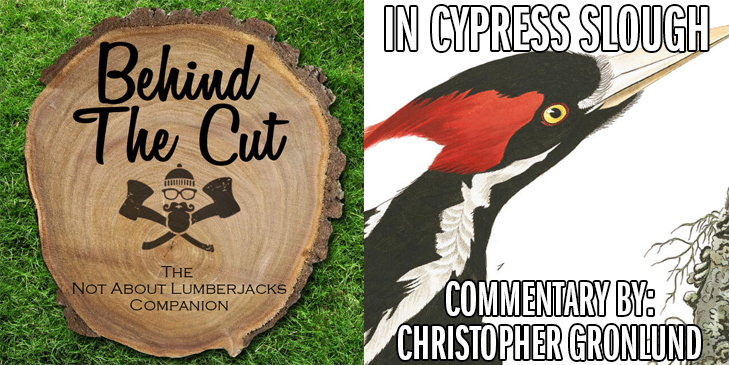
Left side: A cross section of a tree in grass. Text: Behind the Cut - The Not About Lumberjacks Companion.

Right side: A painting of an ivory-billed woodpecker. Text: In Cypress Slough - Commentary By Christopher Gronlund

“In Cypress Slough” includes two gay characters, but it’s not a story about being gay in East Texas.

In this behind-the-scenes look at the latest Not About Lumberjacks story, I talk about representation, the stories I’d never write (and why), and how I approach writing disenfranchised characters who have experienced lives I can only imagine.

* * *

Links to some people and things mentioned in this episode:

  • ScreamQueenz
  • Writing the Other
  • Nisi Shawl
  • Cynthia Ward
  • David Bowles
  • Invisible | Invisible 2
  • Craft in the Real World
  • Alba Salix
  • Fable and Foley
  • Natalia Sylvester

Episode Transcript >>

Podcast: Play in new window | Download

Subscribe: RSS

Filed Under: Behind the Cut, Episodes Tagged With: In Cypress Slough, Literary

In Cypress Slough – BtC Transcript

December 13, 2021 by cpgronlund Leave a Comment

[Listen]

[Intro music plays]

[Woman’s Voice]

This is Behind the Cut. The companion show to Not About Lumberjacks.

[Music fades out]

Christopher Gronlund:

Behind the Cut is an in-depth look at the latest episode of Not About Lumberjacks and likely contains spoilers of the most recent story. You’ve been warned…”

* * *

Some people have wondered if “In Cypress Slough” was inspired by recent-ish news about ivory-billed woodpeckers being declared as officially extinct.

It wasn’t.

I originally planned to release it in November 2020, but it required research and an effort I didn’t have time for a year ago. It just-so-happened I was back to working on it this year when the ivory-billed woodpecker was declared officially extinct.

But I’m not here to talk about species humans have destroyed. Right now, I want to talk about how I handle writing characters who have experienced prejudice I’ve never had to face.

* * *

If you’ve spent enough time on pop-culture social media, you’ve likely seen someone complaining about gay characters in stories. Many a one-star Amazon book review reads like this: “I loved this book…until the author decided to push the gay agenda down my throat!” How dare popular movies include a gay character…and definitely don’t get them started on Jon Kent, Superman’s son, being bisexual!

Include a gay character in a story and some will deem you a social justice warrior. (As though that’s a bad thing to be!) I can’t imagine listening to “In Cypress Slough” and thinking, “This was great…up until Christopher felt the need to make Jorge gay! Why’d he have to go and do that?”

Of the 161 main and supporting characters in all Not About Lumberjacks stories to date, only five are gay. That’s about three percent, which is a lower percentage of gay people in society. (If you’re curious who those five characters are: the narrator of the Christmas episode, “Greetings” and his husband; one of the unnamed girls in “Tracks,” the opening story to last year’s Christmas episode story; and Jorge and Devin from “In Cypress Slough.”)

In the case of “Greetings,” Jeremy and Kurt simply exist as a couple like any other. (I wrote that story with Patrick Walsh from the ScreamQueenz podcast in mind as narrator. I’d been a guest on Patrick’s show multiple times, and I wanted to work with him on a Not About Lumberjacks story.) As far as “Tracks”—some people saw it as a story about two friends growing apart; others got the intended bit that one of them’s gay. “In Cypress Slough” is the only story I’ve written where a character’s sexuality is more than just a passing thing.

* * *

As writers, we can write about whatever we want.

If I want to write a story about what it’s like to grow up Black in the South, I can…but there are many people far more suited to tell that story—people who’ve actually lived it.

I was born on the north side of Chicago and moved to a northern suburb when I was two. When I moved to Texas at fifteen years old, I moved to a very white town…so much so, that its history of being so tightly closed has made nationwide news in recent months. (Do a Google search for “Southlake Carroll High School investigation” if you’re curious.) I never had my resume cross a desk, only to be rejected by someone because of how my name sounds. While I’ve faced hardships in life, I’ve never been discriminated against for where I was born, my sexuality, or the color of my skin.

This isn’t to say that I should only write stories about what I’ve experienced, but there are certain stories where the point of telling it is carries a greater purpose than I’m suited to tell.

I’m suited to tell a story about the bullying I endured as a geeky atheist at Carroll High School, but I’m not the best voice to tell the story about the only Black student in my class when I was there and the hell she endured for simply existing. (But you can be damn sure I based Davy Boyd from “In Cypress Slough” off the kinds of people I went to school with who tormented her family and others.)

* * *

So why, then, does “In Cypress Slough” include two gay characters?

Because representation matters.

The purpose of the story is not what it’s like to grow up gay in East Texas—it’s about a guy who spots an extinct species and what happens as a result. It just happens he’s gay, just like other characters who just happen to be straight. (Which no one ever seems to fume about.)

Initially, Jorge returned to Texas A&M university to show a female biologist the ivory-billed woodpecker footage he got. And, because I wanted to leave the story with something more for the future, I felt it would not be a bad idea to leave the story with a budding romantic [heterosexual] relationship.

But as the story behind Davy Boyd’s bullying became more prevalent, things changed.

* * *

I didn’t mention Carroll High School above just to take shots at a place I hated as a teenager. As I roughed out “In Cypress Slough,” news about the school kept popping up. And I thought about [and chatted about] what it was like back when I attended.

I have a friend from the school who’s a year younger than me. When I got my driver’s license, I gave him rides to school. People suspected this friend was gay (he is), and based on that assumption, he was picked on. By associating with him, people gave me grief as well.

When I gave other friends rides to school, no one cared…just like no one cares when a character is straight in a story. But when I gave this friend rides, suddenly I was told I did so for sexual favors. People told their friends not to get close to me because I probably had AIDS.

What my friend endured was far worse.

And so…as Davy Boyd became a reflection of the small-town bullies I knew growing up, and the friendship between Jorge and Kade developed, Jorge’s sexuality factored into the story.

But it’s still not the main point.

* * *

While I can be a bit brash and goofy at times, I’m also a pretty considerate person. Perhaps some of that comes from being picked on when I was younger…trying to consider the feelings of others even if I haven’t experienced the same wrongs they’ve experienced. So, when I write a character who’s lived through something I have not, I consider the words I put down with an additional level of care. It’s not so much, then, about the tone of the prose, but also the purpose of the story.

The purpose behind “In Cypress Slough” is telling a tale about the human toll on the environment, shared with listeners and readers through the eyes of two best friends still forced to deal with a bully from their past. It is not to say, “This is what it was like to grow up gay in the Piney Woods of East Texas…”—there are other writers far more suited to tell that tale. But that doesn’t mean every character I write must be a milquetoast, cis-gendered white dude from suburbia.

* * *

There’s a great book by Nisi Shawl and Cynthia Ward called Writing the Other: A Practical Approach. (I’ll include a link to the book in the show notes, or you can just go to writingtheother.com for more information.) The book grew out of something Nisi Shawl heard at a writing workshop…someone saying they never included characters with differing backgrounds than their own because you’re likely to get it wrong—so, why bother trying?

Nisi saw that mentality as taking the easy way out…and further white-washing literature. They set out to write an essay about how to write characters with differing racial and ethnic differences than their authors.

Taken from the book’s description:

In the course of writing the essay, however, she realized that similar problems arise when writers try to create characters whose gender, sexual preference, and age differ significantly from their own. Nisi and Cynthia collaborated to develop a workshop that addresses these problems with the aim of both increasing writers’ skill and sensitivity in portraying difference in their fiction as well as allaying their anxieties about “getting it wrong.”

Writing the Other and the personal essays on representation in science fiction and fantasy, Invisible and Invisible 2, are great books. (Hell, I’ll also recommend Matthew Salesses’s Craft in the Real World as a must-read for any writer.)

Sadly, I’ve seen writers who have scoffed at the notion of considering these things and what stories to tell (or not tell). But to ignore that is to ignore more than just craft—it’s to ignore the feelings of entire groups of people. (And that’s a shitty thing to do.)

* * *

I’ve also seen writers who say why bother trying because you’ll be attacked by “social justice warriors” no matter what you do—so just do whatever you want.

That’s a cop out.

I know about Writing the Other because I considered changing a character in the last novel I completed, A Magic Life. I had concerns about a Hualapai character born in northern Arizona, but raised by Swedish immigrants in Arizona and Colorado.

I mentioned my concerns to a diverse group of writers I know—on a Discord server for writers and fans of Fable and Foley’s Alba Salix (and other audiodramas).

Not one person told me I wasn’t allowed to write about this character; in fact, they suggested Writing the Other and ways to approach this character: making sure he’s just as important as other main characters—not just there to prop up the protagonist. Ensuring I’m writing about him as a person and not speaking for an entire People of which I am not. Portraying him in a positive light and, should something bigger happen with the book, finding someone who’s lived closer to his life and paying them a fair fee to read the manuscript for anything I might have gotten wrong.

If you’re familiar with the release of Jeanine Cummings’s American Dirt, following this advice could have avoided much of that wreck (but still not have helped with the indefensible move of plagiarized sections of the book being lifted directly from Latino authors)!

Speaking of the American Dirt debacle and this whole point, it’s summed up rather well by author and professor David Bowles (BOWLS):

“There is nothing wrong with a non-Mexican writing about the plight of Mexicans. What’s wrong is erasing authentic voices to sell an inaccurate cultural appropriation for millions.”

* * *

Representation without speaking for a group of people isn’t hard.

I once gave a talk to a local podcasting group about storytelling. One of the slides supporting what I talked about mentioned the importance of thinking things through. For that slide, I used an image of a Black woman looking up in thought.

After the talk, I was approached by a woman who thanked me for that. She loved attending local meetups about podcasting and web tech, but mentioned how the crowds around here are largely white…and how presenters usually used white people (mostly males) in all their slides containing people. She was happy just to see somebody on a slide who looked like her.

I’m friends with a writer from Perú who’s suffered what many writers like her have experienced: she’s been invited to book festivals and placed on the obligatory “Other Voices” panel discussion and then…no others. Just that! The festivals where she’s been treated equally and given a voice on panels having nothing to do with where she was born and who she is are the festivals she returns to—because they see her as a person and not an object.

* * *

My stories tend to be about people who have rarely seen the spotlight and why…or…stories in which they have their moment. While I will never attempt to write a story about what it was like growing up gay in the 80s, it doesn’t mean gay characters will never appear in the stories I tell.

I recognize there are stories left in better hands than mine, and those are stories I will never attempt to write. I don’t feel anyone is taking anything from me by pointing out that sometimes I’m not the right author for a story.

I was a right author for “In Cypress Slough.” (I won’t say the right author because it’s a story many others could have written.) I care deeply about animals and love the landscape of East Texas. I grew up around people who worked menial jobs—my dad was a mechanic. Hell, I’ve been that person working those kinds of jobs. It’s my kind of story. And, in the process of writing it—as a nod to some of my friends—I chose to make Jorge gay.

I will write characters who are different than me and sometimes find (and pay) narrators better suited for those stories. (And sometimes, like “In Cypress Slough,” I’ll narrate things myself because I’m really pressed for time.)

But I will never try telling a more important story about what it’s like growing up truly oppressed, even though nothing prevents me from doing so…other than my own nature.

For all the hardships I’ve faced, none of them are the result of me being a white guy from suburbia. I don’t acknowledge my privilege out of any kind of shame or to virtue signal—it’s simply a fact that I have opportunities many others do not. And because I recognize this and I’m not an asshole, I will always do my best to acknowledge the advantages I’ve had and put characters who might not have had such luxuries in a positive light.

* * *

Thank you for listening to Not About Lumberjacks and Behind the Cut. Theme music for Behind the Cut is a tune called “Reaper” by Razen. Visit nolumberjacks.com for information about the music, the episodes, and voice talent.

Later this month, it’s the annual Christmas episode—three holiday stories, one of which includes the return of a character from an earlier Not About Lumberjacks Christmas episode.

Until next time: be mighty, and keep your axes sharp!

Filed Under: Transcript

  • « Previous Page
  • 1
  • …
  • 11
  • 12
  • 13
  • 14
  • 15
  • …
  • 29
  • Next Page »

Subscribe to the Mailing List

* indicates required
A monthly update and links to snazzy things! (I will never share your email address with others -- even ax-wielding lumberjacks!)

Copyright © 2026 · Epik on Genesis Framework · WordPress · Log in